For complete wetting, the meniscus has curvature radius equal to the capillary radius . The Young–Laplace equation gives the supporting pressure difference . Balance it against the hydrostatic pressure . Taking the sap's mass density to be water-like, , givesThis is the height supported by the stipulated capillary-pressure model. The density assumption is needed because the surface tension and capillary diameter alone do not determine a height.
For the symmetric regular solution model, the dimensionless mixing free energy is . At the thermodynamic critical point, its second and third derivatives in composition vanish. The third derivative gives ; the second then gives . ThereforeThis uses the equal-size, composition-symmetric mixture model.
The mean interface height fluctuation is zero; its root mean square roughness is obtained by summing the mode variances. Replacing the two-dimensional wavevector sum by its continuum density gives the thermal roughness of a tension-dominated interface:Take with , and with . At ,The logarithm makes the answer only weakly sensitive to order-one choices of cutoff. Gravity has been omitted as stipulated; the fixed mean height removes the zero wavevector mode.
A liquid crystal flows like a liquid while retaining some molecular order. In a nematic liquid crystal, elongated molecules have long-range orientational order but no ordinary positional lattice. The nematic director specifies the preferred axis, with and equivalent for head-tail-symmetric molecules. The nematic order parameter distinguishes an isotropic distribution, , from perfect parallel alignment, . A smectic phase additionally has a periodic layered density modulation, while molecules remain mobile within layers.
The broken rotational symmetry allows birefringence and distinct elastic costs for nematic splay, nematic twist and nematic bend. Under crossed polarizers, rotating a thin aligned sample changes the transmitted intensity because its two optical polarization components acquire different phases. Heating through a nematic-to-isotropic transition removes that orientational birefringence. An electric field can rotate the director if the dielectric anisotropy of a nematic favors alignment, explaining the optical switching principle of a liquid-crystal cell. Molecular shape, temperature, concentration and surface anchoring determine which ordered phase appears.
The restoring force in ideal rubber elasticity is mainly entropic: stretching restricts the conformations of network strands. A Gaussian chain of statistical segments of length has extension free energy , so its small-extension spring constant is proportional to . For an affine network with active-strand number density , the shear modulus is approximately . Increasing the cross-link density normally raises and shortens the strands; polymer entanglement can add effective constraints. Dangling ends and loops do not contribute like elastically active bridges, while junction fluctuations reduce the affine-network estimate.
For incompressible uniaxial stretching by ratio , the nominal tensile stress is in the ideal Gaussian-network model. Finite contour length causes stronger stiffening as strands approach full extension; swelling dilutes the active strands and changes their reference conformations. A direct demonstration is to hang a load from a stretched rubber strip and warm it gently: an entropy-dominated network tends to contract under that fixed load. This temperature dependence contrasts with a model based solely on stretching bond energies. The simple formula assumes equilibrium, adequate cross-linking and temperatures away from glass transitions or degradation.
DLVO theory combines the attractive Van der Waals force with repulsion between overlapping electrical double layers. A charged colloid attracts counterions; their electrostatic and osmotic response screens its field over the Debye length. Adding salt generally shortens this range and can lower the repulsive aggregation barrier, allowing particles to reach the strongly bound primary minimum. A shallow secondary minimum can instead give weak reversible association. Whether Brownian encounters cause rapid aggregation depends on barrier heights relative to , not just on the sign of the force at one separation.
Adsorbed or grafted polymer layers can provide steric stabilization: overlap costs chain entropy and increases the local osmotic pressure. Nonadsorbing smaller particles or polymers can create a depletion force, because bringing large surfaces together increases the volume accessible to the smaller species. Polymer bridging can be attractive when one chain binds more than one particle. A useful comparison experiment varies salt concentration while monitoring scattered light or aggregation, then repeats with a sterically protected suspension. Charge, solvent quality, polymer coverage and particle size determine which interaction dominates; none is a universal constant of all colloids.
For a microscopic swimmer, the Reynolds number is usually small. Taking , and water-like properties gives . The Stokes equations then balance viscous stress and pressure almost instantaneously, so a swimmer cannot coast appreciably when its propulsive stroke stops.
The scallop theorem rules out a reciprocal opening-and-closing stroke in an otherwise unchanged Newtonian environment: reversing the sequence of shapes reverses the motion, and changing the stroke speed does not prevent cancellation. Organisms therefore use nonreciprocal motion. A sperm-like bending wave travels along a flagellum; a bacterium can rotate a helical flagellar bundle. The unequal parallel and perpendicular drag of a slender filament converts those motions into a net thrust. A freely suspended swimmer is force-free and torque-free overall, so body drag balances thrust and the body counter-rotates against the rotating bundle. Tracking a body and its flagellum together can reveal these opposite rotations. The helical microswimmer with a spherical head makes that force and torque balance quantitative.
A linear viscoelastic fluid responds linearly to small imposed strain histories but retains memory of earlier deformation. For shear strain and a relaxed initial state, Boltzmann superposition givesHere is the causal relaxation modulus, the stress following a unit step strain. Doubling a sufficiently small strain history doubles the stress, and responses to added histories add. Elasticity stores deformation energy; viscosity dissipates it. Linearity is an amplitude approximation, not an assertion that the material has no relaxation times.
The Maxwell model has a spring of modulus in series with a dashpot of viscosity . Their stresses are equal and strains add, giving . After a step strain , the strain rate is zero for , so with . Initially the spring takes the step, . Hence
For the convention , the complex viscoelastic modulus is . ThusThe storage modulus exceeds the loss modulus for , so the response is predominantly solid-like above the crossoverAt low frequency ; at high frequency .
The creep compliance is the strain per unit step stress: if , then for . A Newtonian fluid obeys , so under constant stress its initially zero strain grows as . Therefore
Passive microrheology uses thermal bead motion as a probe of mechanical compliance. The fluctuation-dissipation theorem relates equilibrium displacement fluctuations to the same linear response measured by a small applied force. The stated thermal stress scale has units of energy per bead volume; dividing the mean-square displacement by provides a dimensionless effective strain. With that prescribed analogy,The displacement is relative to the starting position, and the variance here is the sum over three spatial coordinates. For a Newtonian fluid, substitution gives , exactly the Stokes–Einstein relation .
The continuum interpretation assumes a dilute no-slip spherical probe, thermal equilibrium, linear response and a homogeneous incompressible medium on the bead scale. The stated stress estimate is an effective scale for the analogy; a literal instantaneous stress variance would also require a microscopic or temporal averaging prescription.
Under a step stress, the Maxwell spring extends immediately by , while the dashpot adds . Hence , and the microrheology of a Maxwell fluid relation givesThis idealized overdamped relation describes an elastic plateau followed by long-time diffusion. Its nonzero extrapolated intercept is not the actual displacement variance at exactly zero lag, which is zero. Inertia or fast solvent relaxation must resolve the initial rise; those processes were omitted from the ideal spring-dashpot model.
An entropic network has approximately one thermal energy of elastic cost per mesh volume, giving . At , the supplied mesh size and viscosity giveThe intermediate-time plateau in the three-dimensional mean squared displacement isAfter the omitted fast initial transient, the log-log sketch is approximately flat for , crosses over near , and grows linearly for . The figure shows the Maxwell compliance prediction over this range.
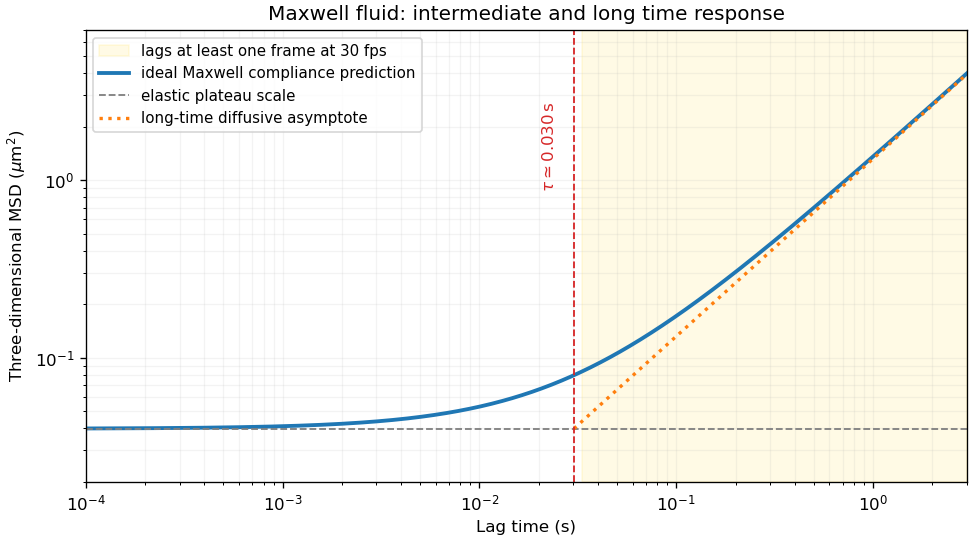
Elastic plateau and diffusive growth in the ideal Maxwell microrheology prediction, with the video time scale marked
. Details. 
An ordinary 25–30 frame-per-second recording samples intervals of about –, comparable to . It therefore has little access to a clear plateau at lags well below the crossover, even if its positional precision resolves a displacement of a few tenths of a micrometre. Higher frame rates and calibrated localization noise would improve the modulus measurement. The bead radius is only twice the mesh size, so treating the network as a homogeneous continuum is also an approximation.
Take the same segment length and a large common number of steps. The ideal walks have size proportional to ; excluded volume swells a three-dimensional chain to approximately and a two-dimensional chain to . Projection changes an isotropic walk's prefactor, rather than its exponent. The projected three-dimensional ideal walk has a smaller planar size than an otherwise equal two-dimensional ideal walk. Therefore the asymptotic ordering isThe following subparts make the size and projection factors explicit. Comparing root-mean-square sizes gives the same ordering as comparing mean distance magnitudes here.
For the planar random walk with independent steps of length , cross terms vanish and . Thus . At large , the planar Gaussian end distribution gives .
A planar self-avoiding walk cannot revisit its occupied sites. In the good-solvent scaling regime, the two-dimensional Flory approximation gives , larger at large than either ideal walk and the projected three-dimensional self-avoiding walk. This is a scaling statement, with microscopic prefactors dependent on the walk model.
For an isotropic three-dimensional ideal walk, each Cartesian component contributes to the mean square. Keeping two components gives . The planar projection of an isotropic random vector therefore has , smaller than the unprojected planar ideal walk by . The corresponding two-dimensional Gaussian mean distance has the same ratio.
A three-dimensional self-avoiding walk has swollen size , with ; the three-dimensional Flory approximation gives the nearby estimate . Isotropic projection gives , preserving this exponent. For the mean distance rather than its root mean square, the orientation average instead gives . Neither prefactor changes its position between the ideal walks and the planar swollen walk.
The Kuhn length is the segment length of an equivalent freely jointed chain chosen to match contour length and the unperturbed mean-square end-to-end distance: . Since , its maximum finite-chain value is , attained by a straight rigid rod. Independent steps of length have and , soFor a long freely rotating chain with fixed angle between successive forward bond vectors, orientational correlations decay as with . Summing them gives the Kuhn length of a freely rotating chain:Positive persistence increases the statistical segment length, while negative bond correlations can reduce it. A chemical internal bond angle is supplementary to this forward-vector angle, so the cosine convention matters. Near the perfectly aligned limit the finite-chain bound replaces the long-chain asymptotic formula.
Write for a segment length and for the excluded-area coefficient, so that the interaction term has the correct dimensions. For a coil of planar size and area of order , the two-dimensional Flory approximation isThe first term is the entropic stretching cost and the second counts repulsive monomer contacts. Minimization gives , henceFor of order this becomes . The parameter multiplying in a two-dimensional interaction energy must have dimensions of area; it cannot simultaneously denote an unsquared bond length.
The polymer overlap concentration is reached when the number of chains per coil area is of order one. If is the chain number per unit interfacial area, then . Equivalently, the monomer area fraction is , assuming an occupied monomer area of order . Below this scale coils are mostly separate; above it they interpenetrate.
For the planar good-solvent coil, . The two-dimensional polymer overlap fraction is thereforeThis is a scaling estimate; the monomer geometry and choice of coil radius set order-one numerical factors.
Here the osmotic pressure is a two-dimensional surface pressure, with units of energy per area. In the dilute regime, independent whole chains provide the translational entropy, soIn the semidilute polymer solution, use a correlation blob containing monomers. Within it the chain still follows the planar good-solvent law . Its area fraction is , so and . There is about one independent thermal contribution per blob area. The semidilute osmotic pressure of a two-dimensional polymer solution is thusIt is independent of total chain length once each chain contains many blobs. The two estimates agree at , where each gives .
Articles by others on the same topic
There are currently no matching articles.