For photon absorption or emission, electron energy changes by and crystal wavevector by modulo a reciprocal lattice vector. Optical photon momentum is normally tiny on the Brillouin zone scale, so interband optical transitions are approximately vertical on an energy-wavevector diagram. A direct-gap semiconductor can therefore absorb a photon between valence and conduction states near the same wavevector; an indirect transition usually needs an additional phonon or another source of momentum. Occupation and optical matrix elements impose further restrictions.
Within one ideal parabolic band of a clean metal, such a small photon momentum cannot normally supply the required finite energy difference. Intraband optical absorption then relies on momentum relaxation by impurities, phonons or boundaries, as in the finite-scattering-time Drude response. Interband transitions can still occur. The first panel shows the near-vertical direct transition.
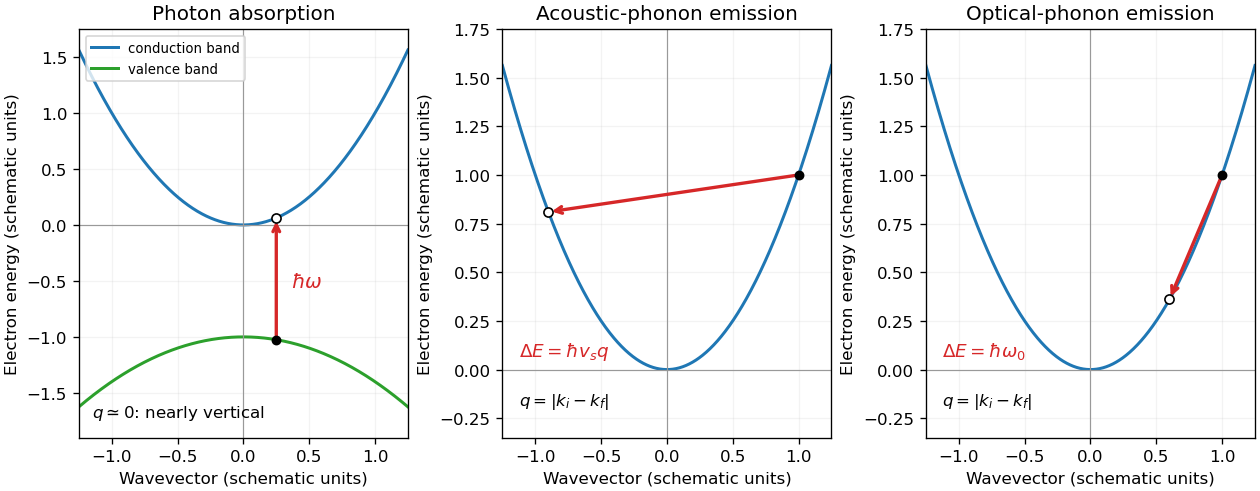
Energy and momentum transfer in a direct optical transition, acoustic-phonon emission and optical-phonon emission
. Details. 
For an acoustic phonon with , energy and crystal momentum conservation require and . The sound speed is usually much smaller than the relevant electron velocity in a metal, so scattering can change the electron's direction substantially while changing its energy only slightly. It is approximately elastic for many transport calculations, though its finite energy transfer is essential for cooling.
The middle panel gives an allowed backscattering example with a small energy loss. In a degenerate metal, the Pauli exclusion principle blocks occupied final states, restricting low-temperature scattering to a thermal neighborhood of the Fermi surface. Phonon occupations also shrink on cooling. A normal process has ; an Umklapp process transfers reciprocal-lattice momentum. In semiconductors, accessible valleys and their separation add further momentum constraints.
An optical phonon often has approximately constant energy over the relevant wavevector range. Its absorption or emission therefore moves the electron between energy surfaces separated by this finite amount, with the phonon supplying the associated crystal momentum modulo a reciprocal vector. The last panel shows emission between two points on a parabolic conduction band.
Emission from a band with a lower edge requires at least of available kinetic energy and an unoccupied final state. For nondegenerate hot carriers this produces a threshold and can lead to rapid energy loss in successive phonon emissions. Absorption is weighted by the Bose-Einstein distribution , while emission has the factor ; absorption is strongly suppressed at . In a metal, Pauli blocking also prevents an electron near the Fermi energy from simply dropping into the occupied Fermi sea.
Let , so the initial conduction-electron kinetic energy is . In the normal momentum-conserving process with the final hole fixed at zero wavevector, the two final conduction electrons obey . Their total kinetic energy satisfiesEnergy conservation for impact ionization is . Consequently , givingThe bound is attained when ; opposite spins permit the two electrons to share that wavevector. Fixing the hole momentum is essential: a mobile final hole gives a different threshold. This is the threshold for impact ionization with a hole at zero momentum.
The two hot electrons subsequently redistribute energy by electron-electron collisions and transfer it to the lattice by electron-phonon scattering. Optical-phonon emission can provide large discrete losses while the electrons are hot; acoustic phonons dominate later small energy exchanges. Electron-electron collisions alone conserve the electron system's total energy and do not cool it into the lattice. The electron-hole pair eventually recombines radiatively or through nonradiative channels, such as defect-assisted recombination or Auger recombination. Recombination is distinct from the preceding intraband cooling.
Articles by others on the same topic
There are currently no matching articles.