For a single carrier type with unit Hall factor, the magnitude of the Hall voltage is , where is the slab thickness parallel to the magnetic field. ThereforeThe longitudinal electrical resistivity is . Using , the electron mobility magnitude isWithout the Hall polarity these data do not identify the carrier charge sign. The inference assumes one dominant carrier population; electron-hole compensation would require a multicarrier analysis.
Put primitive cells in a periodic box. In each reciprocal-space direction, the allowed Bloch wavevectors are spaced by , giving independent values in the first Brillouin zone. There are consequently wavevectors per band and, including two electron spin states at each wavevector,The total and per-atom counts are different; a factor cannot remain in the per-atom count for this monatomic lattice.
In independent-electron band theory, a partially occupied band permits low-energy changes of occupancy and gives a metal. Filled bands separated from empty bands by a finite band gap give a band insulator at zero temperature. An odd number of electrons per primitive cell cannot fill spin-degenerate bands, whereas an even number can; even filling alone does not ensure an insulator if bands overlap. Magnetic symmetry breaking and strong correlations, such as a Mott insulator, go beyond this simple counting criterion.
A plasmon is a quantum of a collective longitudinal oscillation of electron density against the positive background. A small charge displacement creates an electric restoring field; Newton's law then gives the plasma angular frequency. Assuming approximately one conduction electron per atom and spacing gives . HenceThe ordinary frequency is about , with energy . A different conduction-electron count per atom changes this estimate by its square root; dielectric and band-structure corrections also modify the simplest free-electron result.
The tight-binding approximation starts with localized atomic orbitals. Their overlap allows hopping, broadening each atomic energy into a band. For example, a single orbital on a simple cubic lattice with nearest-neighbor hopping gives . Small overlap means a narrow band; orbital symmetry and hopping signs determine its extrema and dispersion.
The nearly-free electron model starts instead with free-electron parabolas, folded into the Brillouin zone, and treats the periodic crystal potential as a perturbation. Near a Bragg plane, states differing by a reciprocal vector become degenerate and mix, opening a gap approximately . Away from such degeneracies, the energy remains close to the free-electron dispersion. These are complementary limits of the same Bloch-band framework, not different counts of electronic states. Both can give metals or insulators depending on filling and band overlap, but their natural basis functions and useful expansion parameters differ.
Thomas-Fermi screening treats the carrier density locally as that of a uniform electron gas whose chemical potential is shifted by the slowly varying electrostatic potential. Linearizing gives for electrons. The resulting screened Poisson equation has inverse screening lengthFor a degenerate gas, including both spins, giving Thomas-Fermi screening length . A nondegenerate semiconductor instead has , giving the Debye length . Electrons and holes contribute additively to the charge susceptibility when both are present; the lattice permittivity replaces the vacuum value.
The approximation requires a potential varying slowly compared with microscopic electronic length scales and a small perturbation for the linearized result. It captures smooth electrostatic screening, but not the full nonlocal response or Friedel oscillations. Low carrier density or carrier freeze-out can make a semiconductor's screening much weaker than a metal's.
The Hubbard model combines band motion and local repulsion:Hopping favors itinerant states, while positive penalizes simultaneous opposite-spin occupation on one site. In a uniform mean-field treatment, a spin imbalance reduces the interaction cost but raises the band-filling energy. The Stoner criterion for instability of the unpolarized metal is when is the density of states per site, per energy, for one spin. Using a total two-spin density of states changes the displayed numerical convention.
The ordered mean-field state has exchange-split spin bands and a spontaneous magnetization, with the kinetic and interaction costs balancing at equilibrium. This is a model of itinerant ferromagnetism, not a guarantee that every repulsive Hubbard system becomes ferromagnetic. Filling, lattice structure and competing order matter: near half filling on a bipartite lattice, antiferromagnetism and a Mott insulator can be favored instead. The approximation also omits important spin fluctuations and strong-correlation effects.
In a two-dimensional electron system under a perpendicular magnetic field, orbital energies form Landau levels with spacing . Each resolved spin level has states in area . At integer filling, the integer quantum Hall effect has Hall conductance in magnitude and vanishing longitudinal conductance in the ideal plateau regime; inversion of the conductivity tensor gives Hall resistance .
A Hall-bar experiment cools the sample, passes a small current and records longitudinal and transverse voltages while sweeping the field. The Hall resistance develops plateaus while the longitudinal resistance develops minima. Disorder broadens the Landau levels and localizes many bulk states, allowing the chemical potential to move through a range of carrier density without changing the number of conducting edge channels. Extended states near a Landau-level center allow transitions between plateaus. Spin splitting determines which integer sequence is resolved. The robustness comes from the quantum state and its edge transport, rather than the Hall bar having a specially calibrated geometric width.
For photon absorption or emission, electron energy changes by and crystal wavevector by modulo a reciprocal lattice vector. Optical photon momentum is normally tiny on the Brillouin zone scale, so interband optical transitions are approximately vertical on an energy-wavevector diagram. A direct-gap semiconductor can therefore absorb a photon between valence and conduction states near the same wavevector; an indirect transition usually needs an additional phonon or another source of momentum. Occupation and optical matrix elements impose further restrictions.
Within one ideal parabolic band of a clean metal, such a small photon momentum cannot normally supply the required finite energy difference. Intraband optical absorption then relies on momentum relaxation by impurities, phonons or boundaries, as in the finite-scattering-time Drude response. Interband transitions can still occur. The first panel shows the near-vertical direct transition.
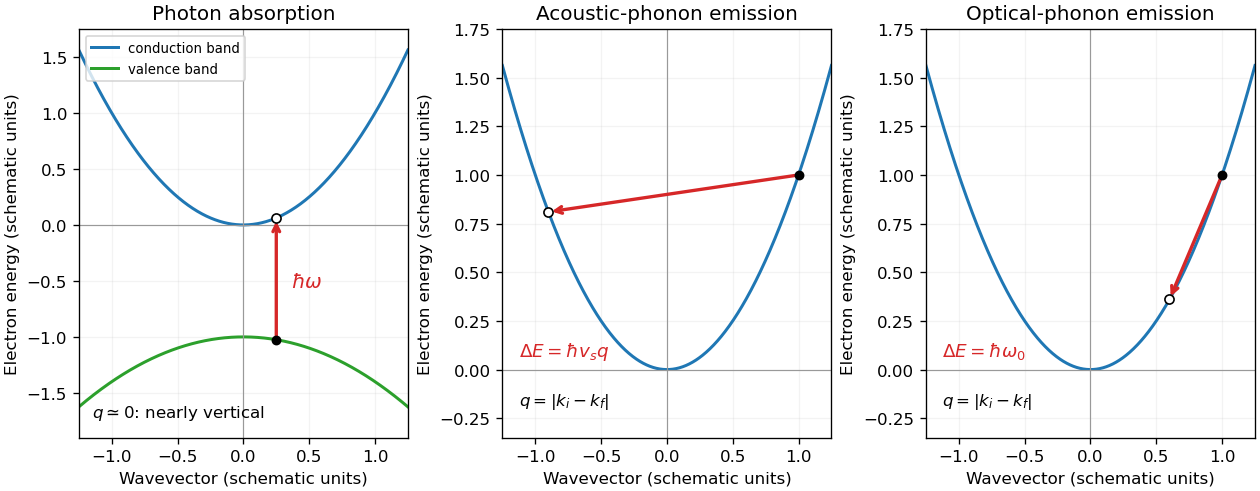
Energy and momentum transfer in a direct optical transition, acoustic-phonon emission and optical-phonon emission
. Details. 
For an acoustic phonon with , energy and crystal momentum conservation require and . The sound speed is usually much smaller than the relevant electron velocity in a metal, so scattering can change the electron's direction substantially while changing its energy only slightly. It is approximately elastic for many transport calculations, though its finite energy transfer is essential for cooling.
The middle panel gives an allowed backscattering example with a small energy loss. In a degenerate metal, the Pauli exclusion principle blocks occupied final states, restricting low-temperature scattering to a thermal neighborhood of the Fermi surface. Phonon occupations also shrink on cooling. A normal process has ; an Umklapp process transfers reciprocal-lattice momentum. In semiconductors, accessible valleys and their separation add further momentum constraints.
An optical phonon often has approximately constant energy over the relevant wavevector range. Its absorption or emission therefore moves the electron between energy surfaces separated by this finite amount, with the phonon supplying the associated crystal momentum modulo a reciprocal vector. The last panel shows emission between two points on a parabolic conduction band.
Emission from a band with a lower edge requires at least of available kinetic energy and an unoccupied final state. For nondegenerate hot carriers this produces a threshold and can lead to rapid energy loss in successive phonon emissions. Absorption is weighted by the Bose-Einstein distribution , while emission has the factor ; absorption is strongly suppressed at . In a metal, Pauli blocking also prevents an electron near the Fermi energy from simply dropping into the occupied Fermi sea.
Let , so the initial conduction-electron kinetic energy is . In the normal momentum-conserving process with the final hole fixed at zero wavevector, the two final conduction electrons obey . Their total kinetic energy satisfiesEnergy conservation for impact ionization is . Consequently , givingThe bound is attained when ; opposite spins permit the two electrons to share that wavevector. Fixing the hole momentum is essential: a mobile final hole gives a different threshold. This is the threshold for impact ionization with a hole at zero momentum.
The two hot electrons subsequently redistribute energy by electron-electron collisions and transfer it to the lattice by electron-phonon scattering. Optical-phonon emission can provide large discrete losses while the electrons are hot; acoustic phonons dominate later small energy exchanges. Electron-electron collisions alone conserve the electron system's total energy and do not cool it into the lattice. The electron-hole pair eventually recombines radiatively or through nonradiative channels, such as defect-assisted recombination or Auger recombination. Recombination is distinct from the preceding intraband cooling.
Only states within an energy window of order around the Fermi energy can change occupation in a degenerate metal. A Sommerfeld expansion gives electronic energy above its zero-temperature value proportional to , hence . Three-dimensional linear-dispersion acoustic phonons have density of states proportional to ; integrating their Bose occupations gives thermal energy proportional to and the Debye heat capacity . Thus at sufficiently low temperature in the normal state.
Reading the straight low-temperature fit gives approximately and . These estimates agree with the reported fit to this material in the original experiment.[ref]
Superconductivity in the Filled Cage Compounds Ba6Ge25 and Ba4Na2Ge25 by Friedrich Malte Grosche and others. Figure 3 caption: low-temperature normal-state coefficients for Ba4Na2Ge25
Treating the graph values as approximate, the molar density of states isThe stipulated two electrons per formula unit give . For a single spin-degenerate parabolic band, the molar density of states is . HenceThese are model-dependent effective parameters inferred from the measured heat capacity and assumed carrier count, rather than an independent determination of a unique band structure.Using the Debye prefactor stated in the question givesThis prefactor counts three effective modes per formula unit. Consistently choosing the same count for the Debye wavevector gives . The corresponding average sound speed isThere is a normalization choice here: a formula unit has 31 atoms. With the conventional full atomic-mode count, the molar Debye coefficient contains an additional factor 31, and both and increase by . That convention gives and , while leaving the inferred sound speed unchanged. The mode count in the Debye model must be used consistently; mixing the printed temperature with an atomic-count wavevector gives an erroneous sound speed.
The upward curvature above about indicates low-energy vibrations missing from a pure acoustic model. In this cage compound, the original analysis fits an additional localized mode with , assigned to a rattling mode of a barium guest atom.[ref]
Superconductivity in the Filled Cage Compounds Ba6Ge25 and Ba4Na2Ge25 by Friedrich Malte Grosche and others. Page 247003-3 and Figure 3: extra Einstein-mode contribution
At temperatures high compared with all relevant phonon energies, the full lattice approaches the Dulong-Petit law, . The reduced three-mode model alone approaches and omits the other branches. An approximately linear electronic term can still be added while the carriers remain degenerate, but cannot be extrapolated beyond their Fermi temperature. Articles by others on the same topic
There are currently no matching articles.