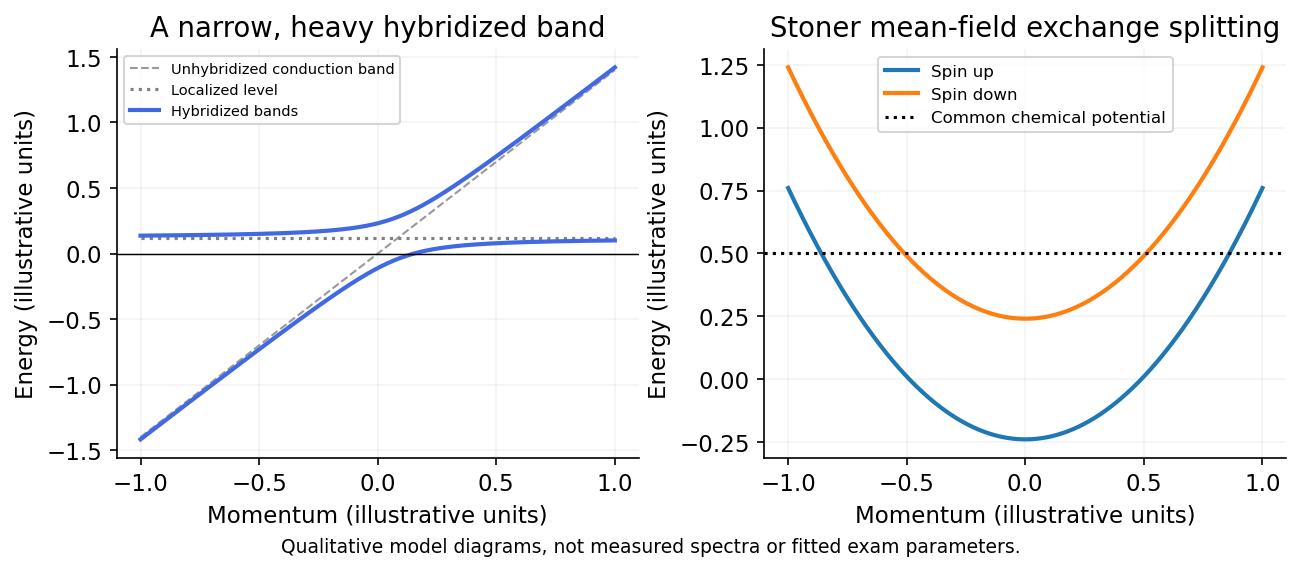
Heavy fermion materials are correlated metals whose low-energy quasiparticles have exceptionally large effective masses. Partly localized -electron moments hybridize with broader conduction states. The Kondo effect and coherence below the Kondo-lattice coherence temperature produce a narrow low-energy band, so a small energy change corresponds to a large momentum-space state density.
For the electronic heat capacity of a heavy Fermi liquid, the resulting density of states gives a large low-temperature electronic specific-heat coefficient,and often an enhanced magnetic susceptibility. Here includes both spins and must be expressed per sample, mole or volume consistently with . A coherent Fermi-liquid regime often has with an enhanced coefficient . Above coherence, scattering by local moments can instead give a Kondo-like resistivity upturn.
The competition between moment screening and intersite magnetic interactions can yield a heavy paramagnetic metal, magnetic order, quantum-critical behaviour or unconventional superconductivity. Ce- and U-based compounds supply familiar examples. “Heavy” describes the emergent electronic quasiparticles, not the ionic mass; the simple heavy-band picture need not survive at a quantum critical point.[ref]
Heavy Fermions and the Kondo Lattice: A 21st Century Perspective by Piers Coleman. Sections 1.1–1.3: heavy electrons, local moments and Kondo-lattice coherence

Articles by others on the same topic
There are currently no matching articles.