Heavy fermion materials are correlated metals whose low-energy quasiparticles have exceptionally large effective masses. Partly localized -electron moments hybridize with broader conduction states. The Kondo effect and coherence below the Kondo-lattice coherence temperature produce a narrow low-energy band, so a small energy change corresponds to a large momentum-space state density.
For the electronic heat capacity of a heavy Fermi liquid, the resulting density of states gives a large low-temperature electronic specific-heat coefficient,and often an enhanced magnetic susceptibility. Here includes both spins and must be expressed per sample, mole or volume consistently with . A coherent Fermi-liquid regime often has with an enhanced coefficient . Above coherence, scattering by local moments can instead give a Kondo-like resistivity upturn.
The competition between moment screening and intersite magnetic interactions can yield a heavy paramagnetic metal, magnetic order, quantum-critical behaviour or unconventional superconductivity. Ce- and U-based compounds supply familiar examples. “Heavy” describes the emergent electronic quasiparticles, not the ionic mass; the simple heavy-band picture need not survive at a quantum critical point.[ref]
Heavy Fermions and the Kondo Lattice: A 21st Century Perspective by Piers Coleman. Sections 1.1–1.3: heavy electrons, local moments and Kondo-lattice coherence
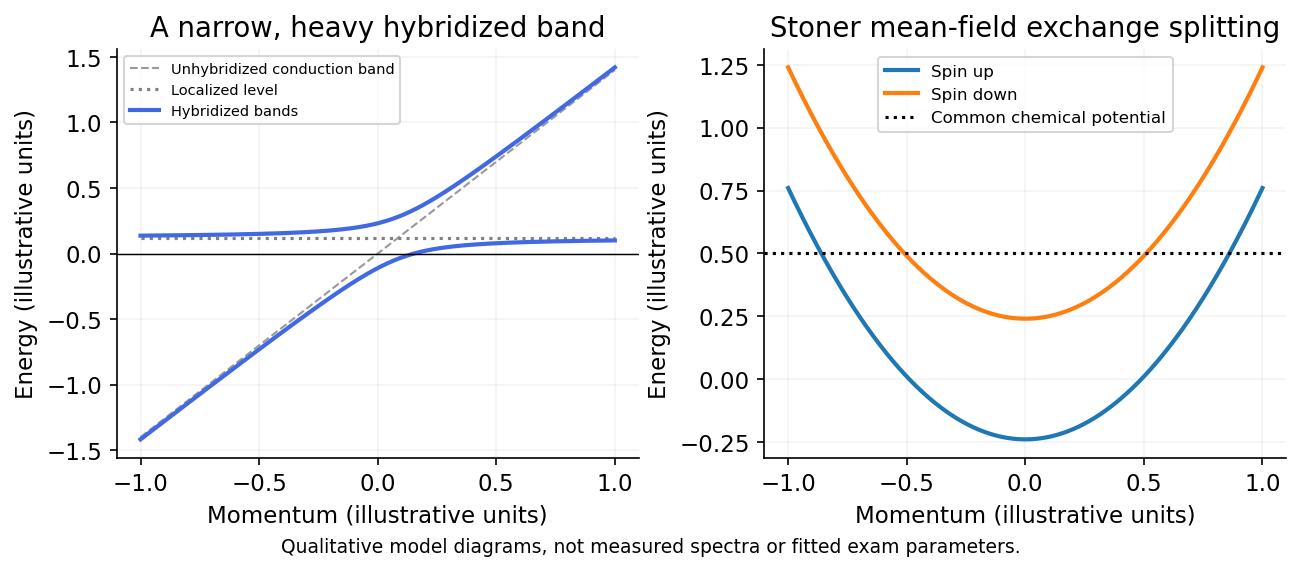
Hybridization flattens a conduction band near a localized level, while an itinerant exchange field splits spin bands
. Source. Details. 
The Hubbard model combines hopping with a local repulsion,Hopping favours a broad itinerant band; the interaction penalizes opposite-spin double occupancy. For uniform Stoner decoupling of the Hubbard interaction, let be the spin imbalance per site. The interaction is , so polarization lowers it by , at the expense of kinetic energy.
If is the noninteracting density of states per spin per site, small polarization costs . Thereforeis the mean-field ferromagnetic instability criterion. The exchange splitting is , and the paramagnetic response is enhanced as . A density of states including both spins changes the written factor in the criterion.
The model explains how itinerant bands can polarize without imposing pre-existing localized atomic spins. It is not a claim that every large- metal becomes ferromagnetic: near half filling the Hubbard model can instead form a Mott insulator with antiferromagnetic superexchange of scale . Band filling, bandwidth and fluctuations matter.[ref] The interaction-energy and kinetic-cost expansion above is the stated mean-field derivation of the enhancement.[ref]
Electron correlations in narrow energy bands by John Hubbard. Original local-repulsion model and the competition between atomic and itinerant limits
For an electron wavepacket in one isolated band under a uniform electric field,Because , acceleration through successive Brillouin zones makes the velocity periodic rather than increasing indefinitely. For ,for a positive field along the chosen axis. Integration givesThe excursion amplitude of a Bloch-oscillating wavepacket is about its mean and peak-to-peak extent . The turning of velocity corresponds semiclassically to Bragg reflection near a zone boundary.
Coherent Bloch oscillations require scattering/dephasing times long compared with and a field weak enough to avoid substantial interband tunnelling. Ordinary metals usually scatter too rapidly; semiconductor superlattices and cold atoms in periodic optical potentials provide cleaner realizations. A completely filled band has canceling velocities, so its net current does not oscillate simply because individual wavepackets can.[ref]
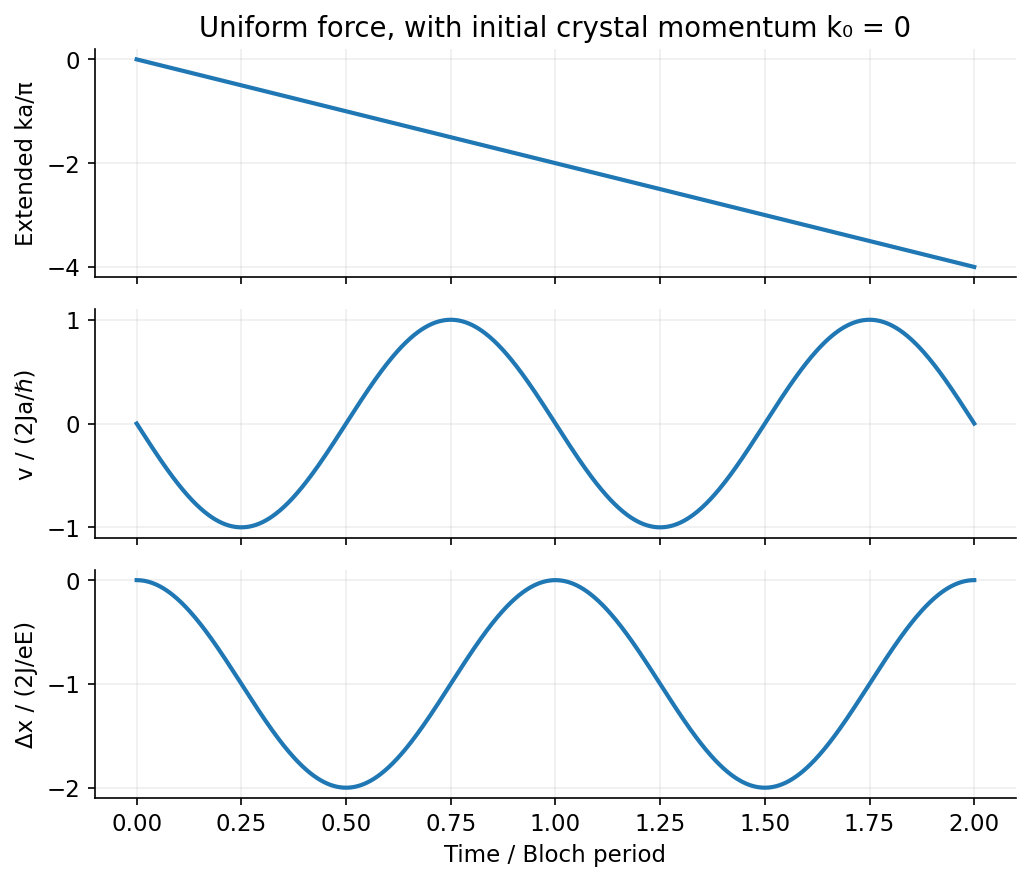
Constant force sweeps crystal momentum linearly, but a periodic band produces oscillating velocity and bounded displacement
. Source. Details. 
Articles by others on the same topic
There are currently no matching articles.