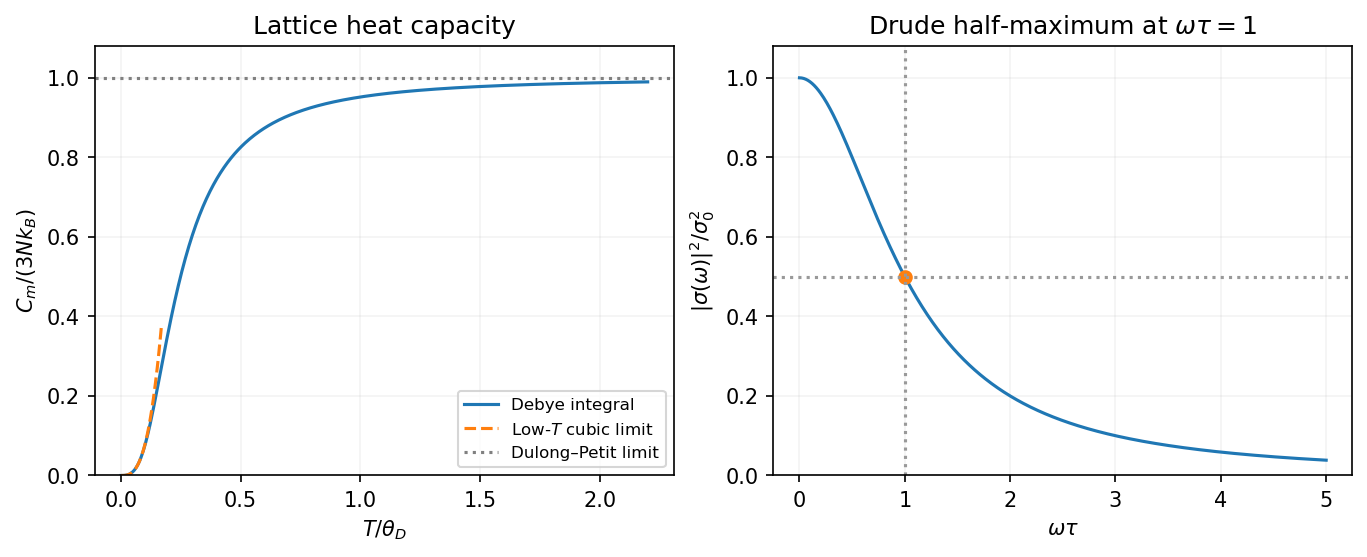
In the three-dimensional Debye model, the lattice has normal modes for atoms. Replacing their dispersion by a linear acoustic dispersion up to a cutoff gives the Debye heat capacityAt low temperature the upper limit can be replaced by infinity. Since the integral then equals ,At high temperature each harmonic mode contributes by the equipartition theorem, giving the Dulong-Petit lawFor one mole replace by . The curve starts with zero slope, rises as , and levels off toward the classical limit. This is the lattice contribution; a metal's electronic heat capacity is a separate low-temperature term.
The Debye wavevector follows by counting three polarizations inside the cutoff sphere:With the supplied speed of sound treated as the effective Debye speed, andHere . Real crystals have different longitudinal and transverse sound speeds; the one-speed estimate uses the stated value, rather than inferring those unprovided branches.

Articles by others on the same topic
There are currently no matching articles.