In the three-dimensional Debye model, the lattice has normal modes for atoms. Replacing their dispersion by a linear acoustic dispersion up to a cutoff gives the Debye heat capacityAt low temperature the upper limit can be replaced by infinity. Since the integral then equals ,At high temperature each harmonic mode contributes by the equipartition theorem, giving the Dulong-Petit lawFor one mole replace by . The curve starts with zero slope, rises as , and levels off toward the classical limit. This is the lattice contribution; a metal's electronic heat capacity is a separate low-temperature term.
The Debye wavevector follows by counting three polarizations inside the cutoff sphere:With the supplied speed of sound treated as the effective Debye speed, andHere . Real crystals have different longitudinal and transverse sound speeds; the one-speed estimate uses the stated value, rather than inferring those unprovided branches.
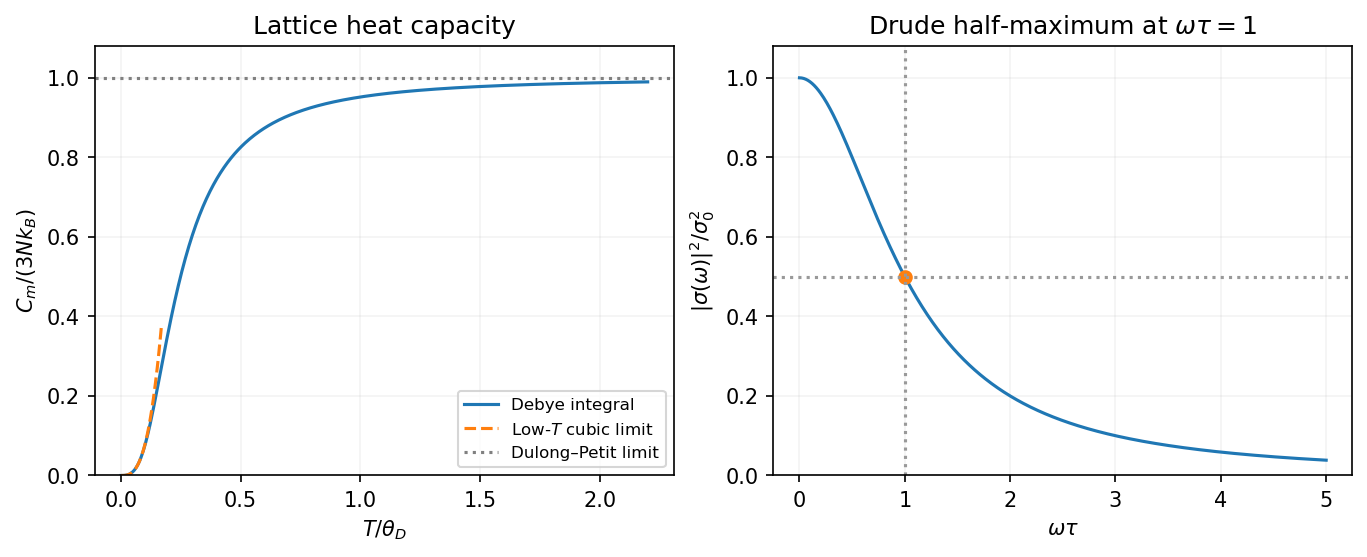

Use physical fields proportional to the real part of . The Drude frequency response isThus the sketch is an even Lorentzian line shape, with maximum at zero frequency, half that value at , and an tail. The positive-frequency half is shown in the preceding figure. Squaring the modulus differs from plotting either or the real part of .
For a single carrier species, the plasma frequency and electrical conductivity satisfyThereforeThe corresponding relaxation time is . This is an angular frequency; the ordinary frequency is . The units of electrical conductivity used in the calculation are , consistently with the SI plasma-frequency relation.
For nondegenerate Electrons in a parabolic conduction band,when the density-of-states effective mass and valley multiplicity are fixed. The intrinsic carrier extrapolation across a crossover must therefore specify how the activation energy changes with temperature.
The usual intended estimate treats the quoted as a constant intrinsic activation energy between the two temperatures, and identifies the crossover by . ThenFor , and , the exponent is and the prefactor is . HenceEquivalently, a fixed-gap intrinsic model with gives this result. A crossover is gradual: if denotes the net ionized donor density and , charge neutrality gives the actual Electron population , rather than exactly .
There are two limits to interpreting the numerical estimate literally. First, the printed data specify only at , without specifying or the valence density of states. They do not mathematically determine : without the intended activation assumption the answer remainsSecond, using the original PDF's and density implies , extraordinarily large for a conventional semiconductor. This confirms that the numerical data should not be treated as a realistic material determination. No unprinted decimal-point correction has been assumed.
Articles by others on the same topic
There are currently no matching articles.