Official past-paper archive: www.sp.phy.cam.ac.uk/drp2/home. The direct PDF link has not yet been verified.
In the three-dimensional Debye model, the lattice has normal modes for atoms. Replacing their dispersion by a linear acoustic dispersion up to a cutoff gives the Debye heat capacityAt low temperature the upper limit can be replaced by infinity. Since the integral then equals ,At high temperature each harmonic mode contributes by the equipartition theorem, giving the Dulong-Petit lawFor one mole replace by . The curve starts with zero slope, rises as , and levels off toward the classical limit. This is the lattice contribution; a metal's electronic heat capacity is a separate low-temperature term.
The Debye wavevector follows by counting three polarizations inside the cutoff sphere:With the supplied speed of sound treated as the effective Debye speed, andHere . Real crystals have different longitudinal and transverse sound speeds; the one-speed estimate uses the stated value, rather than inferring those unprovided branches.
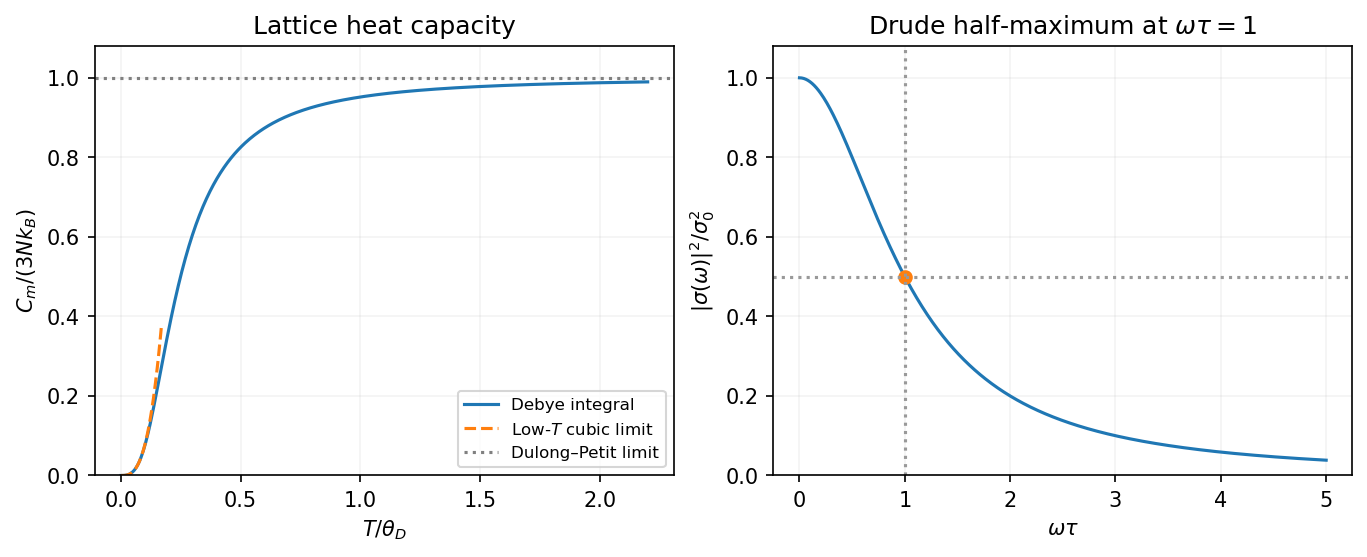
Use physical fields proportional to the real part of . The Drude frequency response isThus the sketch is an even Lorentzian line shape, with maximum at zero frequency, half that value at , and an tail. The positive-frequency half is shown in the preceding figure. Squaring the modulus differs from plotting either or the real part of .
For a single carrier species, the plasma frequency and electrical conductivity satisfyThereforeThe corresponding relaxation time is . This is an angular frequency; the ordinary frequency is . The units of electrical conductivity used in the calculation are , consistently with the SI plasma-frequency relation.
For nondegenerate Electrons in a parabolic conduction band,when the density-of-states effective mass and valley multiplicity are fixed. The intrinsic carrier extrapolation across a crossover must therefore specify how the activation energy changes with temperature.
The usual intended estimate treats the quoted as a constant intrinsic activation energy between the two temperatures, and identifies the crossover by . ThenFor , and , the exponent is and the prefactor is . HenceEquivalently, a fixed-gap intrinsic model with gives this result. A crossover is gradual: if denotes the net ionized donor density and , charge neutrality gives the actual Electron population , rather than exactly .
There are two limits to interpreting the numerical estimate literally. First, the printed data specify only at , without specifying or the valence density of states. They do not mathematically determine : without the intended activation assumption the answer remainsSecond, using the original PDF's and density implies , extraordinarily large for a conventional semiconductor. This confirms that the numerical data should not be treated as a realistic material determination. No unprinted decimal-point correction has been assumed.
A junction field-effect transistor has a conducting channel between source and drain, with gate regions forming reverse-biased p-n junctions to that channel. In an n-channel device, a more negative gate-source electric potential difference increases the reverse bias and widens the depletion region. The conducting cross-section shrinks, reducing the drain electric current. The gate ideally draws only a small leakage electric current, giving a high input resistance; the source-drain supply provides the controlled output power. Carrier motion in a p-channel device reverses the relevant polarities.
At small positive , the channel conducts approximately as a resistor. As the potential rises from source to drain, the local gate-channel reverse bias increases toward the drain. The depletion layers are therefore thicker there. For a symmetric n channel of half-thickness , uniformly doped at density , the one-sided depletion approximation giveswhere is the depletion width from each side and the built-in junction potential. The neutral channel closes locally when . Define the positive geometrical depletion electric potential difference . The approximate drain-end pinch-off condition isMore negative gate bias makes this saturation occur at a smaller drain electric potential difference.
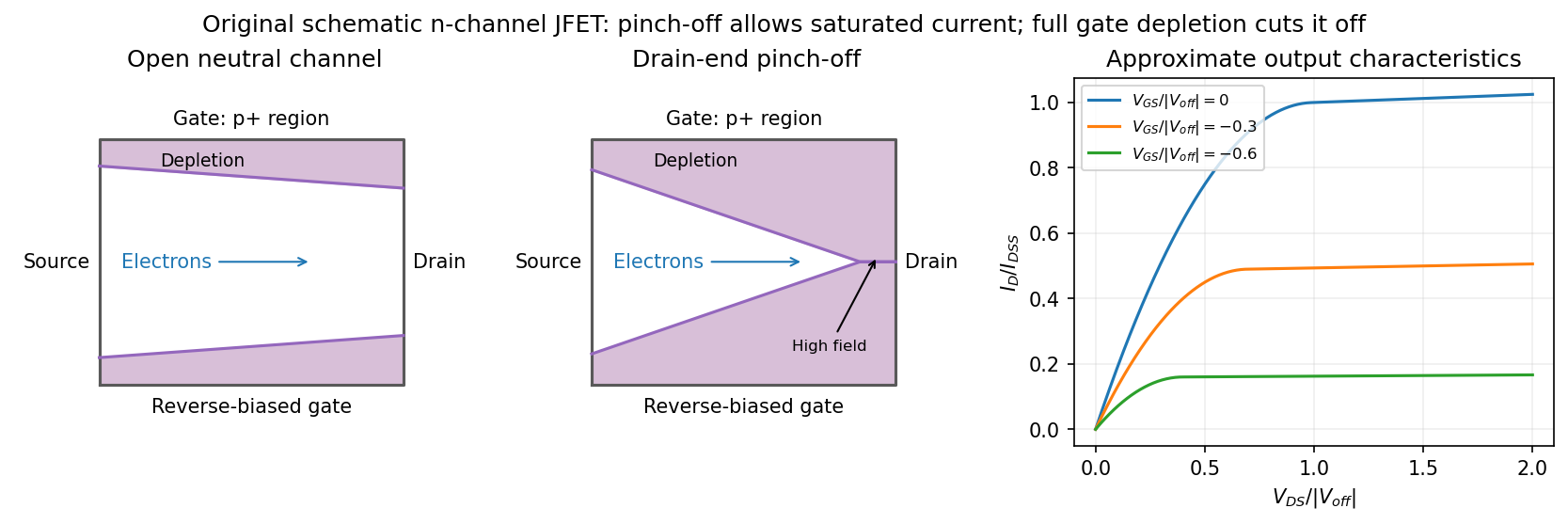
Gate depletion, drain-end pinch-off and approximate current saturation in an n-channel JFET
. Details. Pinch-off in a junction field-effect transistor does not mean that the drain electric current vanishes. Electrons arriving through the remaining neutral channel are swept across the high-field depleted region into the drain. Further increases in mostly fall across that region, so the electric current changes only weakly: this is the saturation regime used for amplification. Channel shortening gives a finite output slope in real devices. Excessive reverse electric potential difference eventually causes breakdown, beyond the normal saturation model.
A sufficiently negative gate electric potential difference can instead deplete the entire channel from the source end and produce cutoff. In the simplified geometry its threshold is . A commonly used approximate transfer law in saturation isHere is the saturated drain electric current at zero gate-source bias. The square law is a useful device approximation, not an exact result for arbitrary channel profiles. It connects field control of depletion to a measurable transfer characteristic while keeping drain-end pinch-off distinct from complete gate cutoff.
Direct exchange is a quantum-mechanical spin-dependent energy arising from the Coulomb interaction and the required antisymmetry of a two-electron state. It requires spatial overlap of the relevant orbitals. It is not the classical magnetic dipole force between two small magnets, and it can be much stronger than that force.
For an explicit fixed-orbital illustration, take orthonormal spatial orbitals . Orthonormality means ; it does not require their spatial densities to occupy disjoint regions. The normalized spatial states areThe symmetric spatial state combines with the antisymmetric spin-one-half singlet state, and the antisymmetric spatial state combines with a symmetric spin-one-half triplet state, so that the complete fermionic state is antisymmetric.
For Coulomb potential , distinguish the direct electrostatic integral and exchange integral:The Coulomb exchange splitting of two orbitals givesThe repulsive Coulomb potential makes in this model. Thus the triplet is favored when the orbitals have nonzero exchange overlap. Its antisymmetric spatial wavefunction suppresses close Electron encounters and reduces their repulsion. Since the Coulomb interaction contains no explicit spin operator, the spin dependence enters through the allowed spatial symmetry.
For dimensionless spin operators , whose pair eigenvalues are in the triplet and in the singlet, the same splitting is represented byThis explicitly states the sign convention: positive here favors parallel spins. A convention would instead have .
In a crystal, direct exchange therefore depends sensitively on orbital extent, overlap and interatomic spacing. It often decreases rapidly as localized orbitals separate. The fixed-orbital example does not prove that every material must be ferromagnetic: orbital rearrangement and competing kinetic or virtual-hopping processes alter the singlet-triplet balance. In particular, antiferromagnetic superexchange through an intermediate ligand is a different mechanism and should not be confused with direct overlap exchange.
A magnetic field quantizes a charged carrier's cyclotron motion into Landau levels. For an isotropic parabolic band, neglecting spin splitting,The degeneracy of each orbital level per unit perpendicular area is per spin. Increasing the field changes both the level spacing and the number of states in each level. Successive levels cross the Fermi energy, producing an oscillatory density of states and hence quantum oscillations in thermodynamic and transport quantities.
For a general closed semiclassical orbit, Onsager quantization relates its wavevector-space area to field:Setting this area to an extremal Fermi-surface cross-section gives successive inverse-field crossings separated byA typical oscillatory contribution is proportional to . The oscillations are periodic in , not in . In three dimensions, extremal cross-sections dominate because contributions from other longitudinal momenta cancel by phase averaging. Rotating the field therefore maps the shape of the Fermi surface.
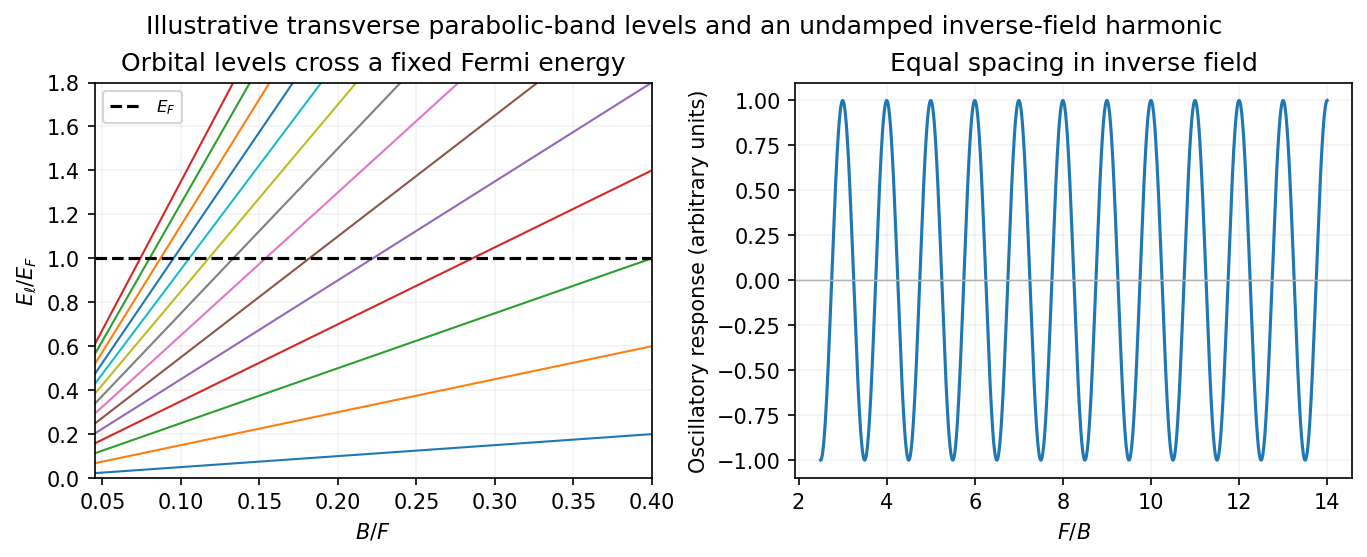
Quantized orbital crossings and their periodicity in inverse magnetic field
. Details. Oscillations in magnetization are the de Haas-van Alphen effect; oscillations in longitudinal electrical resistivity are the Shubnikov-de Haas effect. They are most readily observed in clean samples at low temperature. The thermal damping factor isand a common first-harmonic disorder factor is . Thus the Landau spacing must be sufficiently large compared with thermal broadening and disorder broadening, approximately and , with the displayed factors giving the quantitative suppression.
The temperature dependence measures the cyclotron effective mass, and the field-dependent damping probes the quantum lifetime . That lifetime need not equal the momentum relaxation time controlling electrical conductivity: small-angle scattering can broaden Landau levels while relaxing electric current inefficiently. Spin splitting can generate further modulation or resolved spin structure. Oscillations are not the same as the ordinary smooth magnetoresistance or cyclotron resonance; they probe quantized orbital state counting near the Fermi energy.
mass as band curvature. In a periodic potential, a weakly forced Electron is usefully described by a wave packet confined to one energy band. Its group velocity isDifferentiating the velocity givesThis effective-mass tensor describes the band response, not a change of the Electron's bare rest mass. Along a principal direction, a steep upward curvature gives a small positive mass and a flatter curvature a larger one. Near a band maximum the Electron curvature and effective mass are negative; the corresponding missing-electron description uses positive electron hole masses. Anisotropy produces distinct principal masses, and strong nonparabolicity makes them momentum dependent. The single-band semiclassical description assumes fields weak and slowly varying enough to avoid substantial interband transitions.
Lattice symmetry and Bloch's theorem. Use the active spatial translation operator . A lattice-periodic scalar potential satisfies , while the kinetic term is translation invariant. Therefore . The lattice translations also commute with one another, so they can be diagonalized simultaneously with , including within a degenerate energy subspace.
For a common eigenstate, write . Unitarity gives , and the group law gives . On primitive Bravais vectors , choose . Every lattice vector is an integer combination of these generators, henceThe vector is defined modulo a reciprocal lattice vector. The band index labels the different energy eigenstates with the same translation character. Define . The phase factors cancel under a lattice translation, proving Bloch's theorem in its usual form:This is the Translation-character proof of Bloch theorem; the commutator guarantees a basis of such states, even when an arbitrary superposition of different translation characters is not itself a translation eigenstate.
Periodic Hamiltonian. Acting once with momentum gives . Applying it again and cancelling the common plane-wave factor yieldsThe Bloch Hamiltonian acts on lattice-periodic functions in a unit cell. Expanding its square separates a zero-momentum Hamiltonian, a term linear in and an identity term quadratic in .
Expansion about the zone centre. Let , , and normalize all these states using a unit-cell inner product. For the real scalar Hamiltonian in the question, a nondegenerate zone-centre eigenfunction can be chosen real. Thenbecause opposite unit-cell faces cancel. Equivalently, time-reversal symmetry forbids a nonzero electric current in this nondegenerate spinless state. This explains why no linear energy term appears; it should not simply be omitted without a symmetry or extremum argument.
The first-order energy shift is therefore . In the second-order sum the quadratic term is proportional to the identity and has no off-diagonal matrix elements. Only the linear momentum vertex contributes. Second-order nondegenerate perturbation theory gives the momentum matrix-element expansion of band energyHermitian operator makes the two reciprocal matrix elements complex conjugates. All other periodic eigenstates at enter the sum. The remainder is even because time-reversal symmetry gives near this isolated state. At a degeneracy the denominators signal the need for degenerate perturbation theory instead.
mass ratio and the printed formula. Write . Differentiating the quadratic energy yieldsFor a specified unit direction , the resulting scalar mass ratio isIn an isotropic three-dimensional band, averaging equivalent directions givesCoupling to lower bands contributes positively to inverse mass; coupling to higher bands contributes negatively. Their signs and matrix elements determine the actual curvature.
The original PDF prints . Taken literally as a three-dimensional Laplacian, this misses a factor of three for an isotropic scalar mass. The correct identities areThe printed expression would return even for the free dispersion . It is correct in one dimension, or if its second derivative is interpreted directionally. For completeness, its literal three-dimensional trace ratio would instead be ; that is the trace of the dimensionless inverse-mass tensor, not the usual scalar .
Relaxation-time model. The Drude model treats mobile charge carriers as independent particles accelerated by the Lorentz force between scattering events. Collisions randomize the drift momentum toward local equilibrium and are represented by a uniform, field-independent momentum relaxation time. For the present calculation the carrier density, isotropic mass and relaxation time are fixed, the fields are uniform and stationary, and quantum orbital quantization and intercarrier correlations are neglected. The steady drift velocity obeysHere is the number of carriers of that species per unit volume, their signed charge, their inertial or isotropic band mass, the momentum relaxation time, and their single-species electrical conductivity at zero field.
One-carrier tensor. With and , solving for the electric field givesSince and ,Thus the resistivity tensor, defined by , isIts off-diagonal signs follow from the stated axes and signed . For zero transverse electric current, is the Hall electrical resistivity; reversing charge reverses it. The single-species longitudinal electrical resistivity is independent of in this ideal isotropic model.
Adding Electrons and electron holes. Let both species have density and charges , with . The stipulated equal zero-field electrical conductivity means equal positive charge carrier mobility , even if their masses and momentum relaxation times separately differ. Put and . Inverting each electrical resistivity matrix givesBoth species experience the same electric field, so their electric current densities add. Therefore it is their conductivity tensors, rather than their resistivity tensors, that must be summed. The Hall parts cancel andThis is compensated two-carrier magnetoresistance. Although the net Hall field vanishes, each carrier species is bent in its own direction; maintaining the total longitudinal electric current requires an increasing longitudinal field. Equal carrier numbers alone do not ensure zero Hall response if charge carrier mobilities differ; both equalities given here are used.
Large-field limit and quantum oscillations. Expanding the exact diagonal entry,For ,Here the last equality applies to either species with its own mass and transport time; the stipulated charge carrier mobilities give the same threshold. This is the classical strong-field condition : carriers turn substantially before their drift momentum relaxes.
Observable quantum oscillations additionally require sufficiently sharp Landau levels and a sufficiently cold Fermi-Dirac distribution, approximatelyWhen , the disorder field scale is comparable to the onset scale for large classical magnetoresistance. The thermal condition can demand a much larger field, and when even the disorder criterion is stronger. The quantitative damping factors in Q2(c) show that these are crossover scales rather than sharp visibility boundaries. A large smooth magnetoresistance therefore does not itself demonstrate Landau level; it can exist while thermal smearing suppresses oscillations. Conversely, the asymptotic condition is stronger than merely reaching unity, so there is no universal ordering of the two experimental onset fields without temperatures and lifetime information.
Scaling function. The material's actual zero-field longitudinal electrical resistivity is . Dividing the exact answer by this value givesThe assumption that stays constant is essential to eliminating further temperature-dependent parameters. is a dimensionful scaling variable; is its dimensionless version. The corresponding fractional increase is .
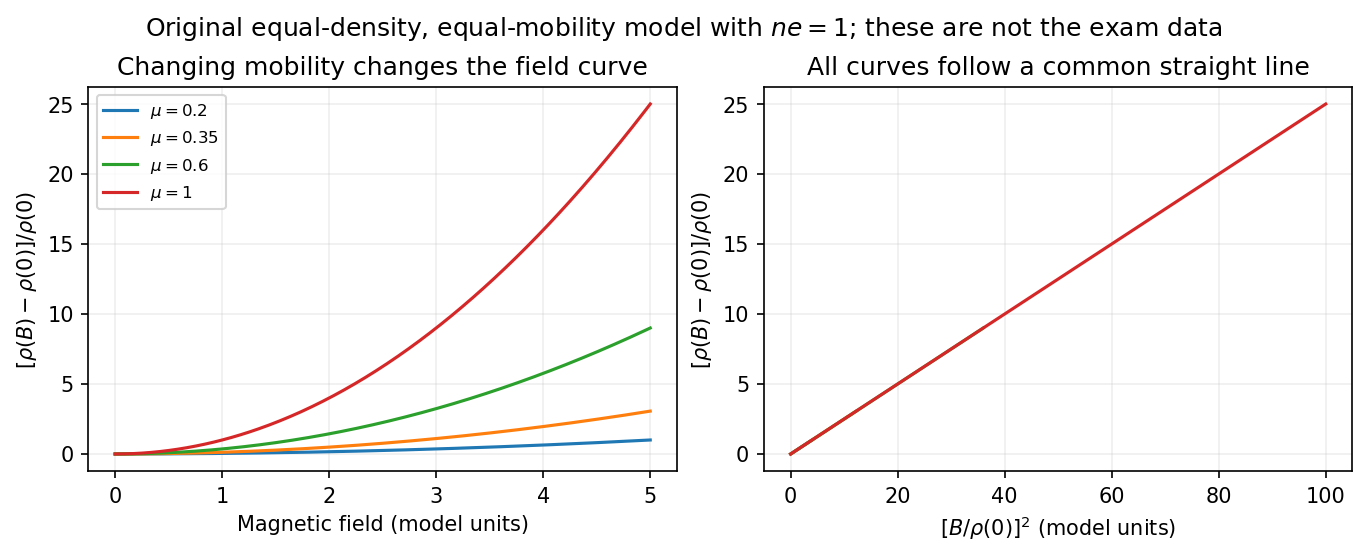


What the supplied data test. In the original PDF's left panel, the field dependence is strongly temperature dependent. In the right panel, plotting the fractional magnetoresistance against the squared rescaled field makes the displayed 125, 150, 175, 200 and 225 K curves collapse approximately onto one straight line, over the field intervals where they overlap. This supports the proposed one-parameter scaling and, on that range, the quadratic field law. The 100 K curve does not collapse: it bends away and has a different slope in the rescaled plot. The indicated scaling is therefore supported for the displayed 125–225 K data, not for the entire displayed temperature range. The graph alone does not locate a sharp transition between 100 and 125 K or establish behavior above 225 K.
This empirical collapse is Kohler's rule. It is consistent with a common temperature-dependent charge carrier mobility or relaxation scale and a fixed carrier population; it is not a unique proof of exact compensation or of one microscopic scattering mechanism. A change in relative scattering times, carrier population or Fermi-surface structure could spoil the collapse, and this figure alone does not select the cause of the 100 K departure.
There is a factor-of-two normalization convention in the printed text. The introduced for each species gives , whereas the final paragraph calls “.” If denotes the experimentally measured zero-field electrical resistivity, the consistent slope isIf one instead keeps the literal single-species definition , the same model has . The choice rescales and offsets the axes by temperature-independent constants, so it does not change which temperature curves collapse, but it must be resolved before inferring a carrier density from the slope.
Articles by others on the same topic
There are currently no matching articles.