A doublet has moment projections . The requested normalization assumes , so the projections are and the two Zeeman energies are . For independent localized ions, the one-ion partition function and thermal moment areTherefore the spin-one-half paramagnetic magnetization isIt saturates at for a field strong compared with . For a different Landé g-factor, replace every moment by ; alone does not fix that factor.
At weak field or high temperature, and , soUsing for the applied-field response and neglecting demagnetizing corrections, the SI volume magnetic susceptibility isThis is Curie's law. If susceptibility is instead defined as , its Curie constant is without ; stating which field is used prevents a units error.
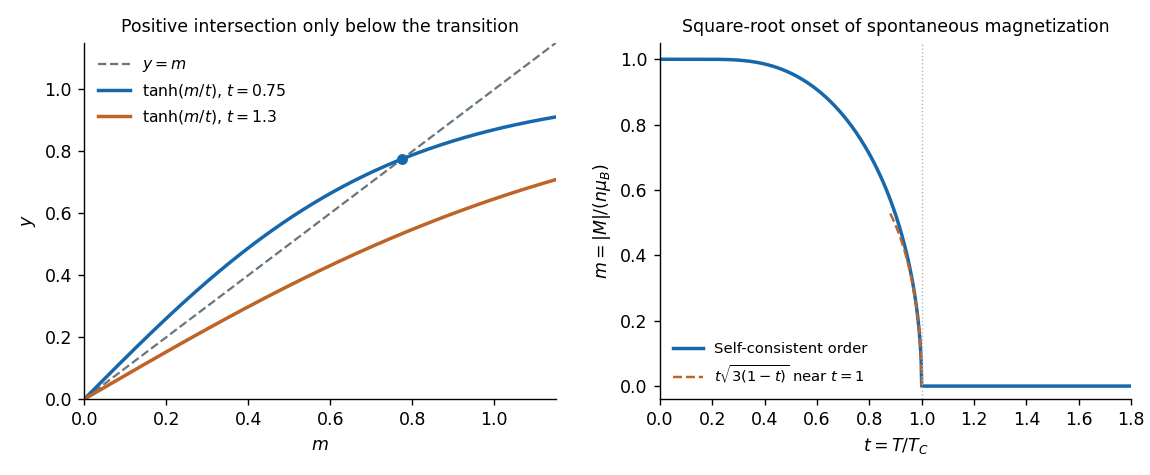
Replace the applied field in the doublet response by the Weiss molecular field . At zero applied field,The equation is odd in , so the two ordered orientations have equal magnitude. With , defineThe mean-field self-consistency equation becomesPlot and . The second has slope at zero and is concave for positive . For it starts above the straight line but is below it by , giving one positive intersection. For , for every . HenceAt the limiting solution is . The onset of spontaneous magnetization is the mean-field Curie temperature.
Close to the critical temperature on the ordered side, both and are small. Expanding the hyperbolic tangent givesFor a nonzero solution, divide by and retain the cubic-order terms:This mean-field onset of two-state ferromagnetism has mean-field critical exponent : the curve reaches zero continuously with a square-root cusp below , and remains exactly zero for all . The factor is what the cubic truncation gives; higher orders also affect the coefficient at relative order , so the robust leading asymptote is .

The large effective field primarily represents exchange interactions, which arise from Coulomb interactions, electronic hopping and the Pauli exclusion principle. It is not usually the much smaller classical magnetic dipole field of neighbouring ions. Direct exchange involves overlapping magnetic-ion orbitals. Superexchange instead uses virtual charge transfer through a ligand while real charge transport remains gapped, allowing substantial magnetic order in an electrical insulator.
Use dimensionless spin operators with eigenvalue , and count each bond once. One consistent Heisenberg model convention isThen favours a Heisenberg ferromagnet, while favours a Heisenberg antiferromagnet. Replacing neighbouring spins by their mean values gives the effective fieldFor equivalent ferromagnetic neighbours with and uniform order, , soThe last equality is the same molecular-field result derived above, not an exact transition temperature for every lattice.
Microscopically, a half-filled orbital pair with virtual hopping and a large on-site repulsion permits an energy lowering of the singlet but not the parallel-spin triplet, yielding antiferromagnetic in this convention. Ligand-mediated hopping is the analogous mechanism in many ionic insulators. Different orbital occupancies and nearly orthogonal ligand paths can suppress this antiferromagnetic term and permit ferromagnetic exchange to dominate. Thus the sign depends on electronic structure and bonding geometry, not simply whether the sample conducts.
For antiferromagnetic coupling on a bipartite lattice, the field on each sublattice is proportional to the opposite sublattice magnetization, with opposite alignment preferred. Two coupled self-consistency equations then permit and vanishing total magnetization: the order parameter is staggered. The single positive- uniform equation describes ferromagnetism and must be extended to these sublattices to describe an antiferromagnet.
Articles by others on the same topic
There are currently no matching articles.