Take as the signed electron charge. The Lorentz oscillator model is a driven damped bound charge:The first term is inertia, the second is a phenomenological frictional loss of coherent motion to other degrees of freedom, and the third is the linear restoring force from binding to the atom. The driving term is the electric force. The natural angular frequency represents the electronic transition; this classical oscillator describes its near-resonant linear response. The friction convention is , so no factor two is hidden in .
Substitute harmonic amplitudes with the specified convention:One electron contributes a dipole moment , so the electric polarization of a density isUsing givesThus the paper's dimensionless is the relative permittivity, rather than the absolute permittivity . The electron's negative charge disappears from the electric susceptibility because both the force and dipole moment contain .
Set . The real part and imaginary part of the complex permittivity areFor positive frequency the loss part is nonnegative. The real part starts at , rises below resonance, falls steeply through the resonance region, and approaches one from below at high frequency. The imaginary part is a positive absorption peak near , tending to zero on both sides.
For a nonmagnetic medium write its complex refractive index as , with and optical extinction coefficient . In a transparent region with and ,The real part controls phase velocity and optical dispersion; the loss part controls wave absorption and the cycle-averaged dissipated power density . Weak damping gives a narrow line but does not make wave absorption weak at its centre. The transparent-medium approximation applies away from the line.
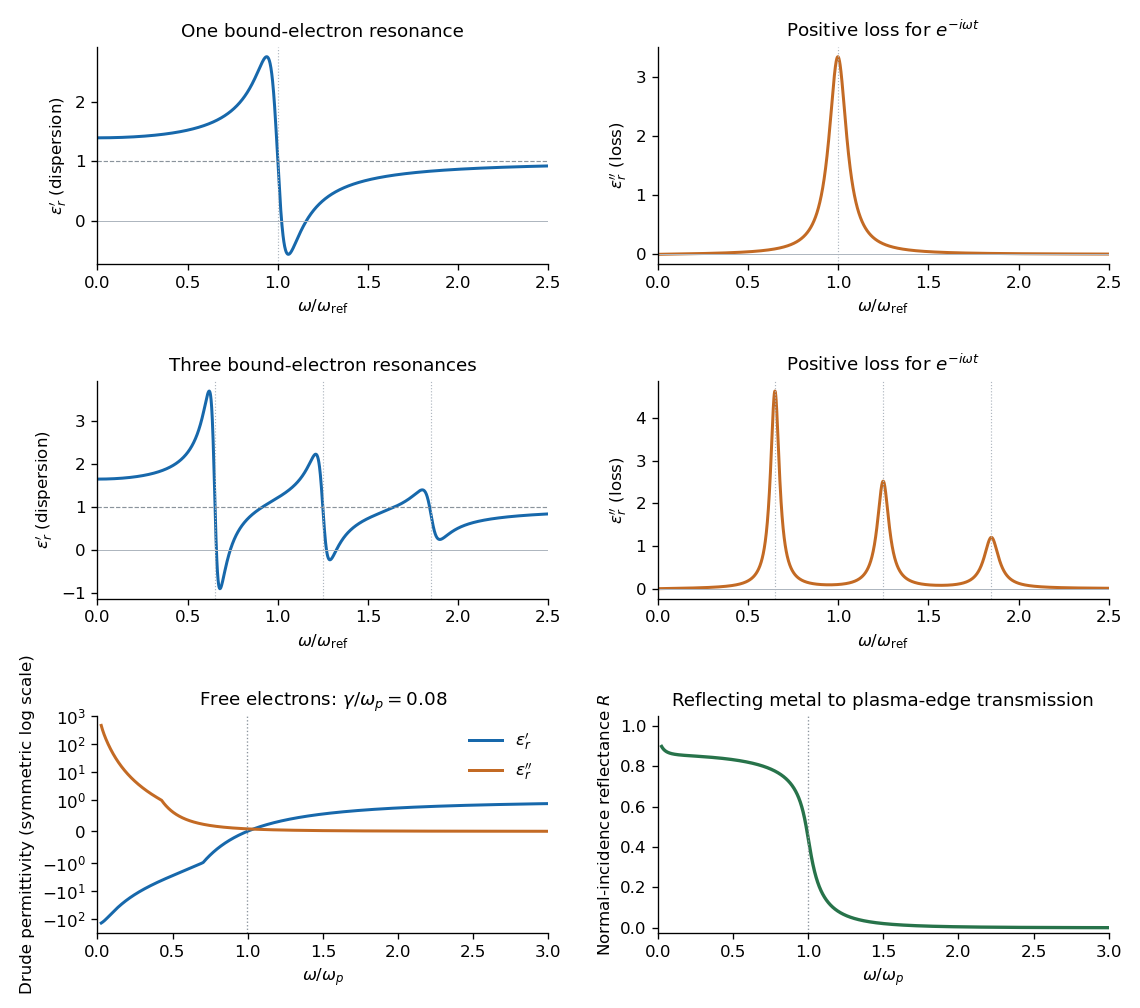

For independent electronic transitions, add the electric dipole moment responses:The positive constants include electron density and transition atomic oscillator strength. Each term adds an absorption peak to and a dispersive positive-to-negative contribution to , as in the middle row of the figure.
Between well-separated absorption lines, where the medium is transparent, the refractive index generally increases with frequency: , or . This is normal dispersion. Near a resonance the real response turns down with increasing frequency, producing an interval of anomalous dispersion, , accompanied by appreciable absorption. The absorptive and dispersive parts are linked by the Kramers-Kronig relations; the steep variation is not independent of the loss spectrum.
An unbound conduction Electron has no local restoring force, so set while retaining inertia and momentum relaxation time . This is the Drude model:Separating the response givesFor a good metal, . The real part is strongly negative at low frequency, crosses zero at , and approaches one from below. The imaginary part diverges as at low frequency, reflecting the finite dc electrical conductivity , then decays as . The low-frequency imaginary response describes conduction loss, not a finite-frequency bound-electron absorption line. Core-electron and interband responses can add a background in a real metal.
At normal incidence from vacuum, the Fresnel equations give the reflectanceA good metal has close to one below its plasma frequency. At very low frequency the electromagnetic field penetrates only a skin depth; the local Drude limit gives . In the collisionless negative-permittivity range the transmitted field is evanescent and reflection remains strong. Near the plasma edge the reflectance drops sharply; above it and propagating waves become possible. In the ideal free-electron high-frequency limit,Finite damping rounds the plasma edge, and interband absorption changes the detailed response of actual metals.
Articles by others on the same topic
There are currently no matching articles.