Use dimensionless spin operators and nearest-neighbour exchange on a regular bipartite graph with N sites and coordination number of a lattice z. Count each bond once and define , real for the inversion-symmetric examples considered here.
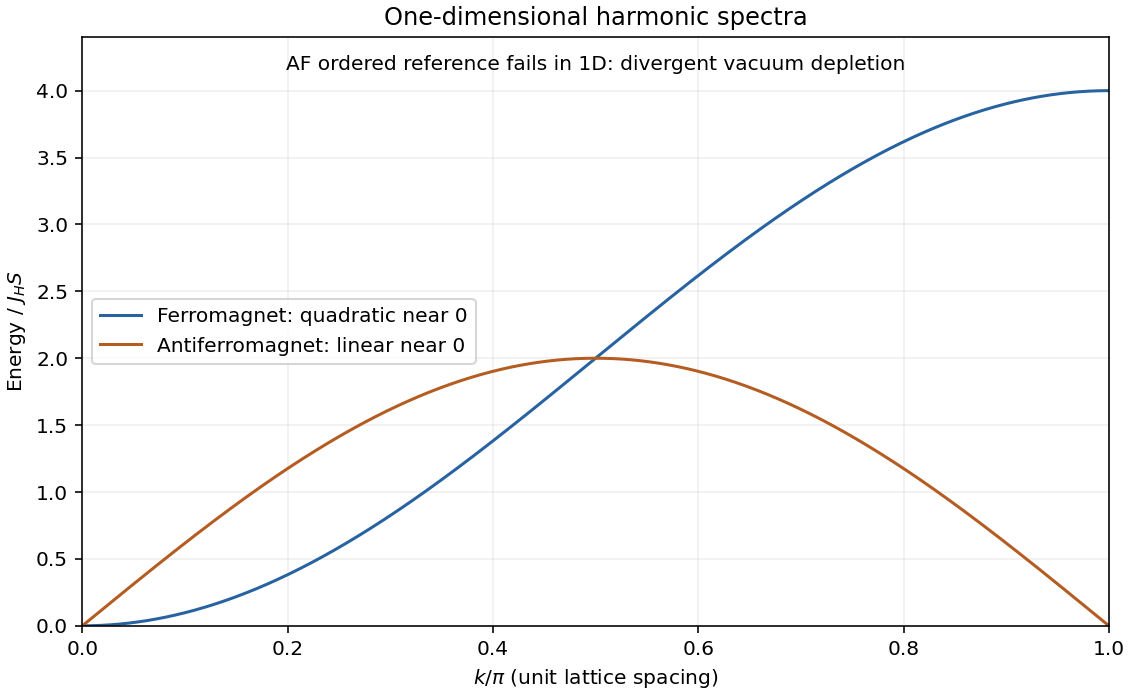
For the ferromagnetic Heisenberg model, . Expanding the Holstein–Primakoff transformation about all spins along +z givesup to interactions of higher order in boson density, with . The isotropic spin-wave vacuum energy comparison starts with this normal ordering. The linear spin-wave approximation then givesEach ferromagnetic magnon lowers total by one. The fully aligned state is an exact eigenstate and ground state; there is no harmonic vacuum depletion or added zero-point energy in this normal-ordered Hamiltonian. The global spin-rotation multiplet remains degenerate. On a hypercubic lattice of spacing a, and , so . The exact one-magnon sector agrees with this result even at finite S; interactions enter for multiple magnons.
For the Heisenberg antiferromagnet, take and expand around a Néel state. On A, and ; on B, and . A bond becomesWith N/2 momenta in the magnetic Brillouin zone,The bosonic Bogoliubov transformation has and . For example and . It gives two branches in this reduced zone,The reduced-zone counting of bipartite spin waves gives N oscillators in total, not 2N. The negative vacuum correction and quantum depletion of Néel order, , distinguish the antiferromagnet from the ferromagnet. At nonzero temperature replace by . Hypercubic small-momentum modes have , hence linear physical frequency .
Self-consistency requires depletion much smaller than S and respects the Holstein–Primakoff occupation constraint. In one dimension the antiferromagnetic vacuum depletion diverges logarithmically, invalidating ordered spin-wave theory; it does not alone prove an exact gap or its absence. At positive temperature, isotropic short-range models in d≤2 cannot sustain such magnetic order by the Mermin-Wagner theorem. In three dimensions the quadratic ferromagnetic modes give the low-temperature magnetization reduction proportional to , whereas the antiferromagnetic thermal reduction scales as . Anisotropy, fields, frustration and magnon interactions alter these conclusions. [ref]
Physics 215C: Quantum Field Theory, Part 3 by John McGreevy. §4.1, contrasting ferromagnetic and antiferromagnetic low-energy dynamics
Insert position resolutions between short-time evolution factors for . Integrating the momenta gives the path integral, with real-time slice factor and weight . A real classical trajectory cannot pass through a barrier with insufficient energy, but the path integral includes nonclassical paths.
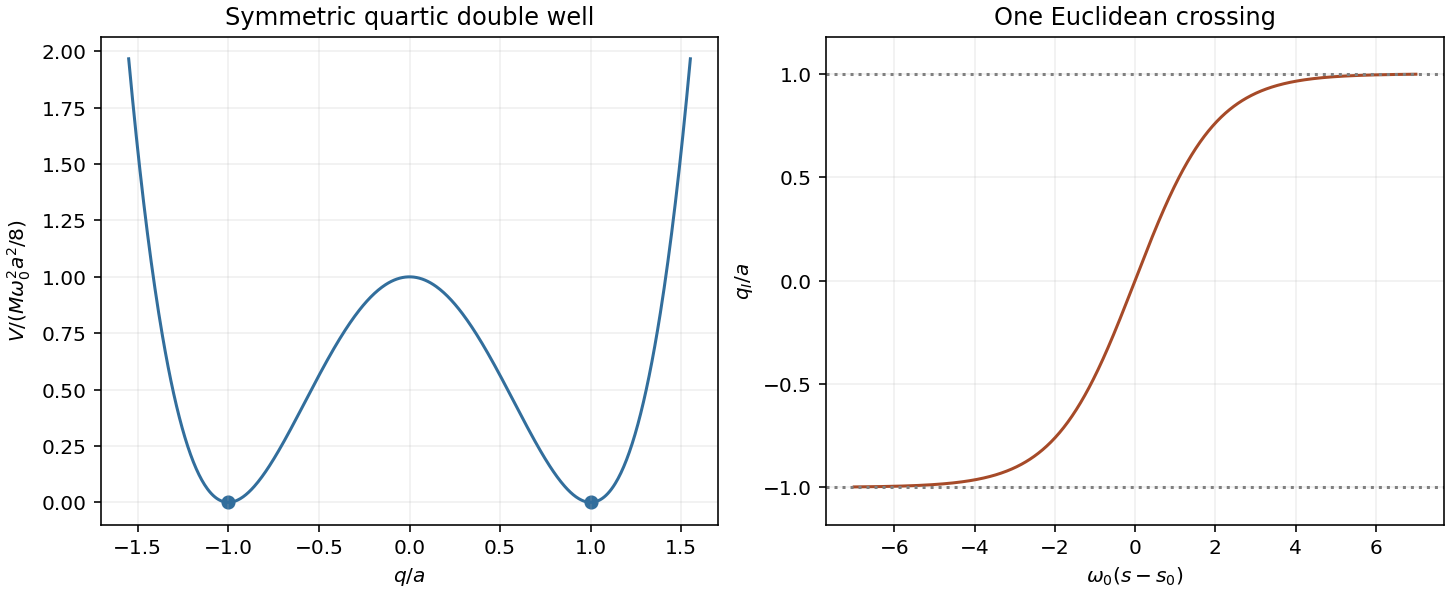
Continue , with s physical imaginary time. The damped kernel isThe Euclidean action saddle obeys : motion in the inverted potential. For degenerate minima at , subtract their common potential energy. A trajectory joining them with zero Euclidean energy satisfiesIt is an instanton; reversing its direction gives an anti-instanton. Thus a crossing amplitude is nonperturbative, proportional to . For the representative quartic well , direct integration givesThe arbitrary center is an instanton translation zero mode. Expanding gives a Gaussian path integral involving . Treating the zero mode as a collective coordinate rather than a zero Gaussian denominator produces the instanton fluctuation prefactorCommon endpoint regularization defines the functional determinant ratio; K and kappa have inverse-time units. The prime removes only the zero eigenvalue, while integrating the center supplies the total available time. Large and justify a dilute instanton gas.
Multiple crossings alternate direction. Integrating n ordered centers gives . Return paths contain even n, and transfer paths contain odd n, so their common local-well factor multiplies and respectively. The two lowest levels are consequentlyThe lower state is the even combination of the two localized states. Local anharmonic corrections modify and higher semiclassical corrections modify K. The thermal trace as a closed Euclidean path integral gives when higher local levels are negligible. This describes coherent level splitting in a stable well, not irreversible decay.
For a scattering barrier at energy E, the leading WKB tunnelling exponent gives an amplitude and a transmission probability with twice that exponent. Endpoint matching fixes prefactors. Metastable escape instead uses a Euclidean bounce, with a negative fluctuation mode and a decay rate. Neither its negative mode nor the probability/amplitude factor should be transplanted into the stable double-well splitting. [ref]
Gauge Theory by David Tong. Chapter2, §§2.3.2–2.3.3, printedpp.56–60: quantum-mechanical tunnelling, fluctuation determinants and repeated instanton events


Use the reduced attractive reduced BCS pairing Hamiltonian with volume V, and attraction :A specified pairing shell or an ultraviolet renormalization is part of the model. The trace is grand canonical. Insert fermionic coherent states into its time-sliced trace. The resulting Grassmann variables are antiperiodic, and with inverse-energy imaginary time the dimensionless action isThis boundary condition is essential for Fermi-Dirac statistics; replacing it by a bosonic periodic trace changes the answer. A complex Hubbard–Stratonovich transformation uses the local identitywith time-slice factors understood. The pairing field renders the fermion action quadratic. For a uniform static field the independent Nambu spinor block hasIts determinant is . The phase-independent determinant sign cancels under consistent reference normalization. Integrating the fermions gives the BCS pairing-field effective action, , with the normal-ordering/reference term retained. The fermionic pairing-block determinant normalization uses one independent pairing block for every k; a fully doubled spin-particle-hole trace instead needs one half. The subtracted grand potential of the reduced BCS model is particularly unambiguous:Performing the Matsubara frequency sum yieldsup to a common constant. At zero gap this reduces exactly to the two-spin free-gas result. The Matsubara derivation of the BCS saddle follows by differentiating with respect to and using givesThe second equation fixes the chemical potential at specified number. This stationary action is BCS mean-field theory, not an exact integration of pairing-field fluctuations. With constant single-spin density of states per volume and a symmetric energy cutoff , weak coupling gives and . The zero-temperature condensation grand-potential density is to leading weak-coupling order; using a spin-summed density would change these displayed factors. The BCS coherence factors are and , and the associated BCS ground state is the normalized product of empty and occupied pair states. [ref]
Lecture Notes for Quantum Matter by Steven H. Simon. Chapter11, BCS variational state, coherence factors, gap and thermal occupations
Allowing a slowly varying complex pairing field generates phase stiffness and, near the transition, the Ginzburg-Landau theory of superconductivity. A neutral paired system has a gapless phase sound mode; in a charged bulk superconductor electromagnetic coupling produces the Anderson-Higgs mechanism in a superconductor and the Meissner effect. These collective fluctuations are distinct from the gapped fermionic excitations. A microscopic dynamical calculation is needed to fix collective-mode dispersion and damping; the static saddle alone does not determine them. [ref]
Physics 215C: Quantum Field Theory, Part 3 by John McGreevy. §§3.1–3.2, coherent-state construction; §2.3, pair-field integration and charged phase dynamics
Articles by others on the same topic
There are currently no matching articles.