Use a real, even interaction . Let and . In the Bogoliubov theory expansion, keep terms with zero or two noncondensed operators. The zero-momentum term gives . The terms with two noncondensed operators giveHere is the direct condensate interaction and is its exchange contribution. At fixed total particle number, , soThe second term cancels the direct normal term. Adding the kinetic energy yields the number-conserving Bogoliubov quadratic HamiltonianThe constant is the condensate mean-field theory interaction energy; the normal term describes moving a particle out of the condensate, while the anomalous term creates or annihilates an opposite-momentum pair by exchanging two particles with the condensate. Total particle number remains fixed in the underlying theory; the condensate amplitudes in this notation are treated as classical amplitudes.
For condensate fluctuation power counting, put . Formal interaction-amplitude counting gives , cubic terms and quartic terms ; these are not uniform bounds on individual modes. Thus the latter are down by and relative to the quadratic interaction terms. The correction is relative . Homogeneity eliminates terms linear in nonzero-momentum operators. Small depletion and weak interactions, not low temperature alone, justify the truncation. [ref]
Lecture Notes for Quantum Matter by Steven H. Simon. §4.5, Bogoliubov expansion; fixed-number cancellation derived above
For each opposite-momentum pair use the Bogoliubov transformationEquivalently , , with . The identity preserves the canonical commutation relation. Vanishing anomalous terms require , and hence the Bogoliubov quasiparticle dispersion isSubstitution and normal ordering giveThis is the requested form after putting each inside the oscillator term. By momentum-pair counting in bosonic diagonalization, all sums cover the full nonzero-momentum set; no further factor of two is needed. The bosonic Bogoliubov zero-point shift combines the two vacuum sums before taking a continuum limit.
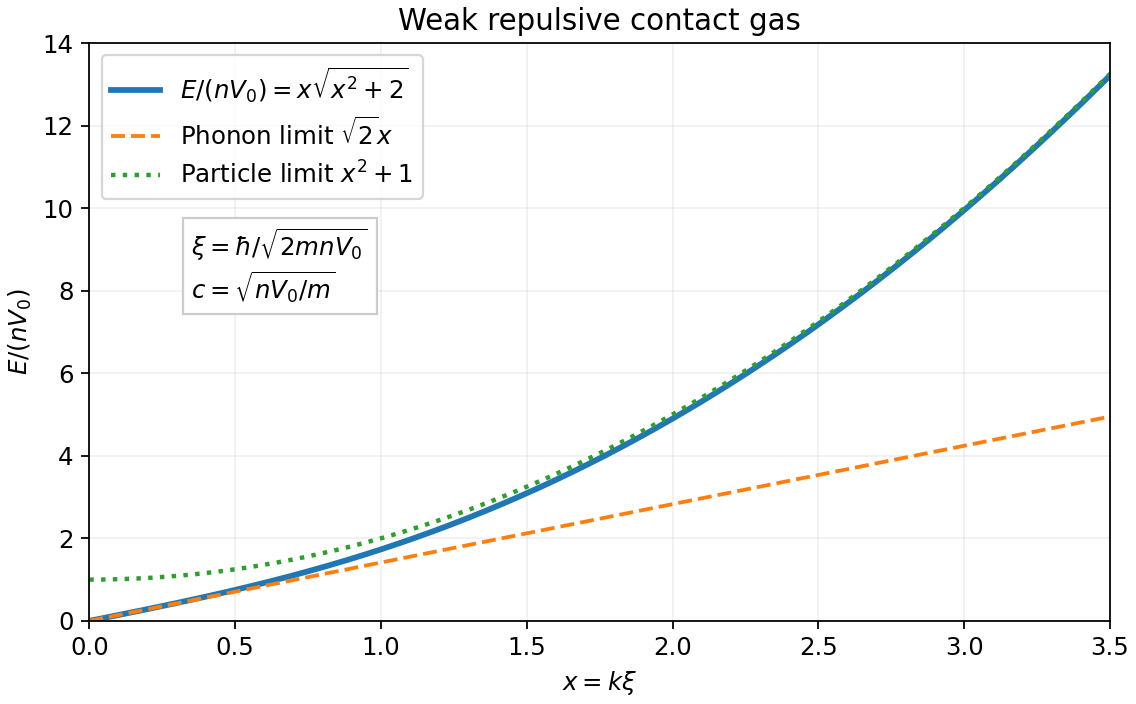
If smoothly, the low-energy excitations are gapless phonons:For contact repulsion, the healing length separates this regime from the particle-like regime . Stability requires for every nonzero mode. A general momentum-dependent interaction need not share the contact model's entire curve. An unregularized contact model also makes the vacuum-energy shift ultraviolet divergent; a physical finite-range interaction or scattering-length renormalization is needed for that absolute ground-state energy.

In the Bogoliubov quasiparticle vacuum, , but the inverse Bogoliubov transformation gives . Consequently the quantum depletion of a Bose condensate isThis expression assumes zero temperature. At nonzero temperature, thermal Bogoliubov quasiparticles add to the depletion:Thus the printed formula is the quantum contribution, or a low-temperature approximation when the thermal contribution is negligible. It is nonnegative for a stable quadratic Hamiltonian and vanishes in the noninteracting zero-temperature limit.
Articles by others on the same topic
There are currently no matching articles.