Keep the electromagnetic units of the supplied Lagrangian, including its factor , and regard as the signed coupling used there. Set . The canonical momentum is , so the Legendre transform givesSingle-valued periodic wavefunctions have normalized eigenstates with integer . Defining dimensionless flux gives , and the trace is thereforeThe flux-threaded quantum rotor spectrum is periodic under after relabelling , corresponding to flux period in these units. A local gauge change can remove the magnetic vector potential from the differential operator but then imposes a twisted boundary condition with phase ; it cannot remove the flux dependence from both the Hamiltonian and boundary condition simultaneously. In SI conventions the flux coupling has no , so one must not mix the two unit systems.
The trace integrates the diagonal thermal kernel over a single fundamental interval, . On the circle a closed path can wind an integer number of times. Lift it to the real covering coordinate so its endpoints are and , with .
Under Wick rotation , , so the real-time phase becomes minus the Euclidean action divided by , withThus sum the path integral over these lifted endpoint conditions and integrate from zero to . This gives the requested winding-sector representation of the trace. The flux term is a total derivative, so it leaves the local classical equation unchanged, but its weight is and distinguishes different winding sectors. This is the Aharonov-Bohm phase in a thermal path integral, rather than a force from a magnetic field on the ring itself.
The Euclidean saddle in winding sector is a constant-speed lifted path, . Write with Dirichlet fluctuation endpoints . The cross term in the kinetic action is proportional to , and the flux term of vanishes for the same reason. ThereforeDefine the fluctuation prefactor byIt is the free-line diagonal Euclidean propagator for the angular coordinate with inertia , or equivalently the Gaussian bridge amplitude about a given classical lifted path. It is independent of and flux. It is not the complete zero-flux ring partition function, which still includes every winding and the initial-angle integral. Translational independence supplies the factor , leavingThe momentum-winding duality of a quantum rotor uses a Gaussian expansion that is exact here because the kinetic action is quadratic and the flux coupling is a total derivative. It is not merely a leading semiclassical approximation.
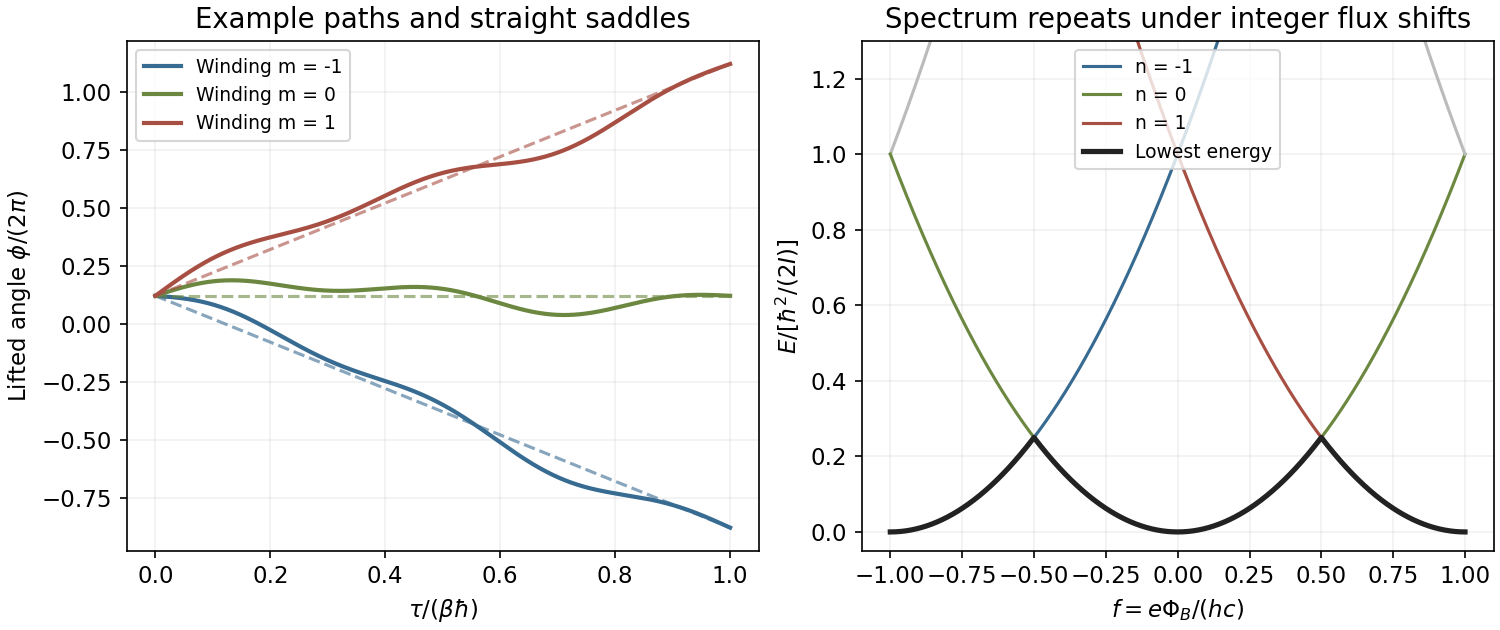
Lifted winding sectors on a flux-threaded ring and the periodic flux dependence of quantum energy levels
. Details. 
Continue the free-particle propagator to and replace its coordinate mass by the angular inertia . The Euclidean free-particle bridge amplitude at coincident endpoints isThis normalization includes the time-sliced Gaussian measure, not just a formal determinant with an unspecified multiplicative constant. Set . The correct Poisson summation formula is ; the source PDF omits the integral sign before its . For the Gaussian Fourier integral givesThe overall prefactor cancels exactly: , and . Hencein agreement with the angular-momentum trace. Pairing and makes the winding expression real, and the momentum expression shows positivity. Both are periodic in flux and invariant under . At high temperature the zero-winding term gives , with exponentially small flux dependence; at low temperature the nearest integer angular-momentum state dominates, with two equal lowest terms at half-integer flux. These independent limits also check the normalization and the flux phase.
Articles by others on the same topic
There are currently no matching articles.