For incoming four-momenta, the momentum-space Feynman rules in the chosen Minkowski metric convention are:
- Each internal line contributes the scalar propagator .
- Each quartic interaction vertex contributes and for momentum conservation.
- Each independent loop momentum is integrated with ; after eliminating redundant Dirac delta functions, one overall conservation factor remains.
- Each graph is divided by its symmetry factor , with external labels held fixed.
There is one connected one-loop one-particle irreducible two-point graph: a single quartic vertex with two external lines and one tadpole diagram. Its symmetry factor is from interchange of the two loop half-edges.
There are three connected one-loop one-particle irreducible four-point graphs: two quartic vertices joined by two parallel internal lines, with external partitions , and . These are the , and scattering channels; each bubble diagram has symmetry factor . External-branch insertions are excluded by the one-particle irreducible requirement.
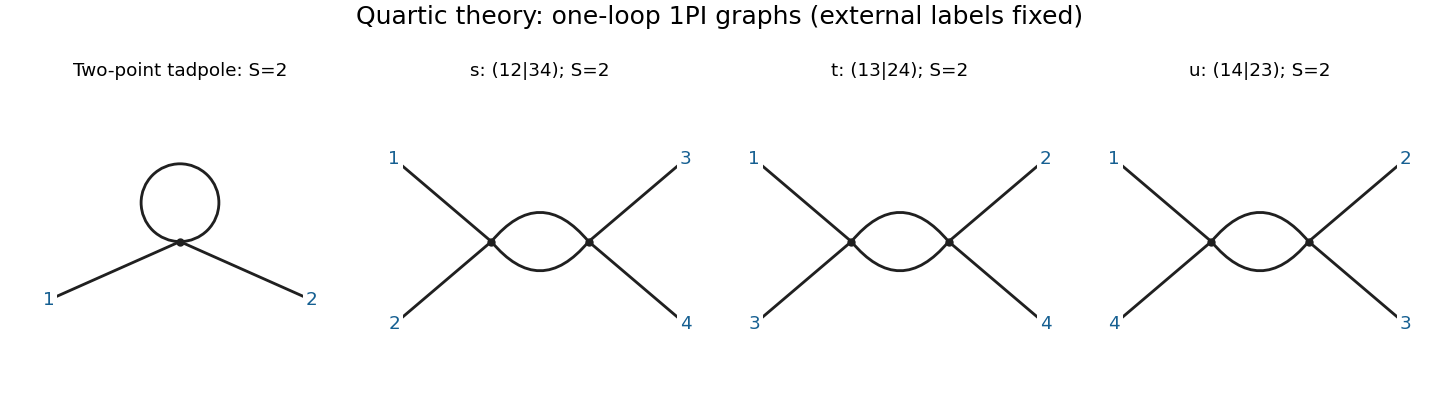
One-loop one-particle-irreducible quartic scalar graphs: the two-point tadpole and the three labelled four-point bubble channels, each with symmetry factor S=2
. Details. 
The positive denominators in this part are Euclidean. Starting with the Minkowski spacetime Feynman rules, first perform a Wick rotation; a bare Minkowski metric integral without a pole prescription would not equal the displayed positive expression. Work initially with and , where the Euclidean massive loop integral converges.
Use Schwinger parameterization followed by the Gaussian integral:The remaining Gamma function integral givesThe factorial form is for positive integral . Dimensional regularization defines the result elsewhere by analytic continuation.
For the scalar bubble integral, combine the two denominators with a Feynman parameter and shift the integration variable to . ThenFor this isThe Gamma function recurrence gives , and the parameter integral is . ConsequentlyThis ultraviolet divergence is independent of the external momentum. The assumption avoids an infrared divergence. In particular the completely massless zero-momentum integral is a scaleless integral and vanishes in dimensional regularization; its ultraviolet and infrared poles must be separated before assigning it the displayed ultraviolet residue.
It is convenient to evaluate the one-particle irreducible vertices using the Euclidean action and then translate the counterterms back to the Minkowski spacetime Lagrangian density. For the tadpole integral, analytic continuation of solution givesIndeed . The negative pole is a property of analytic continuation, not the value of a convergent positive integral.
The Euclidean space inverse two-point vertex has the one-loop correctionThe factor is the symmetry factor weight of the tadpole diagram. A mass counterterm cancels this pole. There is no momentum-dependent pole at this order, and hence no one-loop wave-function renormalization.
For the four-point vertex, the three bubble diagrams giveOne can check the relative minus sign independently from the one-loop effective action: its term has a positive term linear in and a negative term quadratic in it. Thus cancels the quartic pole.
In the Euclidean action, these two counterterms are . Returning to the Minkowski spacetime Lagrangian density givesFor a direct sign check with Feynman rules, the two amputated loop pole insertions are and , while the counterterm insertions are and .
As usual, the displayed pole residues suppress renormalization scale powers: away from four dimensions. The next part restores these powers explicitly with a dimensionless renormalized coupling. Replacing the tree coupling by its renormalized counterpart inside a one-loop residue changes only higher-loop terms.
Because the quartic coupling constant has mass dimension , introduce a renormalization scale and define the dimensionless renormalized coupling by minimal subtraction scheme:Here is the fixed bare coupling constant. Equivalently the tree-level quartic term is , and its one-loop counterterm is . This states explicitly the scale convention implicit in solution.
Put . Differentiating the bare relation at fixed givesWrite . The coefficient of in the last identity is , so . ThereforeThe first term is the engineering term in a dimensionally continued beta function. In four dimensions it disappears, leaving the positive one-loop quartic scalar beta function . Thus the renormalized coupling increases with increasing renormalization scale near weak positive coupling. This quantum running is the obstruction to extending the classical scale invariance in solution to the interacting quantum theory.
Articles by others on the same topic
There are currently no matching articles.