Using Feynman slash notation, the symmetric tensor kills the antisymmetric commutator of the gamma matrices. The Clifford algebra givesConsequently and . For a scalar-coefficient polynomial , split its even and odd powers:This reduction assumes scalar coefficients; arbitrary noncommuting matrix coefficients would not give the stated scalar functions .
Every positive-energy Dirac spinor obeys . Therefore the fermion spin sum satisfiesSince and , the trace of each outer product is its contracted scalar. The prescribed normalization and the two spin states yieldNow make exactly the stated polynomial assumption and apply polynomial reduction of a slashed vector. By a, on the mass shell write . ThenThe matrices and are linearly independent for a physical nonzero , so . The gamma matrix trace identities, and , giveThus andNo explicit representation of the Dirac spinors has been used. The same reasoning covers provided .
Interpret the repeated species label in the Yukawa interaction as summed over : each Feynman vertex is diagonal in species and equals . Define the invariant scattering amplitude by . There is one tree-level Feynman diagram, an -channel scalar exchange. In the left panel, for this part; the right panel only occurs in d. Arrows show fermion-number flow, so an antifermion arrow opposes its physical momentum.
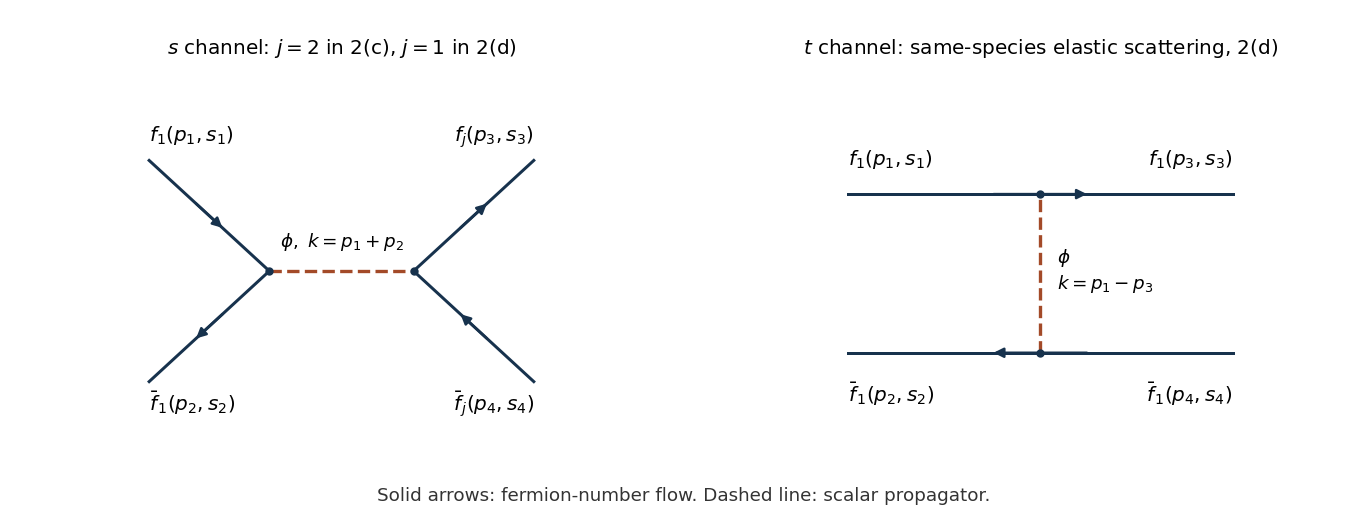
Labelled scalar-exchange annihilation and elastic diagrams, with arrows following fermion-number flow
. Details. 
Writing and , the momentum-space Feynman rules giveThe scalar carries no spin label. Average over the incoming spin states and sum the four outgoing combinations. For the real scalar Yukawa interaction, the conjugate of is . The fermion spin sums then yieldThe bar denotes the initial spin average, not a Dirac adjoint. The gamma matrix trace identities giveand the second trace has the same value because and all external masses are . ThereforeThis is the fixed-order expression away from . If that pole is accessible, a physical scattering resonance requires a scalar self-energy and decay width; the tree formula alone is not finite there.
For a single species both panels of the figure in c contribute, now with . They are the -channel annihilation and -channel scalar exchange, where the Mandelstam variables are , , and . Fix the external-state order consistently with c. The exchange of identical external fermionic operators gives a relative minus sign:Changing the convention for ordering all external states can change the overall sign, but not this relative fermionic sign.
The exchange must include crossing symmetry the associated external spinors, as well as continuing the four-momenta. It interchanges and , leaves fixed, and interchanges the two spinor pairings. Hence the analytically continued invariant scattering amplitude is antisymmetric:The first relation is understood with consistently chosen spinor crossing phases. It is not a substitution of negative-energy arguments into the original positive-energy spinors without changing external states.
Without repeating the spin sum calculation, c fixes the square of the first diagram. Crossing symmetry fixes the second by . Consequently the strongest immediate inference isThe interference function is not determined by the separate diagram squares. In particular adding the two squares and dropping interference is unjustified. The Cauchy-Schwarz inequality applied to the arrays of spin amplitudes also gives on the physical scattering region.
For completeness, its value can be checked with one contracted trace, without another diagram calculation. The cross product isThe relative minus in the invariant scattering amplitude gives . Thus the fully evaluated result, beyond the symmetry inference alone, isEvery term respects the inferred symmetry. In the massless limit the interference numerator reduces to , which is nonzero at a generic scattering angle.
Articles by others on the same topic
There are currently no matching articles.