Source PDF: mmathphys.physics.ox.ac.uk/sites/g/files/vzsiac2991/files/mmathphys/documents/media/a15088w1.pdf
Use natural units and the mostly-minus Minkowski metric. Question 3 has two spatial dimensions: its gamma matrices are the specified two-by-two matrices. The printed in its kinetic term is interpreted as those , rather than as three unmodified Pauli matrices. All spin sums in question 2 instead use four-component Dirac spinors in four spacetime dimensions.
Write . The canonical commutation relations and the product rule for a commutator giveThe other-species terms vanish. Integrating the Dirac delta distributions in the Hamiltonian therefore giveswhere . Consequently the complex scalar field satisfiesDirect differentiation of the time factors gives the same expression, proving the Heisenberg equation of motion
Both a particle and its antiparticle carry the momentum of their mode label. Thus the normal-ordered total momentum operator isThe canonical commutation relations giveThe minus sign in the antiparticle mode label is essential: both terms in the printed mode expansion of a free field contain . Hence
For a small real time displacement , the unitary time evolution operator is . The corresponding Heisenberg picture field transformation is conjugation by its inverse:Here a gives .
Likewise let , with the paper's sign for its spatial translation operator. From b,These are precisely the first-order Taylor expansions. Since and commute in this translation-invariant theory, the finite result is
Choose the zero of energy so that the translation-invariant vacuum state has . A one-particle state of rest mass obeys the relativistic energy-momentum relationThe translation covariance of a quantum field in c remains valid for the full interacting four-momentum operator. Acting its exponential functions on the two momentum eigenstates givesHere . A different additive vacuum energy must be subtracted consistently from both energy eigenvalues before identifying the physical .
Assume , as required to have a rest frame. Choose the Lorentz boost for which , and write its unitary operator as . The stipulated one-particle state normalization gives without a momentum-dependent prefactor. A Lorentz scalar at the origin satisfies , and the vacuum state satisfies . Inserting therefore provesWith a noncovariant normalization of momentum eigenstates, the assumed boost law would instead contain a square-root energy factor, so this equality is specifically tied to the paper's assumption.
Let denote the four-momentum of the other energy eigenstate. Translation covariance first givesThus a suitable ket, including the phase whose complex conjugate appears in its bra, isHere means . The overall phase depends on the fixed insertion point ; it does not change the energy eigenvalue. It cannot simply be dropped if the equality of complex matrix elements is to hold exactly.
The transformed state has four-momentum . Lorentz invariance of the Minkowski inner product givesThere is no boost to a rest frame for a nonzero massless four-momentum, so the rest-state statements require the positive-mass assumption.
Using Feynman slash notation, the symmetric tensor kills the antisymmetric commutator of the gamma matrices. The Clifford algebra givesConsequently and . For a scalar-coefficient polynomial , split its even and odd powers:This reduction assumes scalar coefficients; arbitrary noncommuting matrix coefficients would not give the stated scalar functions .
Every positive-energy Dirac spinor obeys . Therefore the fermion spin sum satisfiesSince and , the trace of each outer product is its contracted scalar. The prescribed normalization and the two spin states yieldNow make exactly the stated polynomial assumption and apply polynomial reduction of a slashed vector. By a, on the mass shell write . ThenThe matrices and are linearly independent for a physical nonzero , so . The gamma matrix trace identities, and , giveThus andNo explicit representation of the Dirac spinors has been used. The same reasoning covers provided .
Interpret the repeated species label in the Yukawa interaction as summed over : each Feynman vertex is diagonal in species and equals . Define the invariant scattering amplitude by . There is one tree-level Feynman diagram, an -channel scalar exchange. In the left panel, for this part; the right panel only occurs in d. Arrows show fermion-number flow, so an antifermion arrow opposes its physical momentum.
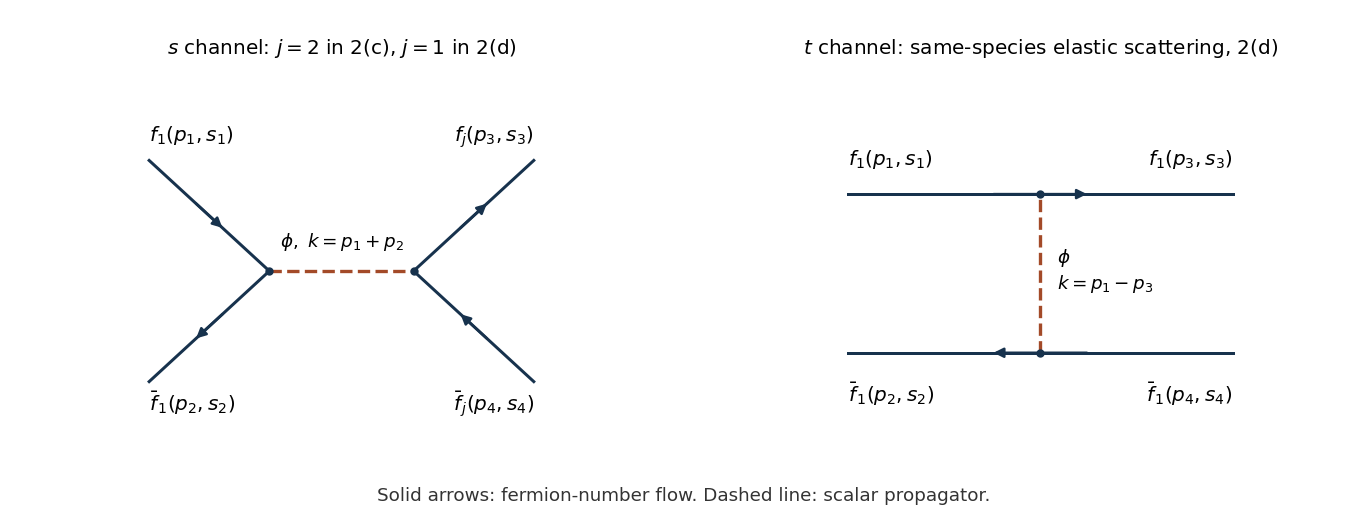
Labelled scalar-exchange annihilation and elastic diagrams, with arrows following fermion-number flow
. Details. 
Writing and , the momentum-space Feynman rules giveThe scalar carries no spin label. Average over the incoming spin states and sum the four outgoing combinations. For the real scalar Yukawa interaction, the conjugate of is . The fermion spin sums then yieldThe bar denotes the initial spin average, not a Dirac adjoint. The gamma matrix trace identities giveand the second trace has the same value because and all external masses are . ThereforeThis is the fixed-order expression away from . If that pole is accessible, a physical scattering resonance requires a scalar self-energy and decay width; the tree formula alone is not finite there.
For a single species both panels of the figure in c contribute, now with . They are the -channel annihilation and -channel scalar exchange, where the Mandelstam variables are , , and . Fix the external-state order consistently with c. The exchange of identical external fermionic operators gives a relative minus sign:Changing the convention for ordering all external states can change the overall sign, but not this relative fermionic sign.
The exchange must include crossing symmetry the associated external spinors, as well as continuing the four-momenta. It interchanges and , leaves fixed, and interchanges the two spinor pairings. Hence the analytically continued invariant scattering amplitude is antisymmetric:The first relation is understood with consistently chosen spinor crossing phases. It is not a substitution of negative-energy arguments into the original positive-energy spinors without changing external states.
Without repeating the spin sum calculation, c fixes the square of the first diagram. Crossing symmetry fixes the second by . Consequently the strongest immediate inference isThe interference function is not determined by the separate diagram squares. In particular adding the two squares and dropping interference is unjustified. The Cauchy-Schwarz inequality applied to the arrays of spin amplitudes also gives on the physical scattering region.
For completeness, its value can be checked with one contracted trace, without another diagram calculation. The cross product isThe relative minus in the invariant scattering amplitude gives . Thus the fully evaluated result, beyond the symmetry inference alone, isEvery term respects the inferred symmetry. In the massless limit the interference numerator reduces to , which is nonzero at a generic scattering angle.
In spacetime dimensions, the dimensionless action gives and . The scalar kinetic term requires , whereas the fermion kinetic term requires . Thus the engineering dimensions of relativistic fields areMatching each interaction to mass dimension three givesHere the brackets mean exponents of mass in natural units. The coefficients are marginal couplings by classical power counting, and is a relevant coupling.
Let count internal scalar and fermion lines and count independent loops in a connected amputated Feynman diagram. At large loop momentum, the scalar propagator falls as and the Dirac propagator falls as , including its numerator. Each loop integration is . The nonderivative interaction vertices add no powers. ThereforeCount endpoints of each kind of line and use the connected-graph loop order identity:Eliminating givesThe cancellation of reflects their dimensionless couplings; every insertion of the positive-dimensional improves the superficial degree of divergence by one.
The printed exact homogeneity is shorthand for ultraviolet power counting, not an identity for a massive integrated correlation function. For example, even the free amputated scalar two-point vertex obeys , which differs from when . Logarithmic divergences, actual numerator cancellations and ultraviolet subdivergences also require separate treatment.
Use one-particle-irreducible correlation functions to identify independent local counterterms. The exact internal symmetry excludes odd , and Dirac fermion number conservation requires equal numbers of and , so is even. From b, the complete list of potentially overall divergent vertices with external legs is:
- : , , potentially divergent for .
- : , , potentially divergent for .
- : , , potentially divergent only for .
- : , , potentially divergent for .
- : , , potentially divergent only for .
The zero-leg vacuum diagrams, with , may also require a vacuum energy density subtraction. Four-fermion vertices have and do not require a new four-fermion counterterm. These are superficial bounds: a particular allowed diagram can vanish or be convergent.
Locality and Lorentz invariance restrict the divergent parts to a finite basis. The scalar two-point vertex can contain a constant and ; there is no Lorentz scalar linear in a single momentum. The fermion two-point vertex can contain and . The remaining listed vertices have no allowed derivative divergence. A complete counterterm Lagrangian, up to total derivatives, is thereforeThe coefficients supply wavefunction renormalization, mass counterterms and renormalizations of the three interactions already present. Recursive subtraction of ultraviolet subdivergences then leaves only these local overall divergences. This finite counterterm closure is why the complete theory is expected to have perturbative renormalizability. It does not mean every listed coefficient first becomes nonzero at one loop, or that setting an allowed coupling to zero is stable under renormalization.
Set the renormalized to zero. For a six-scalar vertex, b gives , so a new overall logarithmic divergence can only occur in graphs with . With , the line counts become and , hence .
At one loop this forces and : the only candidate is a closed triangle Feynman diagram with two external scalar legs at each vertex. Its numerator at large loop momentum is proportional toThis vanishes for the specified two-component gamma matrices, each of which is traceless. Replacing one leading by the fermion mass or an external momentum lowers the superficial degree of divergence from zero to at most . Thus the apparent logarithm cancels. Graphs with a vertex already have negative overall degree; the pure-scalar one-loop triangle, for instance, has . There is no one-loop ultraviolet subdivergence inside these proper one-loop vertices. ThereforeThe six-point correlation function need not vanish: finite terms are allowed. Nor is it correct to say that all odd gamma-matrix traces vanish in dimensions. In this representation,The cancellation above follows from repeating the same leading loop momentum, not from a false four-dimensional trace rule.
At two loops, , and are possible. A closed fermion box with a scalar line joining two of its vertices leaves six external scalar legs. It has , , and four leading gamma matrices; the one-loop odd-numerator argument no longer applies.
A background-field check demonstrates that its logarithm is actually nonzero. Put with constant . Define the background fermion mass , the background scalar squared mass , and the induced three-leg Yukawa coupling . The two-loop quantum effective potential contains the sunset diagram with two fermion lines and one scalar line. After a Wick rotation, its relevant integral, apart from a nonzero overall combinatorial factor, isHere the dots and gamma-matrix traces are Euclidean. With , , , its numerator is exactlyThe first three terms reduce to products of one-loop tadpole integrals, which have no logarithmic pole near three dimensions in dimensional regularization. The remaining term isFor positive regulator masses, the large-momentum region of has a positive, nonzero logarithmic divergence. One can see this directly by restricting the relative angles and the ratio to compact intervals away from zero: the remaining common radial integral is proportional to . Its proper one-loop subgraphs are ultraviolet convergent.
Finally, the coefficient multiplying containsThe two-loop sextic counterterm in quartic Yukawa theory follows because its coefficient is for a nonzero coupling. Other two-loop vacuum topologies reduce to products of finite-in-dimensional-regularization tadpoles and do not cancel this logarithmic pole. ThusA sextic counterterm is required even if the renormalized sextic coupling is set to zero at a chosen renormalization scale. A theory constrained to at every scale lacks counterterm closure when . The decoupled exception is the three-dimensional scalar quartic interaction, which needs no sextic counterterm by power counting.
Articles by others on the same topic
There are currently no matching articles.