The nonzero free scalar propagators join a field to its adjoint:Contractions , and mixed-species contractions vanish. With all momenta incoming, the Feynman vertices areThe two identical light legs cancel the in each cubic interaction vertex; there is no remaining factor in its Feynman rule. Multiply each Feynman vertex by , and integrate an internal unconstrained four-momentum with .
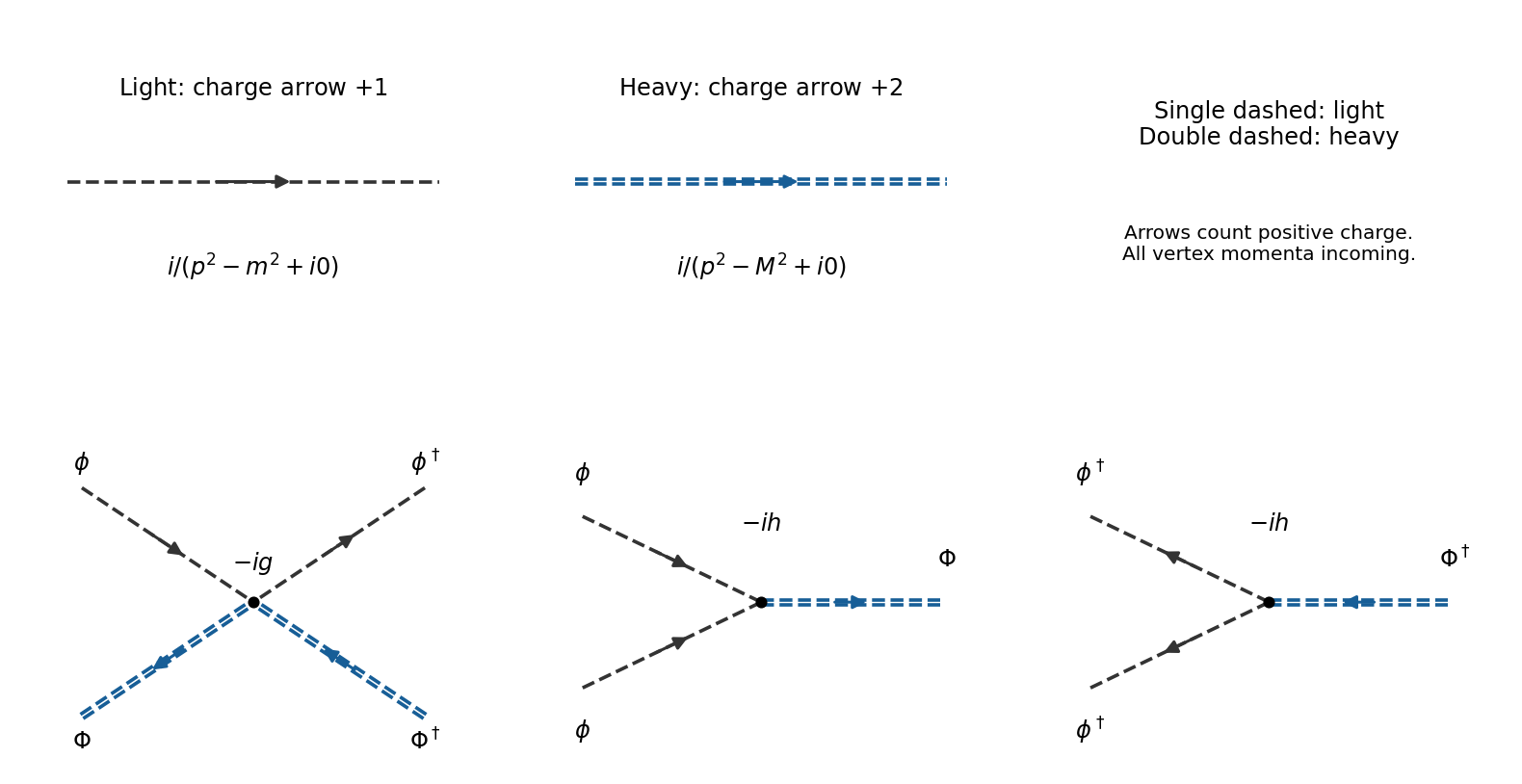
Charged scalar propagators and vertices, with arrows following positive conserved charge and heavy arrows carrying two units
. Details. 
The arrows in the figure follow positive Noether charge: a light arrow carries one unit and a heavy arrow two. Consequently a heavy particle travels opposite its charge arrow, whereas its antiparticle travels along it. At a Feynman vertex, two unit-charge arrows enter and a two-unit arrow leaves; the conjugate Feynman vertex reverses every arrow. The quartic Feynman vertex has one incoming and one outgoing arrow of each weight. These rules prevent attaching a propagator between two unconjugated fields.
Articles by others on the same topic
There are currently no matching articles.