In either exterior region of the finite square well, the time-independent Schrödinger equation reduces to , since . Its general solution is a linear combination of and . On the left, grows as and cannot be a square-integrable function, so its coefficient must be zero. On the right, the excluded growing term is . Hence the surviving tails are for and for .
Inside the well, and the equation becomes , whose general solution is . ThusThe coefficients are initially independent; wavefunction matching at a finite potential step imposes the remaining relations. Here the paper's is the exterior decay constant and is the interior oscillation constant.
For an even function, the interior sine term must vanish, because sine is odd and cosine is even. Comparing reflected exterior tails at any gives . Hence the parity condition alone isIt does not yet impose the matching condition on . Continuity at , when imposed in the next part, additionally gives .
At a finite jump in potential energy, the wavefunction and its first derivative must be continuous. A jump in the derivative would create a Dirac delta function in , for which the finite potential has no balancing term. For the even solution, matching at givesA nonzero solution cannot have . It also cannot have : the first condition would give , while the second would force , a contradiction. Division is therefore valid and yieldsParity makes the conditions at identical to those already imposed. Finally the definitions of the decay and oscillation constants giveThe circle relation fixes the well strength; the tangent relation selects its even bound states.
Write . On the first tangent branch, , the matching relations are equivalent toThe function is continuous and strictly increasing there:The intermediate value theorem therefore gives a unique first-branch root for every . At this root and , so the energy eigenvalueobeys . This proves the even bound state in every attractive square well result.
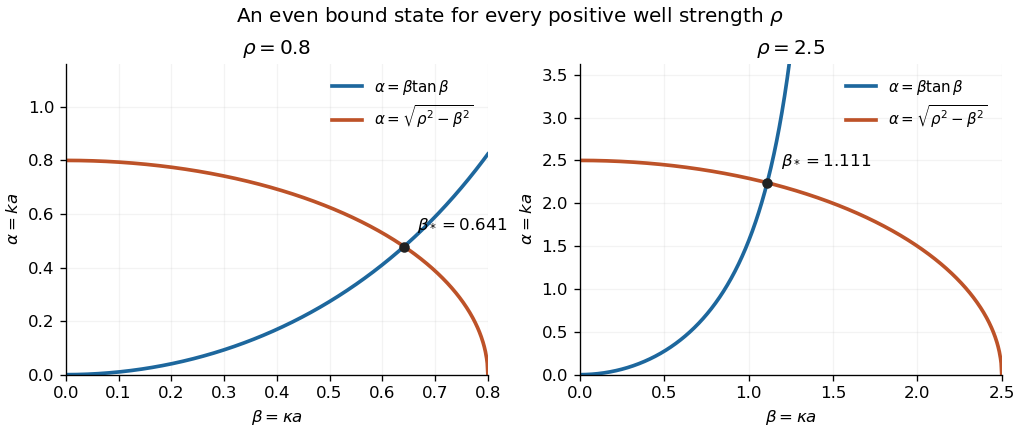
Even-state matching in a finite square well: the rising tangent branch meets the decaying circle for shallow and deeper wells
. Details. 
To verify all the requested properties, take the resulting even wavefunction with exterior tails written in terms of their boundary values:The matching equation makes both the values and first derivatives agree at the endpoints. The exterior tails are square-integrable because , and the interior interval is finite. More explicitly,so choosing as the positive inverse square root of the bracket gives wavefunction normalization. Thus an even, continuously differentiable, normalizable stationary solution always exists, however small the positive depth.
Articles by others on the same topic
There are currently no matching articles.