Source: released examination archive, member
FOI-20210708-1 - Data/a13761w1 (4).pdf, four pages, 15 June 2015. All three questions and nineteen terminal parts are answered below. Oxford's published policy excludes odd-year solutions other than 2019; a bounded search found no advertised answers to this exact paper.The time-independent Schrödinger equation is the energy eigenvalue equation for the Hamiltonian operator:Here is the reduced Planck constant. A corresponding stationary wavefunction evolves as , which follows by substitution in the Time-dependent Schrödinger equation. Its position probability density is time independent because the time factor has unit modulus. Physical energy eigenstates must also satisfy the system's boundary conditions; for a bound state, wavefunction normalization requires .
Define the reflected function . The chain rule gives and . Evaluating the time-independent Schrödinger equation for at and using the even function identity givesThus reflection preserves the energy eigenvalue. The same substitution in the norm givesThis is the action of the parity operator , which is a unitary operator. For a reflection-symmetric physical problem it preserves the Hamiltonian operator's operator domain as well as its differential expression.
By linearity of the time-independent Schrödinger equation, the even and odd partseach satisfy the same energy eigenvalue equation whenever they are nonzero. They obey and , so they have definite parity. At least one is nonzero, and . Each nonzero part can be normalized separately.
Therefore a basis of stationary solutions can be chosen to have definite parity, and solving the even and odd sectors loses no energy eigenvalues. This does not assert that every possible quantum superposition has definite parity; a superposition of the two sectors need not. For one-dimensional bound states in the usual regular setting, nondegeneracy of one-dimensional bound states further implies that each individual energy eigenstate has definite parity.
In either exterior region of the finite square well, the time-independent Schrödinger equation reduces to , since . Its general solution is a linear combination of and . On the left, grows as and cannot be a square-integrable function, so its coefficient must be zero. On the right, the excluded growing term is . Hence the surviving tails are for and for .
Inside the well, and the equation becomes , whose general solution is . ThusThe coefficients are initially independent; wavefunction matching at a finite potential step imposes the remaining relations. Here the paper's is the exterior decay constant and is the interior oscillation constant.
For an even function, the interior sine term must vanish, because sine is odd and cosine is even. Comparing reflected exterior tails at any gives . Hence the parity condition alone isIt does not yet impose the matching condition on . Continuity at , when imposed in the next part, additionally gives .
At a finite jump in potential energy, the wavefunction and its first derivative must be continuous. A jump in the derivative would create a Dirac delta function in , for which the finite potential has no balancing term. For the even solution, matching at givesA nonzero solution cannot have . It also cannot have : the first condition would give , while the second would force , a contradiction. Division is therefore valid and yieldsParity makes the conditions at identical to those already imposed. Finally the definitions of the decay and oscillation constants giveThe circle relation fixes the well strength; the tangent relation selects its even bound states.
Write . On the first tangent branch, , the matching relations are equivalent toThe function is continuous and strictly increasing there:The intermediate value theorem therefore gives a unique first-branch root for every . At this root and , so the energy eigenvalueobeys . This proves the even bound state in every attractive square well result.
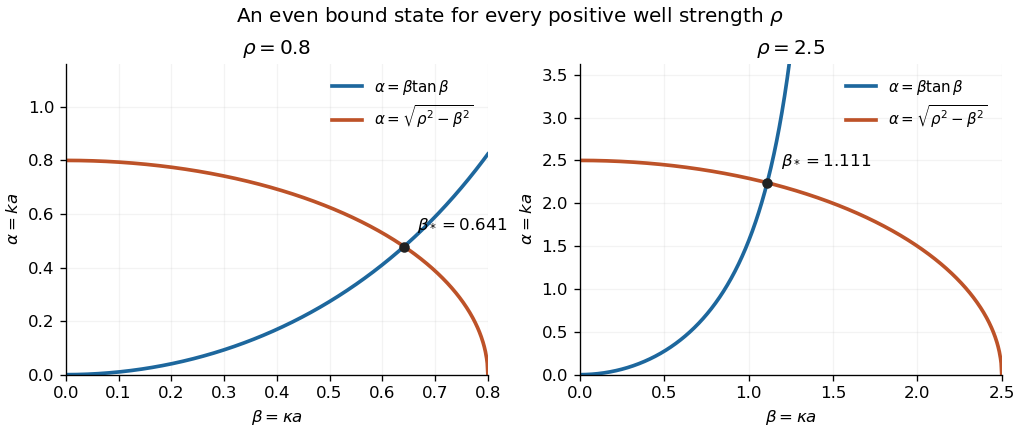
Even-state matching in a finite square well: the rising tangent branch meets the decaying circle for shallow and deeper wells
. Details. 
To verify all the requested properties, take the resulting even wavefunction with exterior tails written in terms of their boundary values:The matching equation makes both the values and first derivatives agree at the endpoints. The exterior tails are square-integrable because , and the interior interval is finite. More explicitly,so choosing as the positive inverse square root of the bracket gives wavefunction normalization. Thus an even, continuously differentiable, normalizable stationary solution always exists, however small the positive depth.
The position operator and momentum operator are self-adjoint operators, so the adjoint operator isUse the canonical commutation relation with the order of factors preserved:Subtracting the first product from the second provesThese creation and annihilation operators are unscaled and carry the paper's phase convention; their commutator is not the unit-normalized oscillator commutator.
From and the commutator product rule,Consequently, if ,Thus the creation operator raises the energy eigenvalue by , and the annihilation operator lowers it by , provided the resulting vector is nonzero. The zero vector is not an eigenstate; in particular the ground state will be annihilated by . The displayed operator identity holds even in that case.
The squared norm is obtained by moving the adjoint operator to the other side of the inner product:For an energy eigenstate, this isSince a squared norm is nonnegative, every nonzero energy eigenstate has . Moreover exactly when .
Write . Repeated application of the annihilation operator lowers the energy eigenvalue in steps of . The lower bound from part (ii) forces this process to stop. To see why it also quantizes the starting energy, writeThe first lowering steps have positive squared norms. If , the next step is also nonzero by part (ii), and its energy would be , contradicting the bound. Thus , andExistence of the ground state can also be checked directly in the position representation. The equation iswhose solution is proportional to . This Gaussian function is square-integrable, so it gives an actual ground state. Its normalization can be chosen using the Gaussian integral.
All the displayed levels occur: for a nonzero state at ,Thus repeated raising creates a nonzero energy eigenstate at every .
Let have energy and put . The lowering norm formula gives, inductively,In particular is a nonzero ground state. By the assumed nondegeneracy, it equals for some .
It remains to show that raising this vector recovers , rather than merely another state at the same energy. On an energy eigenstate at , factorization gives . Iterating the factorization down the ladder yieldsApplying to therefore provesFor this is the original ground-state assumption. This proves nondegeneracy propagated by an oscillator ladder: every energy eigenspace is one-dimensional if the ground state is nondegenerate.
If , it has energy , distinct from the energy of . Eigenstates of a self-adjoint operator with distinct eigenvalues are orthogonal. Explicitly,so . If , the same conclusion is immediate.
Dividing by and using the definition of givesBoth expectation values are real because and are self-adjoint operators. Its real and imaginary parts therefore vanish separately:An oscillator energy eigenstate is centered in both position and momentum, despite having nonzero quantum uncertainties.
Twice applying the creation operator or twice applying the annihilation operator changes the energy eigenvalue by , unless they give zero. The same orthogonality argument as in part (i) therefore givesAlso the factorization in part (a) givesNow and . Squaring in the correct operator order yieldsBy part (i), the means are zero, so these are the variances. Taking positive square roots gives the requested standard deviations:These harmonic-oscillator number-state second moments also show equal mean kinetic energy and potential energy, each . Their uncertainty product is , so the ground state saturates the Heisenberg uncertainty relation.
Introduce the reduced radial wavefunction . Multiplying the radial Schrödinger equation for a central potential by givesFor the decaying bound state, take and put . Differentiation yieldsSince , the two constant multiples of cancel. Dividing by the nonzero exponential givesThis separates the large-radius exponential decay from the remaining Coulomb bound state equation.
Apply the Frobenius method at the origin. The lowest power in is , with coefficientThe terms and start at power and therefore cannot cancel a nonzero coefficient. Because , the indicial equation isIts roots are and . Since , their leading behaviors are respectively and . The physical choice isThis is the Coulomb radial origin condition. For , the other branch is not even locally normalizable: its radial probability integral behaves as , which diverges.
For , the singular behavior is locally square-integrable with the measure , so local wavefunction normalization alone would not reject it. The ordinary three-dimensional Coulomb potential problem additionally requires the regular boundary condition . A branch violates that condition and has divergent kinetic energy integral . Thus it is excluded from the physical energy domain as well. The regular choice gives in every case.
For brevity write . With the physical indicial root , substitute into the equation from part (i). The coefficient of isThe indicial equation has already canceled the still lower power . Rearranging gives the recurrence relationIts denominator is for every .
To impose wavefunction normalization at infinity, first suppose that the series never terminates. ThenThis is the exponential-series growth associated with , which would overwhelm the factor in . A direct lower-bound argument makes the conclusion precise. All sufficiently late recurrence ratios are real and positive, so after a common global phase choice the tail coefficients have one sign. For any , there is an index such thatInduction then bounds the tail below by a positive multiple ofThe finitely many earlier terms form a polynomial and cannot cancel this exponential growth. Thus grows at least as a positive multiple of for large , contradicting wavefunction normalization. This proves that the regular series must terminate.
Since the denominator never vanishes, termination requires the numerator to vanish at some nonnegative integer :Then and every later coefficient is zero. Consequently is a polynomial of degree , with a factor ; equivalently,where has degree . This is series-termination quantization of the Coulomb radial equation. If denotes the principal quantum number, the associated energy eigenvalues areHere counts the degree of the remaining radial polynomial; it is not the principal quantum number itself.
The smallest energy eigenvalue in part (iii) occurs at the smallest possible principal quantum number, . Since , this forces and . Therefore , andFor the spherically symmetric ground state, the full three-dimensional wavefunction normalization uses . Integrating over the solid angle givesPut and use the supplied factorial integral:Thus . Choosing the positive global phase convention givesThis is the radial normalization of the hydrogen ground state convention in which the angular factor is absorbed into the spherically symmetric function. If instead one writes with the normalized spherical harmonic , then . Both conventions describe the same normalized three-dimensional quantum state.
The radial probability density includes the spherical-shell volume factor:Consequently the radial expectation value isKeeping and fixed, the hydrogenic ground-state radius scaling is therefore : the state has half the mean radius of the state. Equivalently, with , the mean radii are and . For the physical electron-nucleus Coulomb potential, is the Bohr radius of the fixed-nucleus hydrogen atom model.
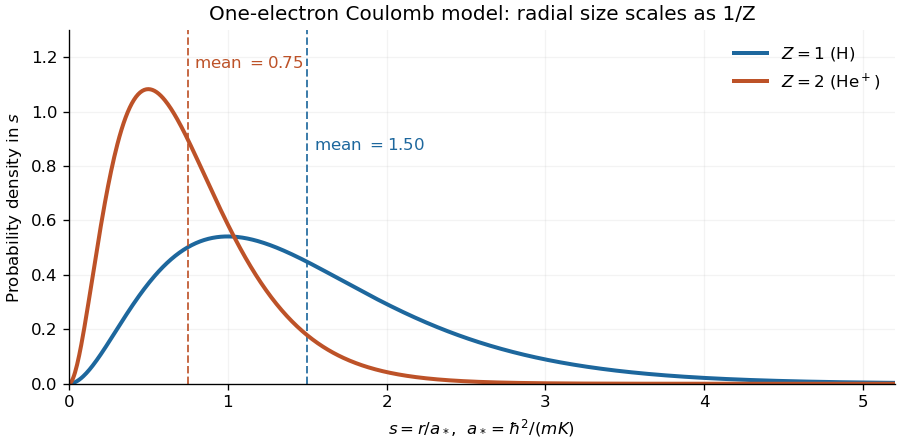
Radial probability densities for the one-electron and Coulomb bound states; dashed lines mark their mean radii
. The horizontal coordinate is . The normalized densities are , so their means are . Details.
The exact comparison in this one-electron model describes the hydrogen-like ion . A neutral helium atom has two electrons; its exact size also depends on their mutual Coulomb interaction and is not determined by this one-electron calculation. The stated half-radius conclusion is the prediction of the model supplied in the paper.
Articles by others on the same topic
There are currently no matching articles.