Take a smooth variation . Differentiating the functional at zero gives the first variationIntegrate the second term once and the third term twice by integration by parts:Choose variations supported away from the endpoints. Stationarity and the fundamental lemma of the calculus of variations forceThis is the Euler-Lagrange equation for a second-derivative functional. With the interior equation imposed, the remaining boundary expression must vanish for every admissible variation.
At each endpoint, a freely varying value requires , and a freely varying slope requires . A fixed value or slope instead makes its corresponding variation zero and supplies no natural condition for that variable. These are the natural boundary conditions for second-derivative functionals, with the value and slope variations treated independently.
Here , , and . The Euler-Lagrange equation for a second-derivative functional is thereforeWrite . After imposing the clamped conditions at zero, the general solution isFree right endpoint. Both endpoint variations are free, so the natural boundary conditions for second-derivative functionals give . Since and , they give , . HenceRight endpoint with fixed height and free slope. Now is imposed, while the free slope gives . These equations yield and , soBoth endpoints clamped. The right conditions are , giving , . ThusEach formula has fourth derivative and satisfies all four boundary conditions of its case. The three endpoint choices therefore change the integration constants, not the interior differential equation.
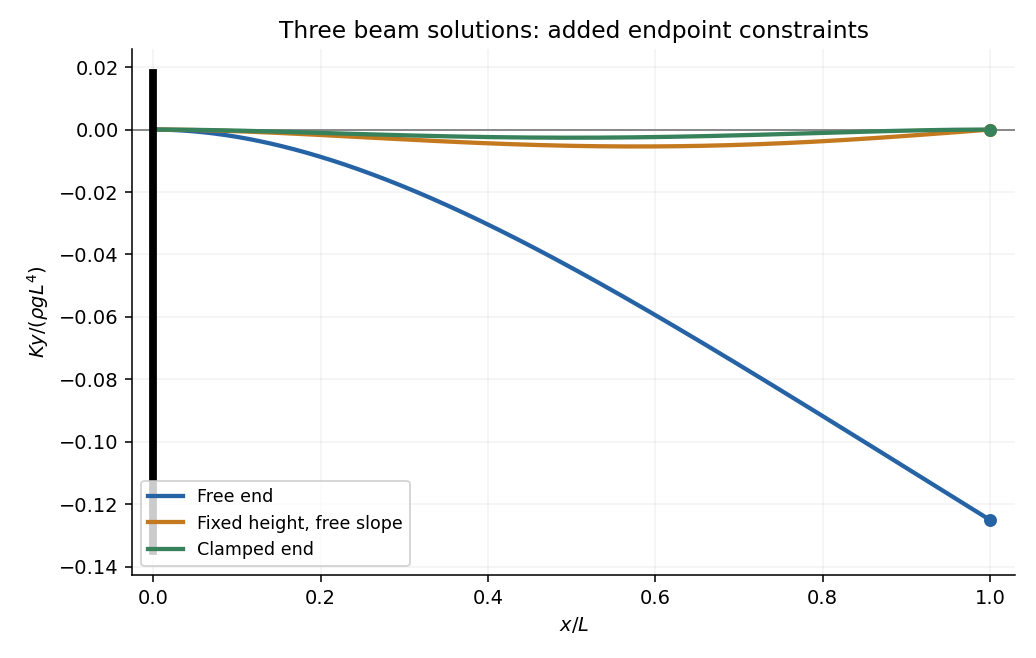
Elastic beam deflections under three right-end boundary conditions
. Original dimensionless plots of the three quartic solutions. Each beam is clamped horizontally at the left. Requiring the right height, then the right slope as well, progressively restricts the admissible deflections. Details.
The sets of admissible functions are nested:All impose the same left conditions; the right height adds a restriction, and the right slope adds another. Minimizing the same functional over a smaller set cannot lower its minimum. ThereforeThe doubly clamped beam has the greatest minimum energy, and the free-ended beam the smallest. No energy integrals are needed. In fact the inequalities are strict: the positive quadratic bending term makes the minimizer unique on the left-clamped space, and the three solutions in part (b) are different. The relevant principle is monotonicity of a constrained minimum under added constraints.
Articles by others on the same topic
There are currently no matching articles.