Use the chain rule along a sufficiently smooth extremal of the functional. For ,The bracket vanishes by the Euler-Lagrange equation. When has no explicit dependence, , giving the Beltrami identity:
For the specified functional,Since , the Beltrami identity gives for some . This suggests a circular arc, but it is worth deriving its equation without dividing by : such division would lose the point where the arc is horizontal.
Substitute the displayed partial derivative and in the full Euler-Lagrange equation. Combining terms over the common denominator givesThus , so and a second integration givesThis establishes the semicircular extremals of the hyperbolic length functional and excludes constant , which would satisfy the first-order Beltrami identity for a suitable but not the full Euler-Lagrange equation.
The two prescribed endpoints giveSubtracting yields . ThereforeIn particular the centre is . Admissibility requires , as the prescribed heights must lie in . Under that condition the radicand is positive throughout : it is a concave quadratic polynomial whose two endpoint values are and . The positive root consequently gives one smooth admissible arc, uniquely determined by the endpoints.
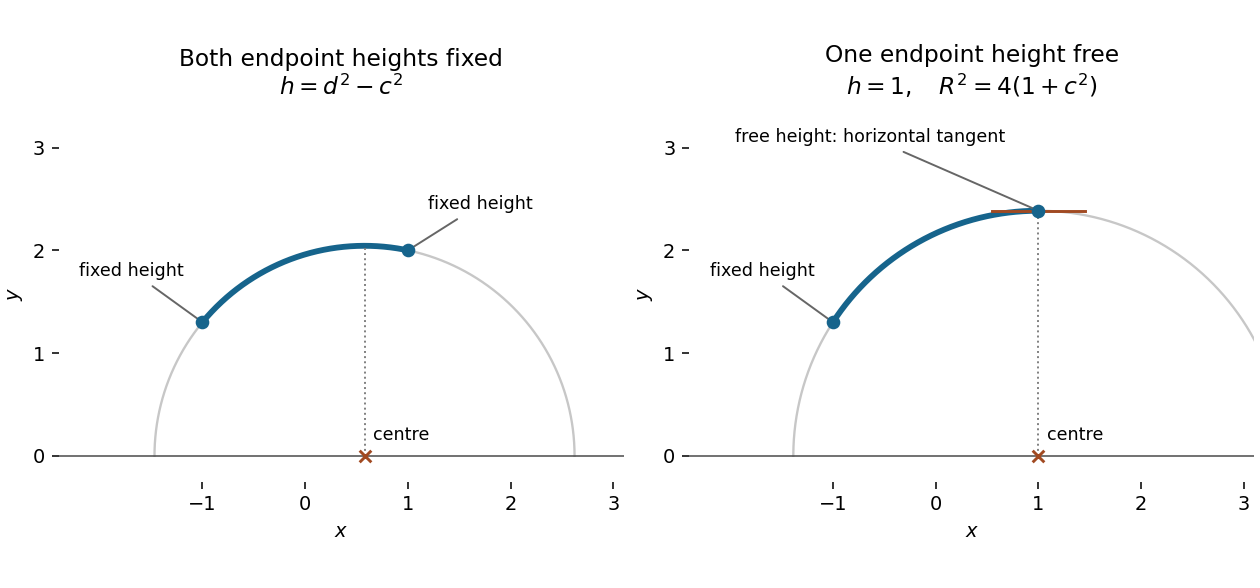
Fixed endpoint heights determine the circle centre; a free endpoint height forces a horizontal tangent
. Details. 
When an endpoint's horizontal coordinate is fixed but its height is free, the natural boundary conditions for a free endpoint require there. In this problem,Every admissible extremal is an upper circular arc with centre on , by part (b). Its tangent is horizontal precisely above its centre. Thus imposing the natural boundary conditions for a free endpoint at forces . The fixed height at gives , soIts free endpoint height is . Positivity on the whole interval follows because the radicand is at least .
There can be no solution satisfying the natural boundary conditions for a free endpoint at both ends: an upper circular arc has only one point with a horizontal tangent, whereas the two endpoints have distinct horizontal coordinates. Therefore
Articles by others on the same topic
There are currently no matching articles.