Let be the gravitational acceleration, and let denote positive downward depth. For a frictionless particle released from rest, conservation of energy gives . The arc length element of is , so the travel time and length areFor a finite-time single arch, require in , , and interpret the endpoint integrals improperly. At a regular constrained minimizer with , the Lagrange multiplier rule for an isoperimetric constraint makes stationary. Dropping the constant givesFor the constraint is regular under interior variations: if its first variation vanished for every compactly supported variation, the Euler-Lagrange equation for would force constant, hence and , a contradiction. Thus the multiplier is justified for a nondegenerate arch.
The printed case is degenerate. Since , equality of the length with the horizontal separation forces and . A particle initially at rest then has no tangential gravitational acceleration and cannot complete the trip. Its travel time is infinite. The finite-time calculation therefore concerns , with endpoint regularity qualified below.
Set and . Since there is no explicit dependence, the Beltrami identity says is constant along a stationary curve. One can verify it directly:by the Euler-Lagrange equation. Here , soThis identity applies on the open arch where . The constant is finite by evaluating at any interior point. Near an endpoint , hence everywhere on such an arch. Thus also throughout it.
With , setThen the first integral gives . On the descending and ascending halves of the physical track choose respectively and , so that . Solving for givesThe unsquared equation requires . At this says ; it is not permissible to retain other values merely because the displayed formula for has a squared denominator.
For completeness, the Euler-Lagrange equation also gives . Thus decreases through zero exactly once, so the chosen parameter runs through the whole single arch without an extra branch. Differentiating the formula for and dividing by gives, continuously also at ,Using yieldsSince , the arc length is obtained by cancelling one factor of in . The conditions and becomeThese determine a unique parameter pair for each . To see uniqueness, regard as the expected value of under a probability density function proportional to on . Differentiation under the integral sign gives the covariance identityThe first argument decreases with and the second increases. The strict sign follows by applying to two independent unequal values and averaging; the integrable endpoint singularity of causes no problem. As , the weight concentrates at , so . As , endpoint estimates give numerator and denominator , so . Continuity then covers every . At one recovers the cycloid and .
Smoothness qualification. Near ,and the other endpoint has . These are smooth graphs on , not graphs on the closed interval. Indeed a finite endpoint slope would make the conserved diverge as . The travel time remains finite becauseThus the printed phrase “smooth solution” must be understood on the interior, with improper endpoint limits. The variational calculation supplies necessary stationary arches; it does not by itself prove global minimality in every larger class of tracks.
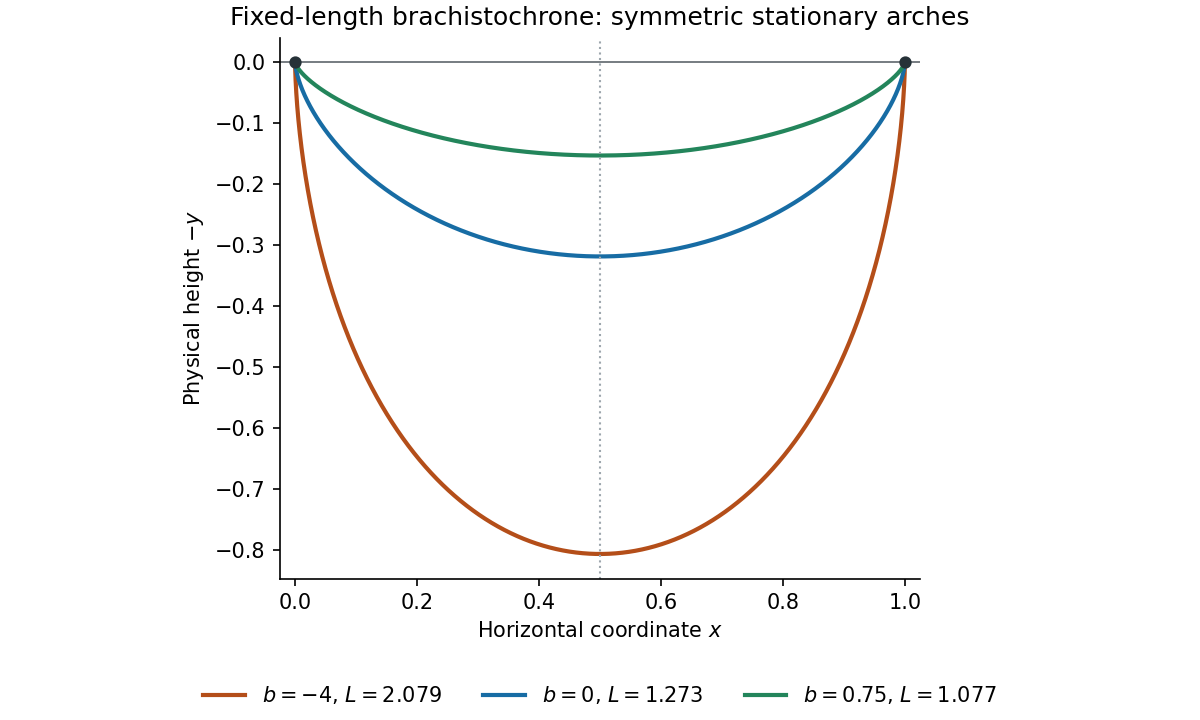
Put . Since , both and . Using in the integral for givesHence the physical track is symmetric about , with . For , , andis positive before and negative after . Therefore the physical height has its unique minimum at , withThe depth has a maximum there. This proves the intended claim for every finite-time member ; has the degeneracy described in (a).

Articles by others on the same topic
There are currently no matching articles.