The per-capita net growth rate is . Thus is the low-density per-capita birth or recruitment rate, is the constant per-capita death or removal rate, and controls density-dependent suppression of recruitment. Both and have units of inverse time; has units of inverse population squared. The population scale halves the recruitment rate from its low-density value. Larger makes suppression important at smaller population sizes. These are interpretations of this phenomenological population dynamics model, rather than independently specified biological mechanisms.
Write . A steady state is a nonnegative zero of . If , the bracket is strictly negative for every , so only exists. If , there are exactly two nonnegative steady states,For an autonomous scalar ordinary differential equation, a steady state with is locally asymptotically stable, while one with is unstable. HereAt the positive steady state, use to obtainTherefore zero is stable for and unstable for , whereas the positive steady state is stable whenever it exists. At the omitted equality , ; zero is nonhyperbolic but still attracts every nonnegative initial state.
Linearizing at the positive steady state gives , so a small displacement decays as . The recovery time of a stable equilibrium is thereforeAs with fixed, and . Thus the equilibrium population approaches extinction and recovers increasingly slowly after small perturbations. This is critical slowing down. Exactly at the threshold the leading equation is , which gives algebraic decay instead of exponential recovery.
For , the sign of is positive on and negative on . Its graph passes through , has positive initial slope , and eventually behaves like . The phase line therefore points toward from both sides.
The vector field is continuously differentiable, so solutions are unique. No positive solution crosses either equilibrium; one starting below increases and stays below it, and one starting above it decreases and stays above it. These bounded solutions exist for all forward time and have a limit. By continuity of , any such limit must be a zero of : otherwise the derivative would stay bounded away from zero near the limit. The increasing solution is bounded below by its strictly positive initial value, excluding zero; the decreasing one stays above . ConsequentlyThe solution starting exactly at is constant. The zero initial condition remains at zero, which is why positivity is stipulated.
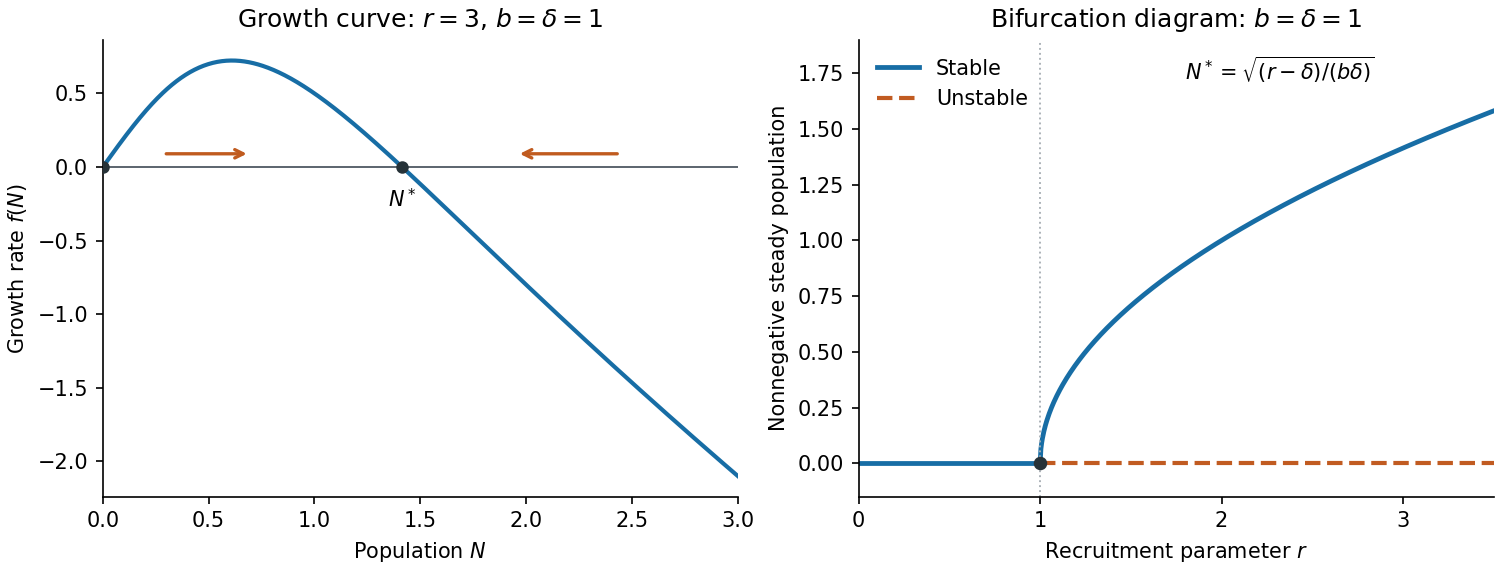

The nonnegative bifurcation diagram has the branch for every , stable for and unstable for . At the stable positive branch emerges:The figure in (iv) uses solid curves for stable steady states and a dashed curve for the unstable zero branch. At the meeting point the zero steady state is nonhyperbolic and attracts from the nonnegative side. If the equation is formally extended to negative , there is also the symmetric branch , giving a supercritical pitchfork bifurcation; its negative half is omitted in the biological diagram. This qualification avoids calling the single nonnegative square-root branch a full pitchfork by itself.
Articles by others on the same topic
There are currently no matching articles.