Singularities. The complex exponential factors as . The second factor has an essential singularity at zero, and multiplication by the nonvanishing holomorphic function does not remove it. There are no other finite singularities. On the Riemann sphere, infinity is also an essential singularity, since .
Symmetry and integral formula. The identity and uniqueness of the Laurent series on give for every integer . The Laurent coefficient formula, on the positively oriented unit circle, givesThe imaginary part vanishes by the substitution . Hence
Polynomial contour integral. For an integer and integer , the binomial theorem gives . The residue theorem selects , that is . Therefore the correct complete statement isThe printed nonnegative-integer condition alone misses . For example satisfies that condition, but the integral is zero and the displayed factorial is undefined.
Explicit coefficients. Both Taylor series inconverge absolutely and uniformly on every compact annulus away from zero, so their product can be regrouped. For , put and . For arbitrary integer , use the already proved symmetry:Here is a modified Bessel function. The printed series is directly meaningful for ; for negative the absolute values, or an appropriately shifted lower summation limit, are essential.
Conformality and analyticity. Use the orientation-preserving convention for a conformal map, with a continuously differentiable, nonzero differential. Its Jacobian matrix must be a positive scale times a rotation,Thus , , the Cauchy-Riemann equations; continuous partial derivatives then imply that is a holomorphic function. If angle preservation is allowed to reverse orientation, the statement needs this qualification: preserves unsigned angles but is an anticonformal map and is not a holomorphic function.
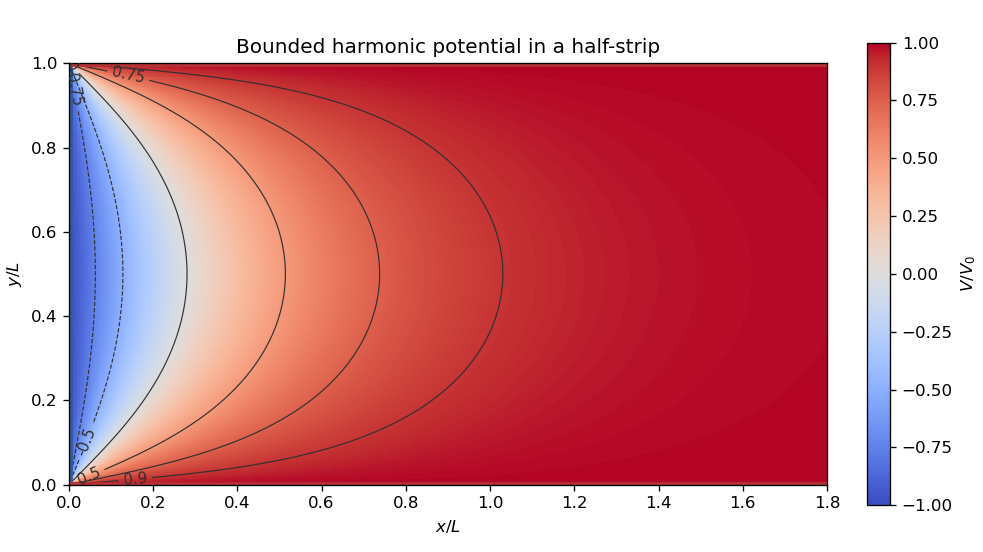
The mapping. Put . The displayed components combine to giveIts derivative does not vanish in the open half-strip , , so it is a conformal map there. Also . The lower edge maps to , the upper edge to , and the vertical edge to . The open half-strip maps bijectively onto the upper half-plane. Indeed, implies ; the half-strip allows only equality. Surjectivity follows by solving and choosing the root with and . The two corners are boundary critical points, not interior failures of conformality.
Transformed boundary values. A conformal map preserves Laplace's equation up to a positive scale. Thus the transformed Dirichlet problem is to find a real harmonic function on withThe conflicting values at the original corners are interpreted as one-sided edge limits.
Logarithmic solution. Choose the complex logarithms of with arguments between zero and in the upper half-plane. A linear combination is a complex-valued harmonic function, since it is a holomorphic function; the real physical potential must be a real or imaginary part. In particular, setThenOn the three real boundary intervals, the argument difference is respectively , which gives the required values. This is the bounded harmonic solution, with at infinity; uniqueness holds in this bounded class by the maximum principle. Without a boundedness or far-field condition, the edge data alone do not give uniqueness: one may add .
Back substitution. Sincethe required continuous argument difference is in the open half-strip. ConsequentlyAs with , the arctangent tends to zero; as with , it tends to . These limits verify every open edge of the Dirichlet problem.

Singularities and cuts. There are four simple poles , , because the roots of are simple and do not coincide with . At , the local behavior is a nonzero constant times : these are square-root branch points. Infinity is not a branch point; on either branch , so it extends there with a zero of order five. Three valid choices of branch cuts are the segment , the two rays joined through infinity, or a semicircular arc joining to and avoiding the poles. A circuit about either endpoint changes the sign, while a circuit about both endpoints does not.
Branch and residues. On , let be the branch with at infinity, and define . Its upper boundary value on is positive. The residue at a simple pole isFor fully explicit values, putIn counterclockwise order , the values of are . Since , substitution yieldsA branch point has no ordinary residue, since it has no single-valued Laurent series on a punctured neighborhood. At infinity the residue is zero.
Contour evaluation. The original contour goes counterclockwise around a large circle and clockwise round the slit, with its upper lip directed to the right. The large-circle contribution is . Small endpoint arcs contribute . The artificial slit extension from to has equal boundary values on both sides, so its contributions cancel. On the two boundary values of are opposite. Thus, with denoting the requested real integral, the residue theorem givesTherefore
Articles by others on the same topic
There are currently no matching articles.