Use transverse coordinates (x,x′) and a signed focusing strength K in Hill's equation, x′′+Kx=0. A drift of length ℓ has beam transfer matrixFor a uniform focusing quadrupole magnet with K=κ2>0, and a defocusing one with K=−κ2,The focusing plane has oscillatory trajectories, while the defocusing plane has hyperbolic growth and decay. A magnetic quadrupole focuses one transverse plane and defocuses the other; reversing its gradient interchanges their roles.
D(ℓ)=(10ℓ1).
QF(ℓ)=(cosκℓ−κsinκℓsin(κℓ)/κcosκℓ),QD(ℓ)=(coshκℓκsinhκℓsinh(κℓ)/κcoshκℓ).
If ∣K∣ℓ2≪1 and the element's internal drift can be neglected or assigned separately, its kick may be concentrated at one position. With 1/f=∣K∣ℓ,Both kicks preserve position and change the slope linearly with displacement. All these ideal uncoupled maps have determinant one.
F=(1−1/f01),G=(11/f01).
Maps act on column vectors, so the first element appears at the right of the product. Starting immediately before the focusing kick, one full cell hasMultiplying givesIt has detMx=1, as required for this lossless linear beam optics. The other transverse plane experiences the opposite quadrupole signs, soThe two planes have different envelopes but the same trace and therefore the same stable phase-advance magnitude for this equal-strength doublet.
Mx=D(L2)GD(L1)F.
Mx=(1−L1/f−L1L2/f2−L1/f2L1+L2+L1L2/f1+L1/f).
My=Mxf→−f=(1+L1/f−L1L2/f2−L1/f2L1+L2−L1L2/f1−L1/f).
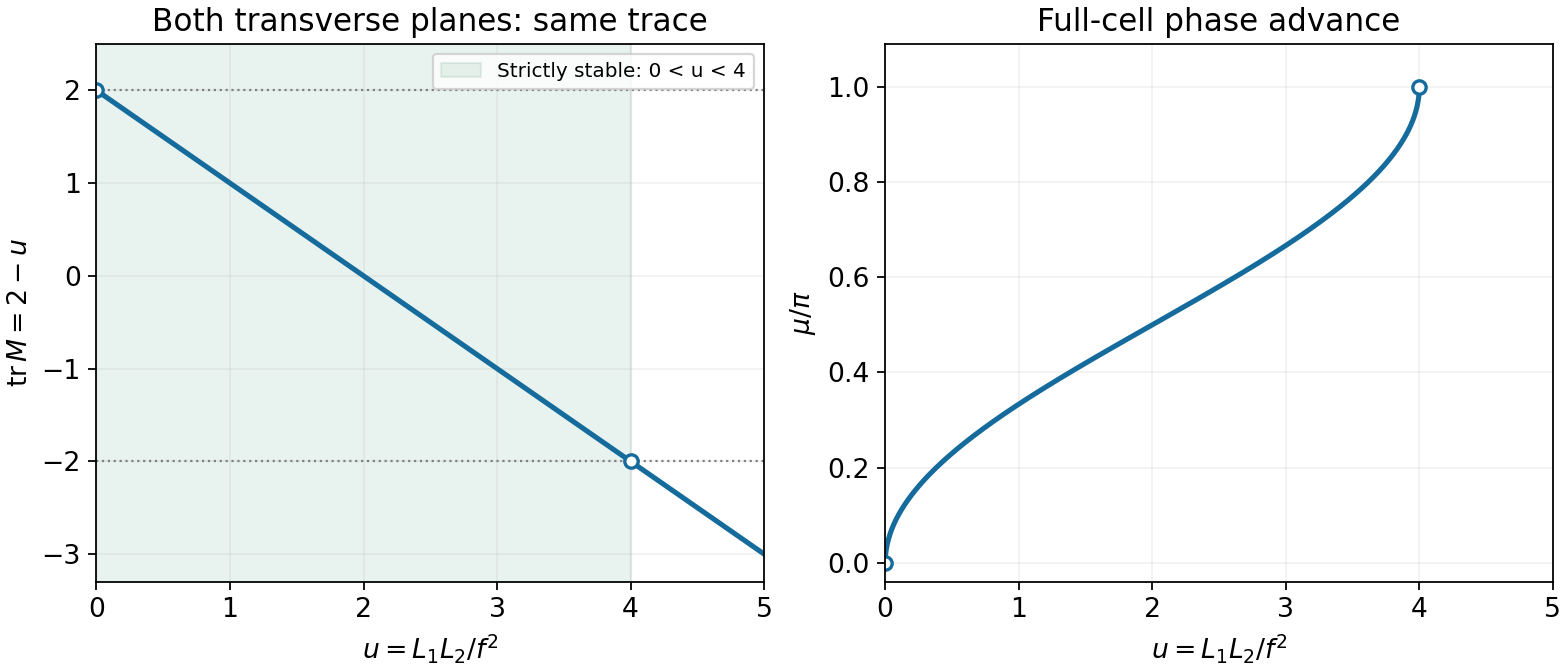
For a real determinant-one map, bounded generic repeated transport requires eigenvalues e±iμ, equivalently ∣trM∣<2. Here both planes have trM=2−L1L2/f2, soFor positive drift lengths and f>0, this means f>L1L2/2. The equalities are marginal and generally produce a Jordan-block growth rather than stable motion. Moving the reference point changes the map by a similarity transformation, M→PMP−1, so the eigenvalues and full-cell phase advance are unchanged.
0<f2L1L2<4,cosμ=1−2f2L1L2.
Write the stable map using the Courant-Snyder parameters, also called Twiss parameters:At the chosen reference point β=M12/sinμ, α=(M11−M22)/(2sinμ), and γT=−M21/sinμ. Repeated traversal givesIf the full ring contains Nc identical cells, its one-turn phase is Ncμ modulo 2π; n ring turns use nNcμ. The displayed Mn is for n repetitions of the specified cell.
M=(cosμ+αsinμ−γTsinμβsinμcosμ−αsinμ),βγT−α2=1.
Mn=(cosnμ+αsinnμ−γTsinnμβsinnμcosnμ−αsinnμ).

Ancestors (10)
- S19
- 2012
- Past exam of the short options paper shared by Prelims and Parts A and B of the physics course of the University of Oxford
- Short options paper shared by Prelims and Parts A and B of the physics course of the University of Oxford
- Physics course of the University of Oxford
- Undergraduate course of the University of Oxford
- Course of the University of Oxford
- University of Oxford
- List of universities
- Home
Discussion (0)
New discussionThere are no discussions about this article yet.
Articles by others on the same topic (0)
There are currently no matching articles.