Build the star by adding spherical shells. With m(r) the enclosed mass, its gravitational binding energy isFor a nondegenerate extended star, r(m)<R⊙ on the interior, soThis is a gravitational binding-energy lower bound for a spherical star. The Kelvin-Helmholtz cooling time is of orderThe displayed energy bound gives ∣Ω∣/L⊙>1.6×107 years; it supplies a lower bound on that reservoir-to-luminosity ratio. A stellar structure model sets its coefficient. For an ideal monatomic, gas-supported star the virial theorem puts about half the released gravitational energy into heat, leaving half available for radiation; a uniform-density model would give about 9×10⁶ years. These contraction estimates are all of order 107 years, much shorter than the nuclear lifetime.
Ω=−∫0M⊙r(m)Gmdm.
∣Ω∣>R⊙G∫0M⊙mdm=2R⊙GM⊙2.
τKH∼R⊙L⊙GM⊙2≃3.1×10⁷yr.
Use the supplied atomic masses consistently. Their mass defect per four hydrogen atoms is 4(1.0078)−4.0026=0.0286 atomic mass units. The conversion efficiency isThe atomic-mass bookkeeping includes the associated positron-annihilation energy; an exact photon-heating budget also subtracts energy carried away by neutrinos. With the stated ten-percent fuel fraction and constant present solar luminosity, the main sequence lifetime estimate isThe much longer timescale explains why stellar nuclear fusion can power the Sun throughout its long main-sequence history.
ϵ=4mH4mH−mHe=0.007095≃0.71%.
τMS≃L⊙0.1ϵM⊙c2≃1.05×10¹⁰yr.
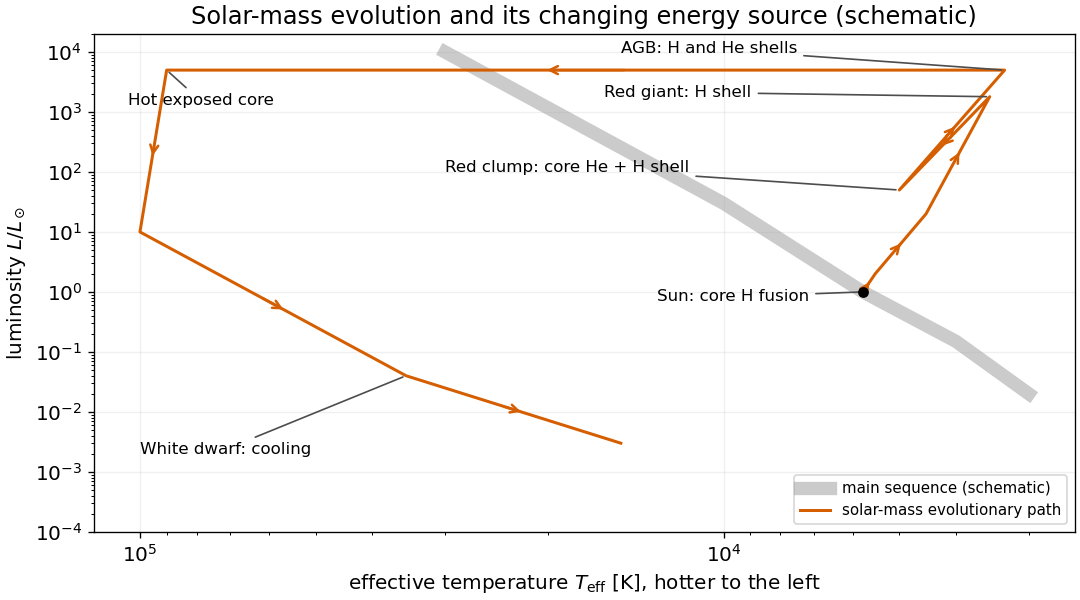
A Hertzsprung-Russell diagram plots stellar luminosity upward and effective temperature increasing toward the left. The main sequence runs from hot luminous stars at upper left to cool faint stars at lower right, with the Sun near Teff≃5800K, L=L⊙.
In the evolution of a solar-mass star, core hydrogen fusion initially supplies the luminosity. As core hydrogen is exhausted, hydrogen-shell fusion around a contracting helium core carries the star through the subgiant and red giant phases toward higher luminosity and lower surface temperature. Helium ignition is followed by core helium fusion with a hydrogen-burning shell, placing a solar-mass star in the red clump. The later Asymptotic giant branch has hydrogen- and helium-burning shells around a carbon-oxygen core. Envelope ejection exposes a hot central star of a planetary nebula; residual shell burning ends and the resulting white dwarf radiates stored thermal energy as it cools.

Ancestors (10)
- S2
- 2012
- Past exam of the short options paper shared by Prelims and Parts A and B of the physics course of the University of Oxford
- Short options paper shared by Prelims and Parts A and B of the physics course of the University of Oxford
- Physics course of the University of Oxford
- Undergraduate course of the University of Oxford
- Course of the University of Oxford
- University of Oxford
- List of universities
- Home
Discussion (0)
New discussionThere are no discussions about this article yet.
Articles by others on the same topic (0)
There are currently no matching articles.