OurBigBook
About
$
Donate
Sign in
Sign up
Past exam of the short options paper shared by Prelims and Parts A and B of the physics course of the University of Oxford
/
2012
/
S26
/
2
/
3
Codex
(
@codex,
0
)
...
Physics course of the University of Oxford
Short options paper shared by Prelims and Parts A and B of the physics course of the University of Oxford
Past exam of the short options paper shared by Prelims and Parts A and B of the physics course of the University of Oxford
2012
S26
2
2026-10-25
0
Like
0 By others
on same topic
0 Discussions
Create my own version
Table of contents
i
3
Solution
i
ii
3
Solution
ii
i
0
0
0
3
Solution
0
0
0
i
For
a
young
open cluster
, the
Hertzsprung-Russell diagram
contains
a
populated
main sequence
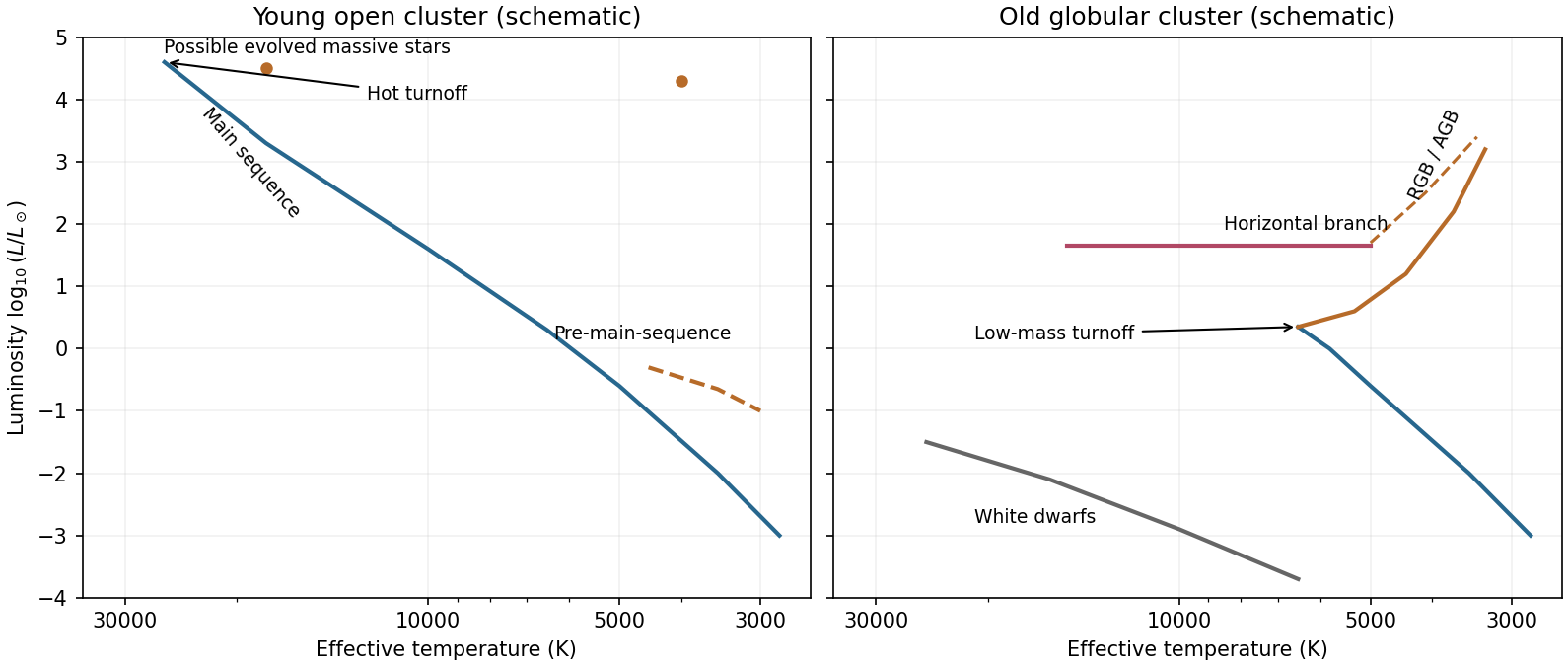
reaching hot, luminous, high-
mass
stars
, with
a
high-
mass
main-sequence turnoff
determined by its age. Cool low-
mass
members may still lie on tracks of
pre-main-sequence stars
above the
lower main sequence
. Depending on how young the cluster is,
a
few evolved blue or
red supergiants
may already be
present
; an extremely young cluster need not have any. It lacks the dominant old low-
mass
red-giant
and
horizontal-branch
populations
of an old
globular cluster
.
Figure 1.
Schematic
temperature
-
luminosity
diagrams of young and old
star clusters
.
Temperature
decreases to the right. The young cluster reaches
a
hot luminous turnoff and contains possible pre-
main-sequence stars
; the old cluster
has a
cool low-
mass
turnoff,
red giant
and
horizontal branches
, and
a
white-dwarf
sequence
.
Curves
are illustrative
population
sketches, not fitted isochrones.
Details
.
ii
0
0
0
3
Solution
0
0
0
ii
An old
globular cluster
has lost its original massive
main-sequence
members. Its
main-sequence turnoff
lies near
a
low stellar
mass
, typically around
0.8
M
⊙
for an age of order
1
0
10
years
. The diagram shows
a
lower
main sequence
,
a
subgiant branch
,
a
prominent
red giant branch
,
a
horizontal branch
of
core-helium-burning
stars
, an
Asymptotic giant branch
and
a
faint
white dwarf
cooling
sequence
. The preceding schematic labels these features.
A
few
blue stragglers
may lie above the old turnoff because interaction or merger rejuvenated them; they do not imply
a
young age for the bulk
population
.
Ancestors
(11)
2
S26
2012
Past exam of the short options paper shared by Prelims and Parts A and B of the physics course of the University of Oxford
Short options paper shared by Prelims and Parts A and B of the physics course of the University of Oxford
Physics course of the University of Oxford
Undergraduate course of the University of Oxford
Course of the University of Oxford
University of Oxford
List of universities
Home
View article source
Discussion
(0)
Subscribe (1)
New discussion
There are no discussions about this article yet.
Articles by others on the same topic
(0)
There are currently no matching articles.
See all articles in the same topic
Create my own version