An absorption line depends on the population of its lower atomic level, ionization state, transition strength, pressure and broadening, not just elemental abundance. Boltzmann distribution changes excitation populations with temperature, while the Saha equation changes ionization with temperature and electron pressure. Thus similar overall composition can produce very different spectra. Molecules survive preferentially in cool atmospheres.
The Harvard spectral classification orders the main stellar classes by decreasing effective temperature: O, B, A, F, G, K, M, from blue to red. Numerical subclasses run approximately from 0, the hotter end of a class, to 9, its cooler end. An A0 star, near 104K, has very strong Balmer series lines; hotter stars ionize much of the hydrogen and cooler stars underpopulate its n=2 level. A G2 star, near 5800K, has weaker Balmer absorption, many neutral and ionized metal lines, prominent Ca II H and K lines and the CH G band. An M5 star, near 3000K, has strong TiO molecular bands, neutral-metal and alkali features, and weak photospheric Balmer absorption.[ref]
https://voyages.sdss.org/expeditions/expedition-to-the-milky-way/spectral-types/absorption-and-emission-lines/. temperature sequence and characteristic atomic or molecular features
For giant and dwarf stars of the same colour, compare gravity-sensitive line widths and ratios. The giant's larger radius gives lower surface gravity and atmospheric pressure, typically narrower pressure-broadened lines; high-pressure dwarf atmospheres have stronger broad alkali wings and different molecular and ionization ratios. These diagnostics assign a luminosity class, such as III for a giant and V for a dwarf. A line ratio or calibrated gravity indicator is stronger evidence than colour alone.
A 1M⊙ star spends roughly 1010 years on the main sequence, deriving most of its luminosity from the proton–proton chain. After central hydrogen depletion, shell hydrogen burning around a contracting helium core expands it into a red giant. The low-mass helium core becomes electron-degenerate before the helium flash. Subsequent core helium burning by the Triple-alpha process, with alpha capture producing oxygen, lasts of order 108 years.
After central helium exhaustion, hydrogen and helium shells burn around a carbon-oxygen core on the Asymptotic giant branch. Strong mass loss removes the envelope, potentially making a planetary nebula, and the remnant becomes a carbon-oxygen white dwarf. It cools using stored thermal energy and does not ignite sustained carbon burning. Detailed durations depend on composition and mass loss; the nuclear endpoint of the isolated solar-mass model is a white dwarf.
A 5M⊙ star has a much greater luminosity and exhausts central hydrogen in roughly 108 to 2×10⁸ years, mainly through the CNO cycle. It crosses the Hertzsprung gap, develops shell hydrogen burning and ignites core helium without the strongly degenerate helium flash of the solar-mass case. Core helium burning lasts roughly 107 years, with possible blue-loop evolution depending on the model.
It subsequently develops a carbon-oxygen core and double-shell burning on the Asymptotic giant branch, with thermal pulses, winds and envelope loss. For ordinary isolated evolution at this mass, the core does not reach sustained carbon ignition and the final remnant is a carbon-oxygen white dwarf. The broad boundary between white-dwarf and core-collapse outcomes depends on composition, overshooting, rotation and mass loss; the quoted mass is comfortably in the usual intermediate-mass regime.
A 15M⊙ star burns core hydrogen chiefly by the CNO cycle for about 107 years. It commonly evolves towards a red supergiant, though winds and mixing alter its track. Core helium burning lasts of order 106 years. Continued contraction then permits carbon, neon, oxygen and silicon burning, producing successively heavier nuclei up to an iron-group core. Neutrino cooling makes the advanced phases much shorter: carbon burning can last thousands of years, while the final burning stages fall to years or days, with substantial model dependence.
An iron-group core cannot gain energy by ordinary fusion into heavier nuclei. Electron captures, photodisintegration and loss of pressure support lead to stellar core collapse. A core-collapse supernova can eject the envelope and leave a neutron star; strong fallback or a failed explosion can instead produce a black hole. The massive-star endpoint involves core collapse, rather than the quiet carbon-oxygen white-dwarf cooling of the two lower-mass examples.
For a young open cluster, the Hertzsprung-Russell diagram contains a populated main sequence reaching hot, luminous, high-mass stars, with a high-mass main-sequence turnoff determined by its age. Cool low-mass members may still lie on tracks of pre-main-sequence stars above the lower main sequence. Depending on how young the cluster is, a few evolved blue or red supergiants may already be present; an extremely young cluster need not have any. It lacks the dominant old low-mass red-giant and horizontal-branch populations of an old globular cluster.
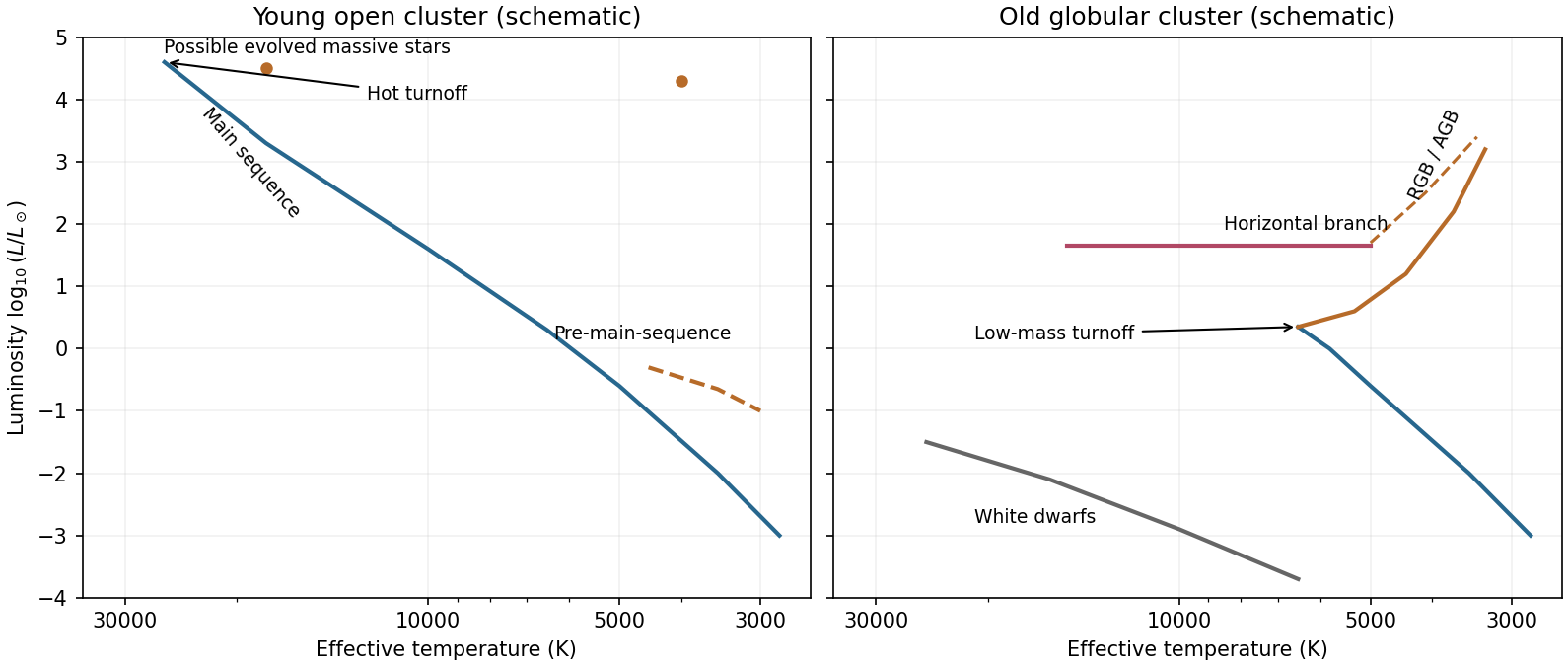

An old globular cluster has lost its original massive main-sequence members. Its main-sequence turnoff lies near a low stellar mass, typically around 0.8M⊙ for an age of order 1010 years. The diagram shows a lower main sequence, a subgiant branch, a prominent red giant branch, a horizontal branch of core-helium-burning stars, an Asymptotic giant branch and a faint white dwarf cooling sequence. The preceding schematic labels these features. A few blue stragglers may lie above the old turnoff because interaction or merger rejuvenated them; they do not imply a young age for the bulk population.
Assume homologous, gas-pressure-supported main sequence stars with nearly constant composition and mean molecular weight μ, radiative energy transport and approximately constant opacity κ. Hydrostatic and mass scalings giveThe radiative diffusion equation gives the luminosity scalingTherefore, under these explicit assumptions,The radius cancels. Radiation-pressure dominance in the most massive stars changes the relation towards the Eddington luminosity scaling L∝M, so the cubic law is an idealized gas-pressure homology result rather than an exact universal massive-star law.
Pc∼R4GM2,ρc∼R3M,Tc∼kBRμmuGM.
L∼κacρcRTc4∝κμ4M3.
L∝Mk,k=3.
The trigonometric parallax gives d=1/0.02=50pc. Neglecting extinction, the distance modulus and given bolometric correction giveUsing the specified solar bolometric magnitude,The mass estimate uses the cubic scaling normalized to solar values. A lifetime estimate additionally needs the fraction of fuel accessible to core burning. Take a core-accessible fraction fc=0.1 and initial hydrogen mass fraction X=0.7. The supplied fusion energy givesThe alternative common solar-lifetime normalization t≃1010(M/M⊙)/(L/L⊙) years gives 1.69×10⁹ years. Thus this simplified turnoff argument gives an age of order 109 years, with its fuel fraction and mass-luminosity assumptions explicitly stated. It does not use a modern fitted Hyades age or a full stellar isochrone. Unresolved binaries, extinction and deviations from the homology law affect the estimate.
MV=5.3−5log10(50/10)=1.80515,Mbol=MV−0.1=1.70515.
L⊙L=100.4(4.6−1.70515)≃14.39,M⊙M≃(14.39)1/3≃2.43.
qH=4mp26.7MeV≃6.4×10¹⁴Jkg−1,tage∼LfcXMqH≃1.25×10⁹yr.
Ancestors (10)
- S26
- 2012
- Past exam of the short options paper shared by Prelims and Parts A and B of the physics course of the University of Oxford
- Short options paper shared by Prelims and Parts A and B of the physics course of the University of Oxford
- Physics course of the University of Oxford
- Undergraduate course of the University of Oxford
- Course of the University of Oxford
- University of Oxford
- List of universities
- Home
Discussion (0)
New discussionThere are no discussions about this article yet.
Articles by others on the same topic (0)
There are currently no matching articles.