Cells interconvert several forms of free energy. Chemical concentration differences and the chemical potentials of metabolites can drive reactions, including ATP hydrolysis. The usable free-energy difference is that between reactants and products under the actual cellular conditions; breaking a chemical bond alone does not release energy without the rest of the reaction. Oxidation-reduction reactions transfer electrons down an electrochemical potential difference and can drive ion pumping in an electron transport chain. Light absorption can create excited states and charge separation in photosynthesis, eventually supporting chemical synthesis.
An electrochemical gradient stores free energy in both an ion concentration difference and a membrane potential. Chemiosmosis couples downhill ion flow to ATP synthesis by chemiosmosis; ATP-powered pumps can run the conversion the other way. Molecular motors and other mechanochemical enzymes convert chemical free energy into mechanical work or elastic strain, while ion gradients can also power transport and rotary motion. These couplings conserve total energy but dissipate some free energy as heat. Equilibrium thermal fluctuations alone cannot sustain directional work without a maintained nonequilibrium resource.
Use number concentrations and write the electrochemical potential of a sodium ion as μ=μ∘+kBTlnc+eψ. Define the inward sodium-motive force as available work per positive charge for transport from outside to inside. With Vm=ψi−ψo,Its negative is the signed inward free-energy cost per charge; stating this direction removes a common sign ambiguity.
ENa=eμo−μi=ekBTlncico−Vm.
Long-open sodium channels establish electrochemical equilibrium, kBTln(ci0/co)+eVm0=0. This does not generally require equal concentrations: impermeant counterions can support a nonzero equilibrium membrane potential. Let n0=ci0V. For a large fixed-concentration external reservoir, after pumping n ions out, ci(n)=(n0−n)/V and Vm(n)=Vm0−ne/C. The sodium export cost from a capacitive vesicle for exporting another ion isThe initial-equilibrium relation was used in the last step. The first term is the incremental electrical cost and the second is the change in chemical cost from their initial balanced values.
ΔGNa(n)=kBTlnn0−ncoV−eVm0+Cne2=Cne2+kBTlnn0−nn0.
If the intended initial reference is uncharged with Vm0=0 and ci0=co, then n0=coV and the requested form in the listed variables isThat equal-concentration reference is an additional assumption. For example, ci0=2co and Vm0=−(kBT/e)ln2 also give zero initial sodium flux, but a different ion inventory. Thus the open-channel condition alone cannot determine n0 from coV. If concentrations are molar rather than number densities, use the corresponding Avogadro constant conversion and RT for molar free energies. Treating the capacitor charge discretely gives a charging-energy increment (n+1/2)e2/C rather than the differential ne2/C; the distinction is negligible for the thousands of ions used next.
ΔGNa(n)=Cne2+kBTlnco−n/Vco,0<n<coV.
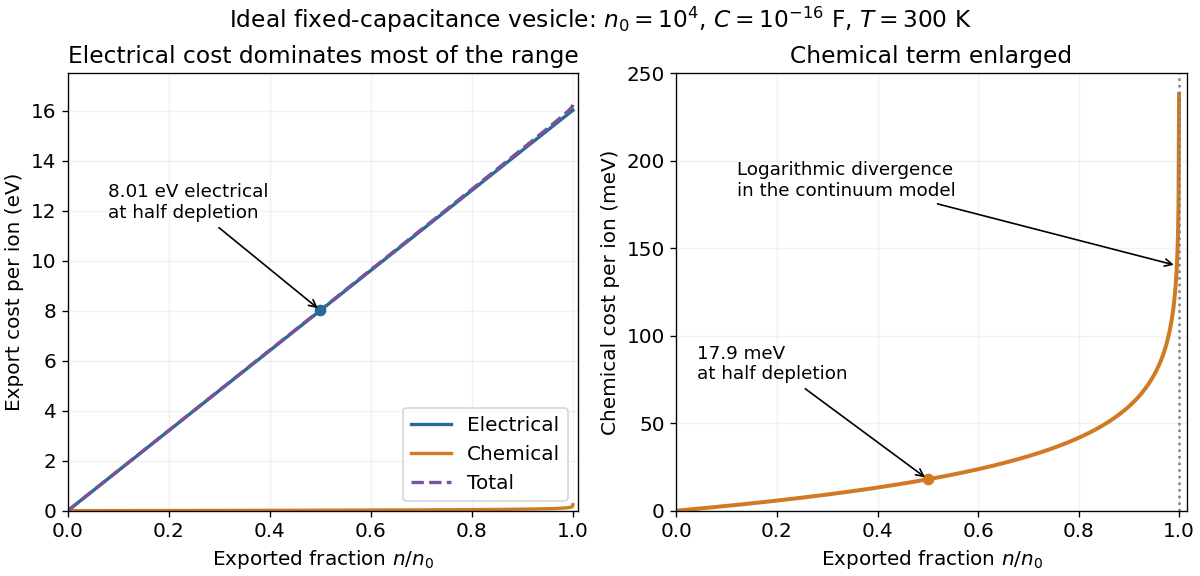
Use the initial equal-concentration, zero-potential reference, or equivalently quote component changes relative to the initial electrochemical equilibrium. At n=n0/2=5000, with C=10−16F,At room temperature T=300K, the chemical component isThe electrical cost dominates by about 447. The associated change in membrane potential is −ne/C=−8.01V. Such a large voltage is a consequence of the ideal fixed-capacitance, perfectly impermeable model; an actual lipid membrane would not generally remain intact and nonconducting over this entire extrapolation.
ΔGelec=C5000e2=1.28×10⁻¹⁸J=8.01eV.
ΔGchem=kBTln2=2.87×10⁻²¹J=0.0179eV.
The electrical component is a straight line through zero, ne2/C. The chemical component, kBTln[n0/(n0−n)], starts at zero, increases convexly, and diverges as n→n0− because the remaining internal concentration vanishes. Their sum lies above both: nearly electrical over most of the stated range, but eventually diverging with the chemical term. For a nonzero initial equilibrium potential, the separate absolute electrical and chemical components have opposite constant offsets; the total curve and the quoted changes remain the same. The final few ions require a discrete-particle treatment rather than a literal continuum divergence.

Ancestors (10)
- S12
- 2015
- Past exam of the short options paper shared by Prelims and Parts A and B of the physics course of the University of Oxford
- Short options paper shared by Prelims and Parts A and B of the physics course of the University of Oxford
- Physics course of the University of Oxford
- Undergraduate course of the University of Oxford
- Course of the University of Oxford
- University of Oxford
- List of universities
- Home
Discussion (0)
New discussionThere are no discussions about this article yet.
Articles by others on the same topic (0)
There are currently no matching articles.