Photosynthesis captures light energy and transforms it into chemical forms that a biological cell can use. In plants, algae and cyanobacteria, this supports carbon fixation: incorporation of carbon from carbon dioxide into chemical compounds used to build living material. Capturing light and incorporating carbon are distinct processes coupled through metabolism. See OpenStax Biology 2e, 8.1: overview of photosynthesis.
For oxygenic photosynthesis, a simplified net equation writes a six-carbon sugar, glucose, as the representative product:This is net stoichiometry, not a one-step mechanism. A worked bookkeeping check counts six carbon chemical atoms, twelve hydrogen chemical atoms, and eighteen oxygen chemical atoms on each side: the product side has six oxygen chemical atoms in the sugar and twelve in molecular oxygen. The light label supplies energy, not additional chemical atoms.
Crucially, the released molecular oxygen comes from water, not carbon dioxide. Cancelling water made and consumed in different steps hides this distinction in the net equation. The Calvin cycle supplies a net three-carbon triose phosphate, such as glyceraldehyde 3-phosphate, for subsequent sugar synthesis; it does not directly export glucose. See OpenStax Biology 2e, 8.2: light-dependent reactions and OpenStax Biology 2e, 8.3: using light energy to make organic molecules.
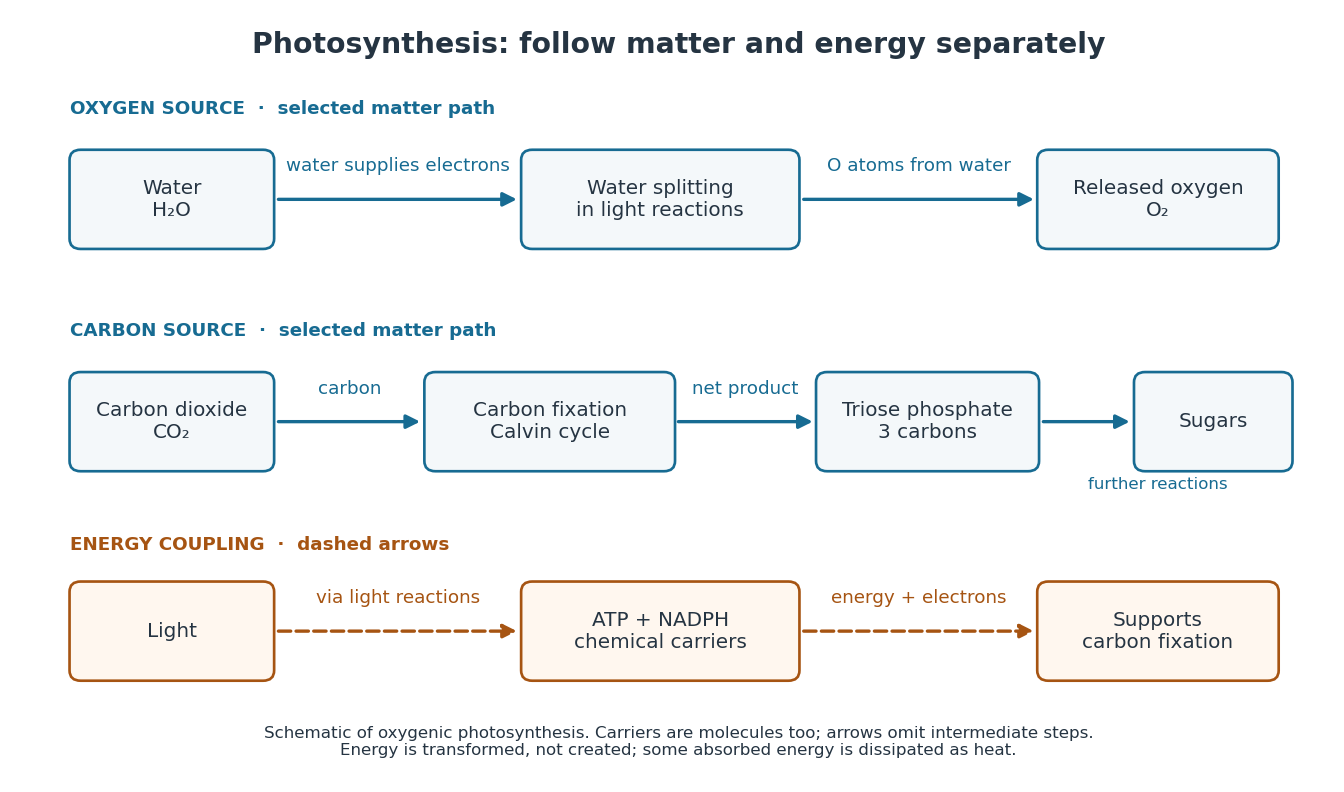
The useful achievement is connecting incoming light to both usable energy and new biological material. ATP is an immediate energy currency; NADPH supplies electrons for synthesis; carbon dioxide supplies the carbon incorporated into carbohydrates. These roles are complementary. Conservation of energy still holds: photosynthesis transforms energy, never creates it, and some absorbed energy is dissipated as heat. A plant also carries out cellular respiration, including in biological cells that perform photosynthesis. Gas exchange reflects both processes. Oxygenic photosynthesis remains central to interpreting terrestrial molecular oxygen as an atmospheric biosignature gas. See OpenStax Biology 2e, 8.3: photosynthesis and respiration.
Radiation in the approximate 400–700 nm interval conventionally counted for photosynthesis. Organisms differ in spectral use, so equal integrated light does not imply equal biological utility.
Adjustment of the composition, capacity or organization of photosynthetic machinery to prevailing conditions. It acts alongside faster regulation of existing components.
A light-associated reduction in photosynthetic capacity, often involving damage and recovery processes. It should be distinguished from rapidly reversible protective energy dissipation.
Processes limiting light-induced damage when absorbed excitation exceeds safe photochemical use. Energy dissipation, regulated electron flow and repair have complementary roles.
Light-dependent movement of chloroplasts within plant cells. Accumulation can increase interception under weak light, whereas avoidance can reduce exposure under strong light.
The pigment–protein machinery converting excitation into separated redox equivalents. Productive charge separation competes with decay of the excited state.
A pigment–protein assembly collecting light and transferring excitation towards a photosynthetic reaction centre. Excitation transfer between pigments differs from electron transfer after charge separation.
Conductance for gas exchange through stomata, influencing carbon uptake and water loss. Responses to carbon dioxide and atmospheric dryness can affect growth and water-use efficiency.
Total photosynthetic carbon uptake over the stated area and interval, before subtraction of producer respiration.
A measurable signal used to investigate the state of the photosynthetic machinery. Recovery after drying can be informative, but should be complemented by measurements of growth and reproductive success.
A photosynthetic state transition redistributes excitation between photosystems in response to their relative activity. In plants, regulated phosphorylation of a mobile LHCII fraction helps alter its functional association with the two photosystems.
Photorespiration is the metabolic route processing products of Rubisco oxygenation and recovering part of their carbon. It consumes energy and releases some carbon dioxide; under particular conditions it also provides a sink for energy and reducing power.
Cyclic electron flow around photosystem I returns photosystem-I-derived electrons to the intersystem electron-transport chain. It can support proton-gradient formation without net NADPH production, helping adjust ATP supply and photoprotection.
Photosynthetic control refers to regulation of electron flow, especially lumen-pH-dependent restriction at the cytochrome b6f complex. Slowing electron delivery can protect downstream acceptors from excessive reduction.
The xanthophyll cycle reversibly changes antenna-associated xanthophyll composition with light conditions. Lumen-acidification-dependent de-epoxidation towards zeaxanthin can support photoprotective quenching in plants.
Non-photochemical quenching describes pathways that reduce chlorophyll fluorescence through routes other than photochemical charge separation. Rapid protective components can dissipate excitation as heat, but a fluorescence decrease alone does not uniquely identify the pathway.
Oxygenic photosynthesis uses water as an electron source and releases molecular oxygen. Plants, algae and cyanobacteria provide examples. The defining distinction from anoxygenic photosynthesis is molecular oxygen release, not merely capture of light.
Anoxygenic photosynthesis captures light without producing molecular oxygen. It occurs in some bacteria and uses electron sources other than water. Whether carbon fixation accompanies this light capture depends on the organism and conditions; photosynthesis does not imply one universal carbon-assimilation pathway. See Alberts et al.: chloroplasts and photosynthetic bacteria.
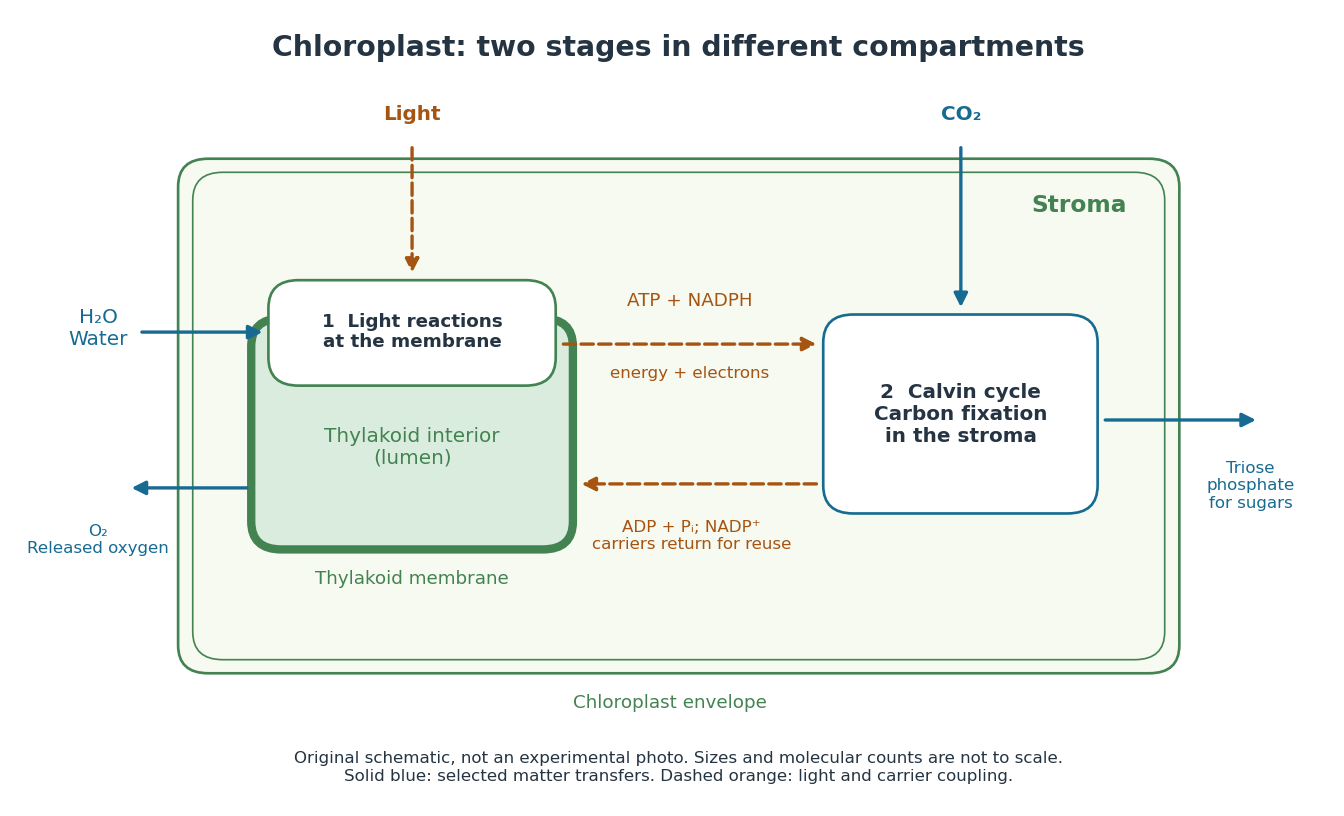
In a chloroplast, light-dependent reactions take place at thylakoid membranes. Chlorophyll captures light; electron transfer helps establish an electrochemical gradient across the thylakoid membrane, enabling formation of ATP. The oxygenic photosynthesis pathway also forms NADPH and releases molecular oxygen from water. ATP and NADPH become available in the chloroplast stroma for the Calvin cycle. See Alberts et al.: chloroplast light reactions.
An organized light-harvesting and reaction-center assembly supporting photosynthetic energy conversion.
Photosystem I is a light-driven reaction-centre complex in oxygenic photosynthesis. Excitation supports electron transfer to acceptors including ferredoxin; the balance between linear and cyclic routes affects reductant and ATP supply.
A photosystem involved in water oxidation during oxygenic photosynthesis. Its reaction-center components include D1 protein.
The manganese–calcium-containing catalytic machinery that extracts electrons from water in oxygenic photosynthesis. Four oxidizing equivalents permit formation of one oxygen molecule from two water molecules.
LHCII is a major light-harvesting antenna complex in plants. A regulated mobile fraction participates in photosynthetic state transitions; antenna redistribution is distinct from simply dissipating excitation.
PsbS participates in rapid proton-dependent regulation of photosynthetic antenna quenching in plants. Loss of PsbS-dependent quenching can be separated experimentally from loss of light-harvesting capacity.
Processes replacing damaged photosystem II components and restoring functional complexes. Regulated D1 protein synthesis is one part of this cycle.
A reaction-center protein of photosystem II, encoded by psbA messenger RNA in chloroplast expression systems. Damage creates demand for replacement during photosystem II repair.
Chlorophyll is a family of molecules that absorb light for photosynthesis. In chloroplasts, chlorophyll works with proteins in thylakoid membranes; absorbing light initiates energy capture rather than directly constructing a sugar. See OpenStax Biology 2e, 8.2: photosynthetic pigments.
A widespread photosynthetic pigment with prominent blue and red absorption bands. Its concentration is a useful index of phytoplankton biomass, but pigment per unit carbon varies with light acclimation and physiological condition.
Articles by others on the same topic

Photosynthesis is a biochemical process by which green plants, algae, and some bacteria convert light energy, usually from the sun, into chemical energy stored in glucose and other organic compounds. This process is essential for life on Earth, as it is the primary means by which energy enters the ecosystem. It also generates oxygen as a byproduct, which is vital for the respiration of most living organisms.



It is quite cool that photosynthesis works just like cellular respiration by producing a proton potential through chemiosmosis.