The one-dimensional Time-dependent Schrödinger equation isThe left side generates time evolution; the two terms on the right are the kinetic and potential parts of the Hamiltonian operator. For a time-independent potential and an energy eigenstate, set ψ(x,t)=ϕ(x)e−iEt/ℏ. Cancelling the time factor gives the time-independent Schrödinger equation, −ℏ2ϕ′′/(2m)+Vϕ=Eϕ.
iℏ∂tψ=[−2mℏ2∂x2+V(x)]ψ.
By the Born rule, ∣ψ∣2dx is the position probability in an interval of width dx, with ∫∣ψ∣2dx=1 for a normalized particle. Therefore [ψ]=length−1/2 in one dimension. An ideal scattering plane wave instead uses flux normalization and is not itself a normalizable single-particle state on the whole line.
The reflection-one result describes a semi-infinite potential step, rather than a finite-width barrier. Define k=2mE/ℏ and κ=2m(V0−E)/ℏ. For E>0, takeThe growing exponential is excluded by boundedness as x→∞. Continuity of ϕ and ϕ′ at the finite step gives 1+r=c and ik(1−r)=−κc, henceThe probability current of the decaying tail is zero; the reflected and incident currents have equal magnitude. This agrees with the classical reflection coefficient even though the spatial wave function differs from a classical trajectory.
ϕ(x)={eikx+re−ikx,ce−κx,x<0,x>0.
r=k+iκk−iκ,c=k+iκ2k,R=∣r∣2=1.
On the incident side, ϕ is the superposition of incoming and reflected waves, producing a standing-wave pattern whose travelling-wave de Broglie wavelength is λ=2π/k. On the forbidden side, it decays exponentially and remains nonzero near the boundary. A sketch should therefore show oscillations for x<0, a continuous function and slope at zero, and the evanescent tail for x>0 beside the potential step.
The quantum distinction is finite probability density inside the classically forbidden region, despite complete reflection. There is no transmitted flux at arbitrarily large positive x for this semi-infinite step. A finite-width barrier would allow quantum tunnelling, a different boundary-value problem.
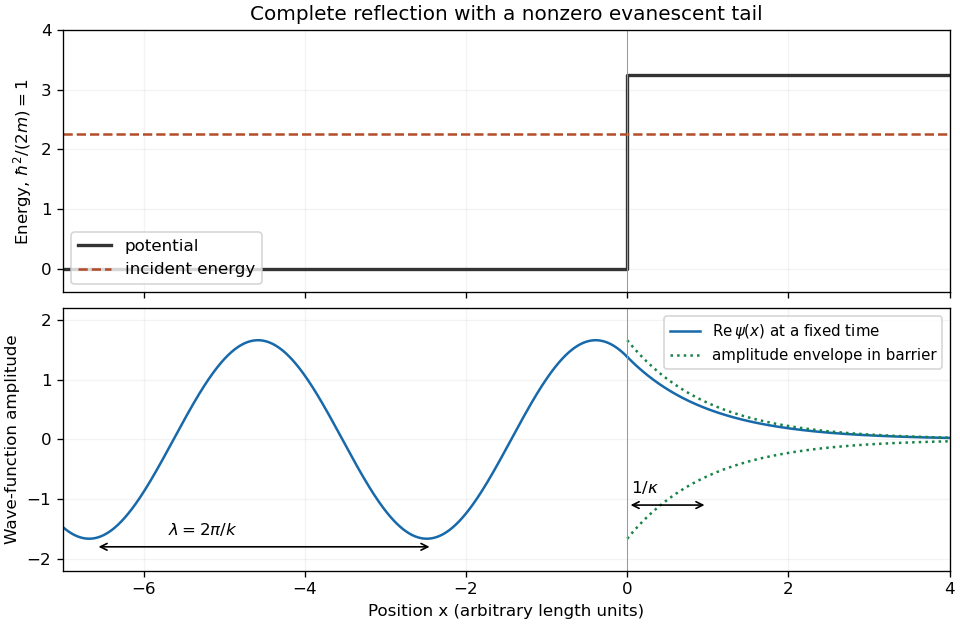
The wave-function amplitude decays as e−κx, so its e-folding penetration depth isThe probability density decays as e−2κx and has the smaller e-folding depth 1/(2κ). Specifying which quantity decays avoids a factor-of-two ambiguity in the term penetration depth.
Δx=κ−1=2m(V0−E)ℏ.
A stationary evanescent wave does not assign a classical trajectory or a real local speed inside the forbidden region. The dwell time in a semi-infinite potential step measures probability stored in x>0 divided by incident probability current. For incident amplitude one,This gives a time in terms of m,E,V0 through the definitions of k,κ. A simpler dimensional estimate is the penetration length divided by the incident speed, Δx/vin=m/(ℏkκ)=ℏ/[2E(V0−E)]. The dwell time equals (2E/V0) times that estimate. Different operational timing definitions need not agree; treating the imaginary under-barrier momentum as a real particle velocity would not justify a unique traversal time.
τD=ℏk/m∫0∞∣c∣2e−2κxdx=ℏκ(k2+κ2)2mk.
Using m≃4mp and T=15meV, the nonrelativistic de Broglie wavelength and speed areFor the square interferometer, the enclosed area projected into a vertical plane is a2sinθ. The gravitational phase shift in matter-wave interferometry is Δφ=mga2sinθ/(ℏv) to leading order in the small gravitational energy change. Thus rotation from horizontal to vertical changes the fringe count byOne way to see the phase is that the horizontal arms differ in gravitational potential energy by mgasinθ for a flight time a/v. Which-path detection entangles the atom with distinguishable detector states. If those states are orthogonal and the path record is ignored, their coherence is lost and the interference fringes disappear. This is a loss of interference visibility, not a change in the atom's de Broglie wavelength.
λ=2mTh≃1.17×10⁻¹⁰m,v≃8.48×10²ms−1.
N=hvmga2≃1.17×10³,NMoon≃1.95×10².
For the macroscopic mass,The ideal fixed-momentum expression tends to infinity as v→0. An everyday localized object is not a perfectly coherent momentum eigenstate, however: its thermal and environmental momentum uncertainty remains nonzero, and decoherence rapidly suppresses spatially separated coherent alternatives. Merely setting the mean velocity to zero does not prepare an object with a macroscopic coherence length.
λ=mvh=2(33)6.626×10⁻³⁴≃1.00×10⁻³⁵m.
For a uniformly illuminated single slit of width w, the far-field amplitude is proportional to sinu/u, with u=πwsinϑ/λ. Its first zeros occur at sinϑ=±λ/w. If the quoted peak width is the full width between those zeros, the small-angle geometry givesThe Fraunhofer diffraction approximation is appropriate since w2/(λL)≪1. If the supplied width instead meant a half-width or full width at half maximum, its numerical conversion factor would differ; the displayed answer states the first-zero convention explicitly.
Δy≃w2Lλ,w≃Δy2Lλ≃2.3×10⁻⁸m.
The normalized linear polarization state is ∣θ⟩=cosθ∣H⟩+sinθ∣V⟩. A transmitted-photon count implements the projector ∣θ⟩⟨θ∣. The Born rule givesthe single-photon form of Malus's law, assuming ideal polarizers and detection.
p(θ)=∣⟨θ∣H⟩∣2=cos2θ,
For the product state ∣H⟩A∣H⟩B, the two projection amplitudes multiply. ThereforeThe independent factors arise from this product input; they cannot be assumed for a general correlated pair state.
p(θA,θB)=cos2θAcos2θB.
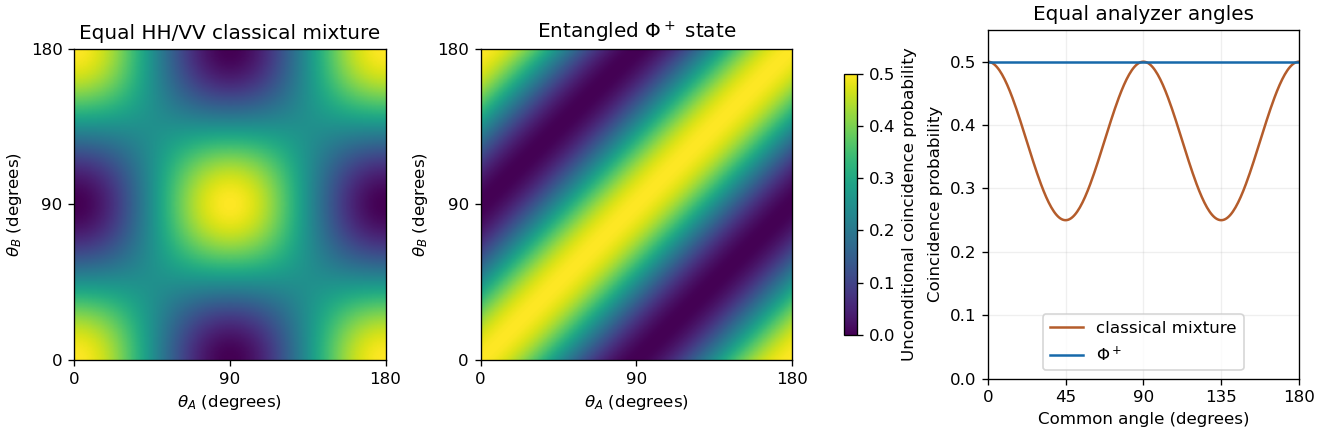
The classical mixture has density matrix ρ=21∣HH⟩⟨HH∣+21∣VV⟩⟨VV∣. Average the probabilities of its two alternatives:Alice's single-detector transmission probability is 1/2 at every angle. Dividing by it givesAt 45∘, Alice's click does not distinguish the two classical alternatives. At zero, it selects the horizontally polarized alternative.
p(A,B)=21[cos2θAcos2θB+sin2θAsin2θB].
p(B∣A,θA=45∘)=21,p(B∣A,θA=0)=cos2θB.
The normalized Bell statehas equal outcomes for any common real linear-polarization basis. In the stated rotated basis it is (∣θ(+)θ(+)⟩+∣θ(−)θ(−)⟩)/2: the cross terms cancel when the inverse rotation is substituted.
∣Φ+⟩=2∣HH⟩+∣VV⟩
Thus the coincidence probability for the transmitted ports is p(A,B)=21cos2(θA−θB). At equal angles it is 1/2 per emitted pair, while Bob transmits with probability one conditional on Alice's transmission. Both photons are blocked for the other half of ideal pairs. The phrase always in coincidence must therefore mean matching outcomes or conditional transmission, rather than unit unconditional transmission through both polarizers.
The classical mixture has no coherence between HH and VV; it gives equal-angle coincidence probability 1/4 at 45∘, rather than 1/2. The coherent quantum superposition maintains correlation in this rotated basis. Bob's unconditional transmission remains 1/2, so the conditional correlation does not permit signalling by Alice's polarizer choice.


Ancestors (9)
- 2015
- Past exam of the short options paper shared by Prelims and Parts A and B of the physics course of the University of Oxford
- Short options paper shared by Prelims and Parts A and B of the physics course of the University of Oxford
- Physics course of the University of Oxford
- Undergraduate course of the University of Oxford
- Course of the University of Oxford
- University of Oxford
- List of universities
- Home
Discussion (0)
New discussionThere are no discussions about this article yet.
Articles by others on the same topic (0)
There are currently no matching articles.