The normalized linear polarization state is ∣θ⟩=cosθ∣H⟩+sinθ∣V⟩. A transmitted-photon count implements the projector ∣θ⟩⟨θ∣. The Born rule givesthe single-photon form of Malus's law, assuming ideal polarizers and detection.
p(θ)=∣⟨θ∣H⟩∣2=cos2θ,
For the product state ∣H⟩A∣H⟩B, the two projection amplitudes multiply. ThereforeThe independent factors arise from this product input; they cannot be assumed for a general correlated pair state.
p(θA,θB)=cos2θAcos2θB.
The classical mixture has density matrix ρ=21∣HH⟩⟨HH∣+21∣VV⟩⟨VV∣. Average the probabilities of its two alternatives:Alice's single-detector transmission probability is 1/2 at every angle. Dividing by it givesAt 45∘, Alice's click does not distinguish the two classical alternatives. At zero, it selects the horizontally polarized alternative.
p(A,B)=21[cos2θAcos2θB+sin2θAsin2θB].
p(B∣A,θA=45∘)=21,p(B∣A,θA=0)=cos2θB.
The normalized Bell statehas equal outcomes for any common real linear-polarization basis. In the stated rotated basis it is (∣θ(+)θ(+)⟩+∣θ(−)θ(−)⟩)/2: the cross terms cancel when the inverse rotation is substituted.
∣Φ+⟩=2∣HH⟩+∣VV⟩
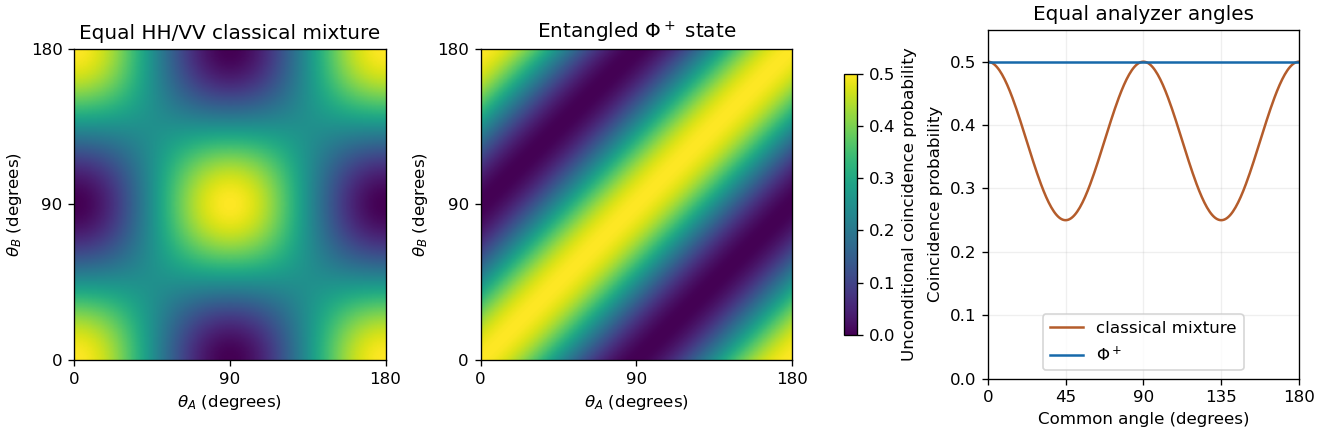
Thus the coincidence probability for the transmitted ports is p(A,B)=21cos2(θA−θB). At equal angles it is 1/2 per emitted pair, while Bob transmits with probability one conditional on Alice's transmission. Both photons are blocked for the other half of ideal pairs. The phrase always in coincidence must therefore mean matching outcomes or conditional transmission, rather than unit unconditional transmission through both polarizers.
The classical mixture has no coherence between HH and VV; it gives equal-angle coincidence probability 1/4 at 45∘, rather than 1/2. The coherent quantum superposition maintains correlation in this rotated basis. Bob's unconditional transmission remains 1/2, so the conditional correlation does not permit signalling by Alice's polarizer choice.

Ancestors (10)
- S3
- 2015
- Past exam of the short options paper shared by Prelims and Parts A and B of the physics course of the University of Oxford
- Short options paper shared by Prelims and Parts A and B of the physics course of the University of Oxford
- Physics course of the University of Oxford
- Undergraduate course of the University of Oxford
- Course of the University of Oxford
- University of Oxford
- List of universities
- Home
Discussion (0)
New discussionThere are no discussions about this article yet.
Articles by others on the same topic (0)
There are currently no matching articles.