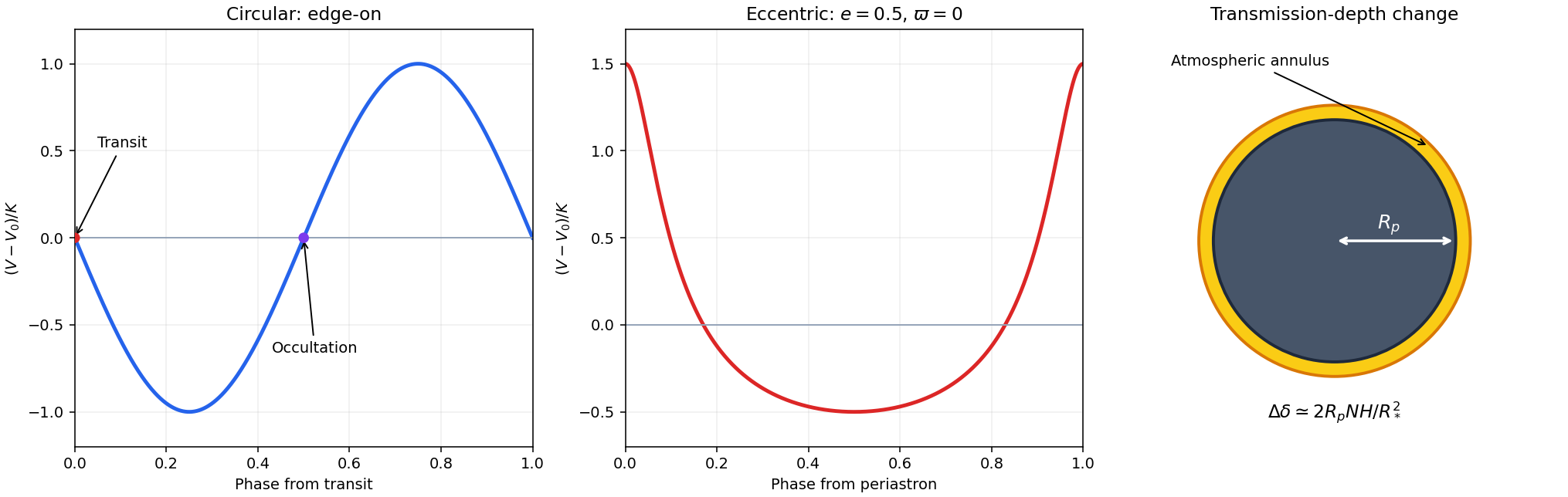
Transit occurs at the decreasing systemic-velocity crossing ϕ=0; secondary eclipse is at the increasing crossing ϕ=1/2. Extrema occur one quarter of an orbit away. Reversing the velocitysign convention reverses the crossing directions but not the conjunction phases.
For an eccentric orbit, ν is not proportional to time. Solve M=E−esinE, then use tan(ν/2)=(1+e)/(1−e)tan(E/2) in the stated velocity relation. Motion is fastest near periastron, so the curve has an abrupt feature there and a more prolonged change near apastron, with its shape also depending on ϖ. It is not merely a shifted sinusoid. An eccentric transit need not coincide with V=V0, because the ecosϖ offset remains at conjunction.
. Original calculated velocitycurves use a circular transit as phase zero on the left, and periastron as phase zero for the separate eccentric example with e=0.5 and ϖ=0. The right panel illustrates the projected area added by one atmospheric scale height; its atmospheric thickness is exaggerated for visibility. Details.