Use the relative star–planet separation and specific angular momentum per unit reduced mass,For r=l/(1+ecosθ), differentiation gives r˙=Jesinθ/l, while the transverse speed is rθ˙=J/r=J(1+ecosθ)/l. Adding the squared orthogonal components yieldsThe Binet equation for the relative two-body inverse-square force is u′′+u=G(M+m)/J2, with u=1/r. The conic has u′′+u=1/l, soThe printed division by l is an error: J2 has dimensions length4/time2, while G(M+m)/l has dimensions of speed squared. A circular orbit independently checks the correction: J2=r2v2=G(M+m)r, with l=r.
J=r2θ˙.
v2=l2J2(1+2ecosθ+e2).
J2=G(M+m)l.
For a closed ellipse, l=a(1−e2) and 1+2ecosθ+e2=2l/r−(1−e2). Substitution now gives the vis-viva equation,This is relative orbital speed; either body's speed about the barycentre follows by the corresponding mass-ratio factor.
v2=G(M+m)(r2−a1).
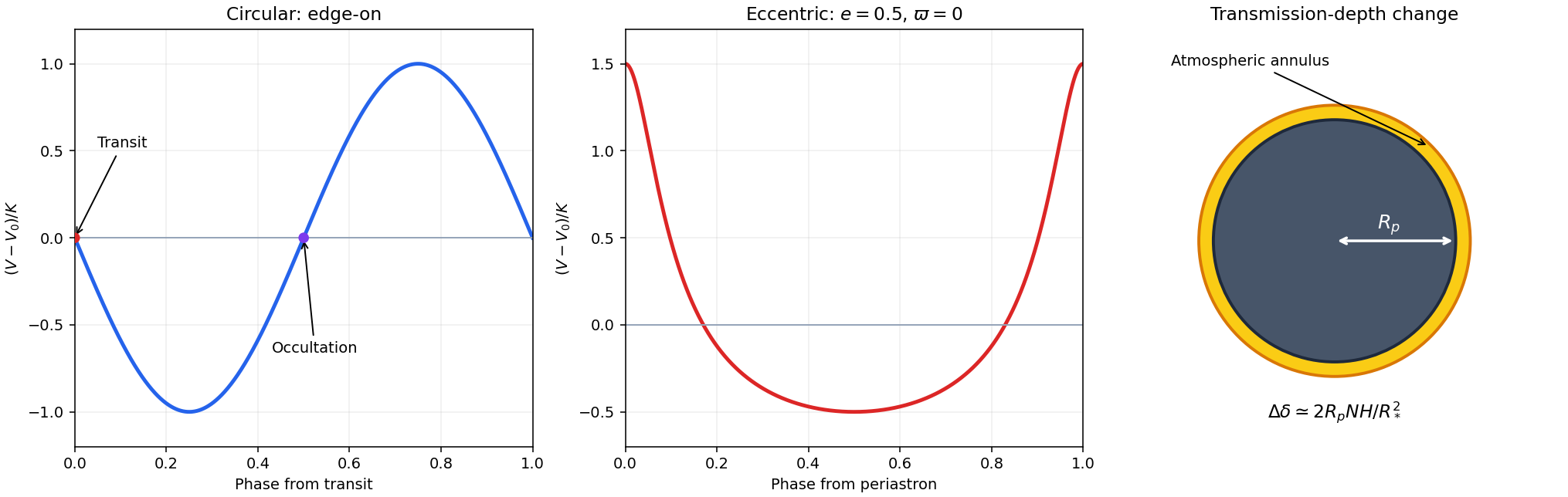
A circular orbit has uniform angular motion, so its Keplerian radial-velocity curve is sinusoidal. Choose phase ϕ=(t−ttr)/P, positive stellar velocity away from the observer, and an edge-on circular orbit. One consistent convention isTransit occurs at the decreasing systemic-velocity crossing ϕ=0; secondary eclipse is at the increasing crossing ϕ=1/2. Extrema occur one quarter of an orbit away. Reversing the velocity sign convention reverses the crossing directions but not the conjunction phases.
V−V0=−Ksin(2πϕ).
For an eccentric orbit, ν is not proportional to time. Solve M=E−esinE, then use tan(ν/2)=(1+e)/(1−e)tan(E/2) in the stated velocity relation. Motion is fastest near periastron, so the curve has an abrupt feature there and a more prolonged change near apastron, with its shape also depending on ϖ. It is not merely a shifted sinusoid. An eccentric transit need not coincide with V=V0, because the ecosϖ offset remains at conjunction.

Assume the companion is much less massive than the star, the sinusoid represents a circular Keplerian orbit, and the transit implies sini≃1. Ignore dilution, limb darkening and grazing geometry when estimating the radius. With P=5×86400s,The stellar reflex radial-velocity semi-amplitude gives K≃(m/M⊙)(2πa/P), while transit depth gives δ≃(Rp/R⊙)2. ThereforeThe mean density relative to the supplied Jupiter values isThis is a low-density hot gas giant. Strong irradiation can slow contraction or help sustain an inflated envelope; internal heating and a different heavy-element fraction are other possibilities. The inferred low mass also reduces gravitational compression. Mass and radius alone do not determine which inflation mechanism operates.
a≃(4π2GM⊙P2)1/3=8.56×109m=0.0572AU.
m≃1.12×1027kg=0.589MJup,Rp≃9.84×10⁷m=1.408RJup.
ρˉJupρˉp≃1.40830.589=0.211,ρˉp≃2.80×10²kgm−3.
The source expression E=21μv2−GMm/r is total mechanical energy in the centre-of-mass frame, not kinetic energy alone. Take v0 as the relative speed at a large initial separation where the mutual potential is negligible. At closest approach, the radial relative velocity is zero, so conservation of angular momentum and conservation of energy giveUsing Mm/μ=M+m eliminates vc:An impact occurs when rc≤R, where R=rM+rm. Since the right side increases with positive rc, the collision threshold isThe mutual escape velocity is the relative speed at contact required to reach infinite separation with zero residual speed. Setting total mechanical energy to zero givesThis includes target recoil. If the given initial speed were instead at a finite non-negligible separation, its potential energy would have to be retained; v0 would then not equal the asymptotic speed used in the focusing formula.
μbv0=μrcvc,21μv02=21μvc2−rcGMm.
b2=rc2+v022G(M+m)rc.
bcol2=R2[1+Rv022G(M+m)],f=Rv022G(M+m).
vesc=rM+rm2G(M+m),f=vesc2/v02.
The collision cross section in the incoming impact-parameter plane isWithout gravity it is only σgeom=π(rM+rm)2, so gravitational focusing increases the cross-section by 1+f. Trajectories that would miss geometrically can be bent into contact, especially for slow relative encounters. Gravity does not itself guarantee sticking: the following accretion estimate assumes collisions agglomerate rather than fragment, rebound or erode the target.
σcol=πbcol2=π(rM+rm)2(1+f).
A uniform incoming projectile mass density ρp has mass flux ρpv0, soThe formula counts mass swept per unit time and assumes an adequate continuing projectile supply, the stated speed, and negligible many-body or stellar-tidal modification of the two-body cross-section.
dtdM=ρpv0σcol.
In the strong-focusing, small-projectile limit, write RM=(3M/(4πρs))1/3 with constant solid-material density. ThenIntegrating dM/M4/3=Adt from M0 to M givesfor M≫M0. The fractional growth rate M˙/M∝M1/3 increases with mass: larger bodies gain an increasing advantage, hence gravitationally focused growth of a planetary core is called runaway accretion in this regime.
σcol≃v022πGMRM,M˙=AM4/3,A=v02πGρp(4πρs3)1/3.
t=A3(M0−1/3−M−1/3)≃3M0−1/3(34πρs)1/32πGρpv0
The formal finite time to unlimited mass is not physical. Growth depletes the feeding region; embryos also stir planetesimal velocities and reduce focusing, while fragmentation, orbital competition and stellar tides alter the encounter geometry. A growing core can enter an oligarchic rather than runaway regime, and eventually reach a supply-limited isolation mass.
Dynamical friction transfers random kinetic energy from a massive body to a swarm and tends toward MvM2∼mvm2. Larger bodies therefore have smaller random eccentricities and inclinations, remain concentrated near the planetesimal layer, and can retain favorable encounter conditions. When their own random motion contributes appreciably to relative speed, damping it also strengthens focusing through f∝v0−2. If the small-body dispersion already dominates v0, equipartition of the core alone does not further lower that encounter speed: the displayed growth law assumed a fixed v0, not an automatically imposed v0∝M−1/2.
During a exoplanet transit, starlight traverses the planetary limb. The effective opaque radius varies with wavelength because the altitude of slant optical depth near unity depends on molecular absorption and scattering. Differencing the in-transit and out-of-transit stellar spectra measures this wavelength-dependent blocked area, the exoplanet transmission spectrum. Stellar spots and faculae can contaminate that difference and require control.
During a exoplanet secondary eclipse, the disappearance of planetary light permits subtraction of the stellar contribution. Visible planetary light is predominantly reflected starlight, sensitive to clouds, hazes, Rayleigh scattering, and atomic sodium and potassium absorption. Infrared planetary emission and limb absorption show rotational-vibrational features of species such as water, carbon monoxide, carbon dioxide and methane, together with collision-induced absorption involving molecular hydrogen. Thermal emission also depends on the atmospheric temperature-pressure profile; a temperature inversion can turn a molecular absorption feature into emission. Which species are prominent depends on composition, temperature and the observed band, rather than being universal to every planet.
The measured mass and radius implyCompared with the supplied composition curves, this is inconsistent with a bare iron-rich or ordinary rock-only planet. A volatile-rich interior and/or an extended low-density gas envelope is needed. A water-rich body with an atmosphere and a rocky core with a modest H/He envelope are different plausible families; mass and radius do not uniquely determine the composition.[ref]
ρˉp=ρ⊕2.636.6≃2.1gcm−3.
For the requested H/He estimate, assume a hydrostatic, approximately isothermal terminator at the zero-Bond-albedo, fully redistributed equilibrium temperature. The orbit and temperature areSurface gravity is g=Gm/Rp2≃9.58ms−2. With molar mass M=2.2×10⁻³kgmol−1, the atmospheric scale height isA spectral feature spanning N scale heights changes the blocked stellar fraction by the atmospheric annulus area:Thus one scale height is about 338 parts per million in transit depth; a clear strong feature spanning roughly five scale heights is of order 1.7×10⁻³. The number of scale heights requires the actual opacity ratio; N≃ln(κline/κcont) is a useful isothermal estimate, not a supplied measured value. The true terminator temperature need not equal this redistribution estimate.
a=[4π2G(0.16M⊙)P2]1/3=0.0144AU,Teq=30002a0.21R⊙≃552K.
H=MgRuT≃2.18×10⁵m≃218km.
Δδ≃R∗22RpNH≃3.38×10⁻⁴N.
A nearly flat spectrum can result from a high-mean-molecular-mass atmosphere with a much smaller scale height, or from optically thick clouds/hazes that hide the deeper absorption features. These are the two qualitative possibilities; detailed precision data can discriminate them. In particular, the pre-2015 HST study favored clouds over the clear high-molecular-mass models it tested, so listing both physical mechanisms is not a claim that all such models fit those data equally well.[ref]
https://arxiv.org/abs/1401.0022. 2014 transmission-spectrum study, abstract: featureless near-infrared spectrum and rejection of tested cloud-free high-molecular-mass models
The circumstellar habitable zone is the range of stellar irradiation at which a suitable rocky planet could maintain liquid water at its surface under specified atmospheric conditions. It is not a guarantee of life or even of liquid water on every planet at that distance. Its boundaries depend on greenhouse gases, clouds, humidity, pressure, albedo, rotation and the stellar spectrum; stellar evolution, ultraviolet activity, atmospheric loss and tidal locking can complicate applications to cool stars.
Approximating both stars as blackbodies, the host luminosity relative to the Sun isThe Earth-irradiance orbit therefore hasUse the largest projected separation and a visible reference wavelength of 550nm. The Rayleigh criterion for a circular aperture givesThis is only a diffraction-based minimum: detecting a faint planet beside its star additionally requires contrast suppression and adequate photon counts. An interferometer baseline, rather than its collecting-aperture diameter, sets its angular resolution.
L⊙L∗=0.212(57783000)4≃0.00320.
aE=L∗/L⊙AU≃0.0566AU,θmax≃14.6pcaE=3.88mas.
D≳θmax1.22λ≃35.7(550nmλ)m.
For reflected light the reflected-light planetary phase curve gives the flux ratio ϵ=AgΦ(α)(R⊕/aE)2, where Ag is geometric albedo and Φ(0)=1. Numerically,A unit-geometric-albedo reference gives about 6×10⁻⁷; an Earth-like chosen Ag=0.3 gives 1.7×10⁻⁷. Albedo and phase function were not specified, so an exact contrast cannot be inferred just from the radius. Full-phase brightness occurs close to zero projected separation for an edge-on orbit; at the best-resolved quadrature, a Lambert sphere has Φ(π/2)=1/π, reducing the Earth-albedo example to 5.4×10⁻⁸. Thus the best angular separation and maximum reflected contrast are not generally achieved at the same phase.
ϵfull≃5.66×10⁻⁷Ag.
Ancestors (9)
- 2015
- Past exam of the short options paper shared by Prelims and Parts A and B of the physics course of the University of Oxford
- Short options paper shared by Prelims and Parts A and B of the physics course of the University of Oxford
- Physics course of the University of Oxford
- Undergraduate course of the University of Oxford
- Course of the University of Oxford
- University of Oxford
- List of universities
- Home
Discussion (0)
New discussionThere are no discussions about this article yet.
Articles by others on the same topic (0)
There are currently no matching articles.