Use the relative star–planet separation and specific angular momentum per unit reduced mass,For r=l/(1+ecosθ), differentiation gives r˙=Jesinθ/l, while the transverse speed is rθ˙=J/r=J(1+ecosθ)/l. Adding the squared orthogonal components yieldsThe Binet equation for the relative two-body inverse-square force is u′′+u=G(M+m)/J2, with u=1/r. The conic has u′′+u=1/l, soThe printed division by l is an error: J2 has dimensions length4/time2, while G(M+m)/l has dimensions of speed squared. A circular orbit independently checks the correction: J2=r2v2=G(M+m)r, with l=r.
J=r2θ˙.
v2=l2J2(1+2ecosθ+e2).
J2=G(M+m)l.
For a closed ellipse, l=a(1−e2) and 1+2ecosθ+e2=2l/r−(1−e2). Substitution now gives the vis-viva equation,This is relative orbital speed; either body's speed about the barycentre follows by the corresponding mass-ratio factor.
v2=G(M+m)(r2−a1).
A circular orbit has uniform angular motion, so its Keplerian radial-velocity curve is sinusoidal. Choose phase ϕ=(t−ttr)/P, positive stellar velocity away from the observer, and an edge-on circular orbit. One consistent convention isTransit occurs at the decreasing systemic-velocity crossing ϕ=0; secondary eclipse is at the increasing crossing ϕ=1/2. Extrema occur one quarter of an orbit away. Reversing the velocity sign convention reverses the crossing directions but not the conjunction phases.
V−V0=−Ksin(2πϕ).
For an eccentric orbit, ν is not proportional to time. Solve M=E−esinE, then use tan(ν/2)=(1+e)/(1−e)tan(E/2) in the stated velocity relation. Motion is fastest near periastron, so the curve has an abrupt feature there and a more prolonged change near apastron, with its shape also depending on ϖ. It is not merely a shifted sinusoid. An eccentric transit need not coincide with V=V0, because the ecosϖ offset remains at conjunction.
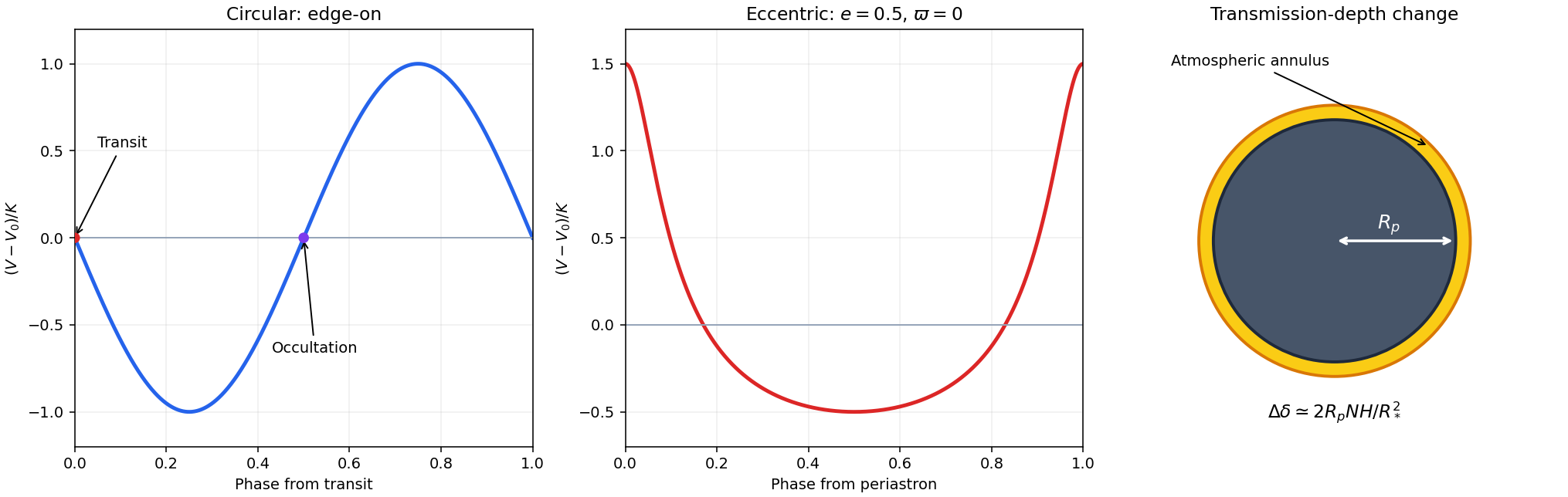

Assume the companion is much less massive than the star, the sinusoid represents a circular Keplerian orbit, and the transit implies sini≃1. Ignore dilution, limb darkening and grazing geometry when estimating the radius. With P=5×86400s,The stellar reflex radial-velocity semi-amplitude gives K≃(m/M⊙)(2πa/P), while transit depth gives δ≃(Rp/R⊙)2. ThereforeThe mean density relative to the supplied Jupiter values isThis is a low-density hot gas giant. Strong irradiation can slow contraction or help sustain an inflated envelope; internal heating and a different heavy-element fraction are other possibilities. The inferred low mass also reduces gravitational compression. Mass and radius alone do not determine which inflation mechanism operates.
a≃(4π2GM⊙P2)1/3=8.56×109m=0.0572AU.
m≃1.12×1027kg=0.589MJup,Rp≃9.84×10⁷m=1.408RJup.
ρˉJupρˉp≃1.40830.589=0.211,ρˉp≃2.80×10²kgm−3.
Ancestors (10)
- S30
- 2015
- Past exam of the short options paper shared by Prelims and Parts A and B of the physics course of the University of Oxford
- Short options paper shared by Prelims and Parts A and B of the physics course of the University of Oxford
- Physics course of the University of Oxford
- Undergraduate course of the University of Oxford
- Course of the University of Oxford
- University of Oxford
- List of universities
- Home
Discussion (0)
New discussionThere are no discussions about this article yet.
Articles by others on the same topic (0)
There are currently no matching articles.