Complex differentiability gives ux=vy, uy=−vx. Differentiating once more, for continuously differentiable first derivatives with the needed second derivatives, yields uxx+uyy=vyx−vxy=0 and vxx+vyy=−uyx+uxy=0. Thus both components satisfy Laplace's equation. The result is local on the domain of holomorphy; it makes no assertion across a branch cut.
Choose a continuous argument θ on a simply connected domain avoiding zero, and put r=x2+y2. With u=xlogr−yθ, direct differentiation givesHere θx=−y/r2, θy=x/r2; these identities specify the branch needed in the written arctangent. Integrating the Cauchy-Riemann equations givesThe literal principal arctan(y/x) works only separately on suitable half-planes. It cannot stand for a single continuous argument across the imaginary axis.
ux=1+logr,uy=−θ,uxx=x/r2,uyy=−x/r2.
f(z)=zLogz+iC,v=ylogr+xθ+C,C∈R.
For the upper half-plane use 0<θ<π, and interpret the source's arctangent as this argument. Then V=(V0/π)Im(zLogz) is harmonic, so E=−∇V has zero curl and divergence where there is no charge. On the positive boundary θ→0 and ylogr→0; on the negative boundary θ→π. Hence the two boundary values are respectively zero and V0x.
Branch qualification: the principal real arctangent alone gives zero on both sides of y=0, contradicting the stated negative-axis boundary condition, for example at x=−1. The continuous upper-half-plane argument repairs this notation; it is not an optional additive constant.
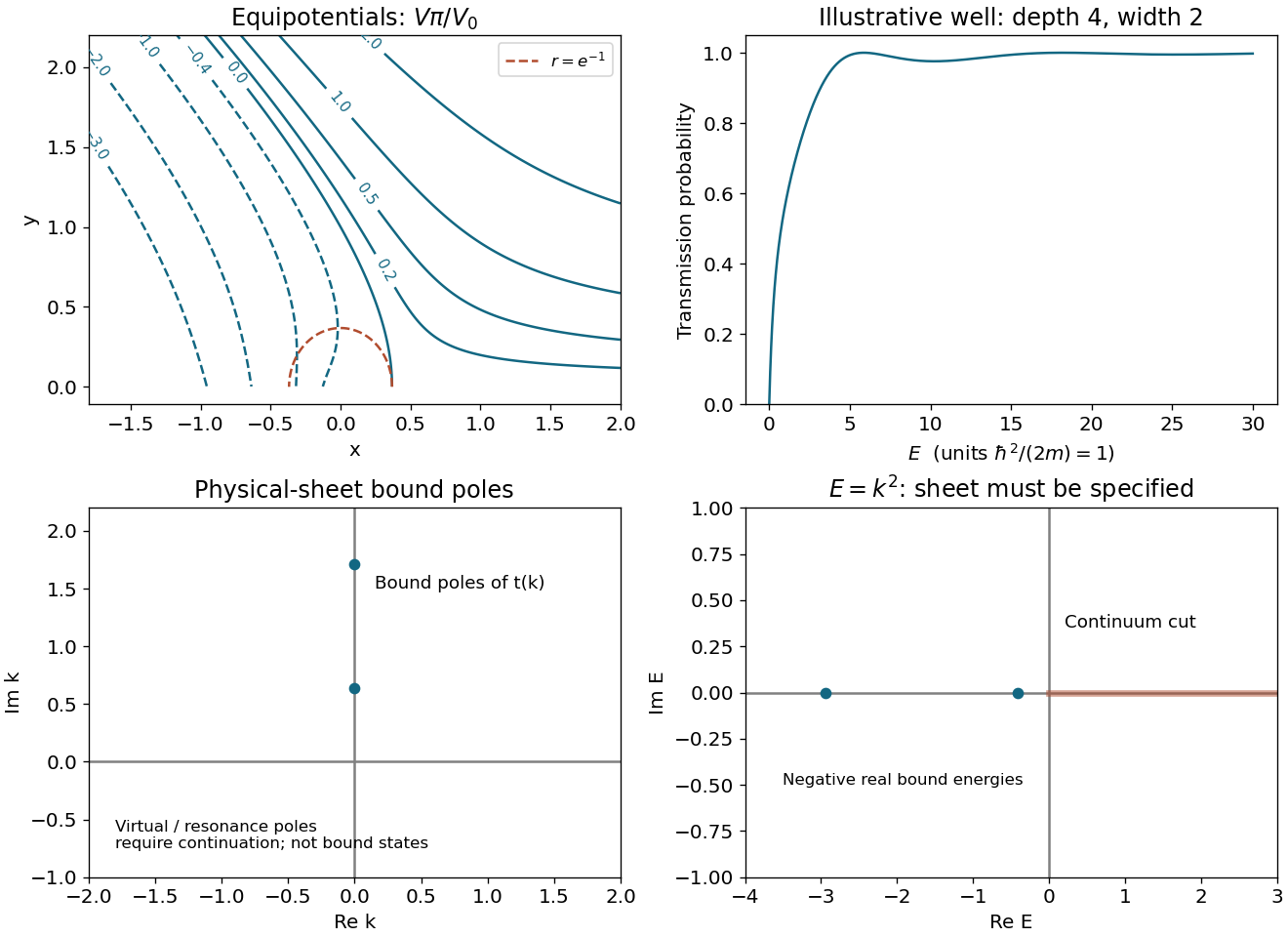
Along a level curve, Vxdx+Vydy=0, with Vx=V0θ/π and Vy=V0(1+logr)/π. ThereforeIn the intended upper half-plane 0<θ<π, the slope is positive for 0<r<e−1, vertical at r=e−1, and negative for r>e−1. At the positive real boundary θ=0 the slope is zero except at the stationary point (e−1,0), where both derivatives vanish and the quotient is indeterminate. More generally, outside the chosen half-plane its sign is the sign of −θ(1+logr), with the argument branch held fixed. A convenient parametric description of the curves to sketch is Vπ/V0=r(sinθlogr+θcosθ).
dxdy=−1+logrθ.

Ancestors (10)
- S1
- 2017
- Past exam of the short options paper shared by Prelims and Parts A and B of the physics course of the University of Oxford
- Short options paper shared by Prelims and Parts A and B of the physics course of the University of Oxford
- Physics course of the University of Oxford
- Undergraduate course of the University of Oxford
- Course of the University of Oxford
- University of Oxford
- List of universities
- Home
Discussion (0)
New discussionThere are no discussions about this article yet.
Articles by others on the same topic (0)
There are currently no matching articles.