Complex differentiability gives ux=vy, uy=−vx. Differentiating once more, for continuously differentiable first derivatives with the needed second derivatives, yields uxx+uyy=vyx−vxy=0 and vxx+vyy=−uyx+uxy=0. Thus both components satisfy Laplace's equation. The result is local on the domain of holomorphy; it makes no assertion across a branch cut.
Choose a continuous argument θ on a simply connected domain avoiding zero, and put r=x2+y2. With u=xlogr−yθ, direct differentiation givesHere θx=−y/r2, θy=x/r2; these identities specify the branch needed in the written arctangent. Integrating the Cauchy-Riemann equations givesThe literal principal arctan(y/x) works only separately on suitable half-planes. It cannot stand for a single continuous argument across the imaginary axis.
ux=1+logr,uy=−θ,uxx=x/r2,uyy=−x/r2.
f(z)=zLogz+iC,v=ylogr+xθ+C,C∈R.
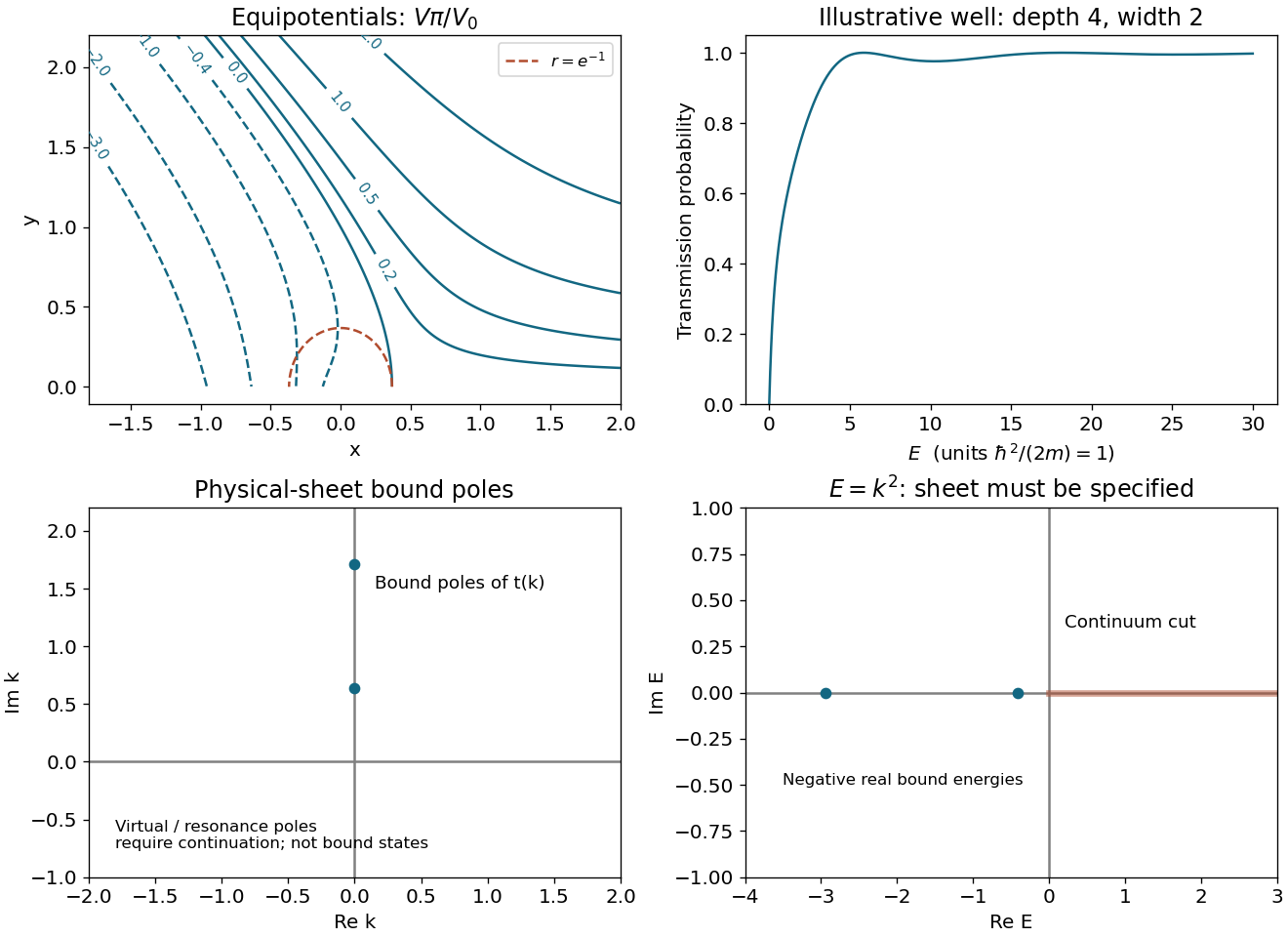
For the upper half-plane use 0<θ<π, and interpret the source's arctangent as this argument. Then V=(V0/π)Im(zLogz) is harmonic, so E=−∇V has zero curl and divergence where there is no charge. On the positive boundary θ→0 and ylogr→0; on the negative boundary θ→π. Hence the two boundary values are respectively zero and V0x.
Branch qualification: the principal real arctangent alone gives zero on both sides of y=0, contradicting the stated negative-axis boundary condition, for example at x=−1. The continuous upper-half-plane argument repairs this notation; it is not an optional additive constant.
Along a level curve, Vxdx+Vydy=0, with Vx=V0θ/π and Vy=V0(1+logr)/π. ThereforeIn the intended upper half-plane 0<θ<π, the slope is positive for 0<r<e−1, vertical at r=e−1, and negative for r>e−1. At the positive real boundary θ=0 the slope is zero except at the stationary point (e−1,0), where both derivatives vanish and the quotient is indeterminate. More generally, outside the chosen half-plane its sign is the sign of −θ(1+logr), with the argument branch held fixed. A convenient parametric description of the curves to sketch is Vπ/V0=r(sinθlogr+θcosθ).
dxdy=−1+logrθ.

A branch point obstructs a single-valued analytic continuation around a closed circuit. Continuing logz=log∣z∣+iθ once around zero increases its value by 2πi. A branch cut removes a curve joining branch points or extending to infinity so that a continuous argument can be chosen on the remainder. Zero and infinity are logarithmic branch points; the positive-axis cut used here selects 0<argz<2π. The cut is a choice of representation, not a line of poles of the multivalued logarithm.
The large circle contributes O((logR)n/R) and the small circle contributes O(ϵ∣logϵ∣n), so both disappear. The enclosed simple poles are i and −i, with logarithms iπ/2 and 3iπ/2. Their residues are (iπ/2)n/(2i) and −(3iπ/2)n/(2i). The positive orientation of the keyhole therefore givesThe upper bank runs outward and the lower bank inward. Their logarithms differ by 2πi; keeping that orientation is essential for the sign.
∮Γ1+z2(Logz)ndz=πn+1(i/2)n(1−3n).
Taking the difference of the two bank integrals at n=2 givesThe Ij are real and convergent. Comparing real and imaginary parts proves I0=π/2, I1=0. Independently, x↦1/x changes the sign of each odd logarithmic moment and preserves the measure, so every odd Ij vanishes.
∫0∞1+x2(logx)2−(logx+2πi)2dx=4π2I0−4πiI1=2π3.
At n=3 the bank difference is −6πiI2+12π2I1+8π3iI0, while the residue result is 13iπ4/4. Substitution of I0,I1 yields I2=π3/8.
At n=5, the odd moments vanish and the remaining relation isThusAs an independent generating-function check, F(s)=∫0∞xs/(1+x2)dx=π/[2cos(πs/2)] for ∣Res∣<1. Differentiating twice and four times at zero gives the same moments.
−10πiI4+80π3iI2−32π5iI0=−16121iπ6.
I2=8π3,I4=325π5.
For a meromorphic function with no poles on a positively oriented closed contour, the contour integral equals 2πi times the sum of enclosed residues, weighted by winding number for a general contour. At a simple pole a, the residue is limz→a(z−a)f(z). Analyticity on the contour and the absence of other interior singularities are necessary hypotheses.
Put z=eiθ, so dθ=dz/(iz), cosθ=(z+z−1)/2 and sinθ=(z−z−1)/(2i). Rational expressions in these trigonometric functions become rational contour integrands on the unit circle. The method is especially useful when the resulting denominator has a small number of identifiable poles. A pole on the integration circle requires a separately specified principal value or indentation; the residue theorem does not automatically assign an ordinary integral there.
First remove the removable singularities introduced by tangent and secant: the integrand is cosθ/(3+cosθ+2sinθ). The denominator stays positive since 3>5. With z=eiθ the contour integrand isIts interior poles are zero and r=−1/(1−2i); the other quadratic root is −5/(1−2i) and lies outside. The residues are 1/[i(1+2i)] and (r2+1)/(4ir), whose sum is i/10. ConsequentlyAssigning arbitrary finite values at the isolated removable points does not change the integral.
iz{(1−2i)z2+6z+(1+2i)}z2+1.
∫02π1+2tanθ+3secθdθ=−5π.
Split the sine into exponentials. The eiz term closes in the upper half-plane and picks up the pole ia, giving 2πie−a; the e−iz term closes clockwise below and encloses no pole. Jordan's lemma applies to these separate contours. HenceTo pass to a↓0 without an invalid dominated-convergence argument on an infinite interval, pair positive and negative x first: the imaginary part is odd and the real part is 2∫0∞xsinx/(x2+a2)dx. On a bounded interval the limit is harmless, while integration by parts bounds the oscillatory tail uniformly for 0<a≤1. This gives the convergent improper Dirichlet integral ∫−∞∞sinx/xdx=π.
∫−∞∞x−iasinxdx=πe−a,a>0.
Ancestors (9)
- 2017
- Past exam of the short options paper shared by Prelims and Parts A and B of the physics course of the University of Oxford
- Short options paper shared by Prelims and Parts A and B of the physics course of the University of Oxford
- Physics course of the University of Oxford
- Undergraduate course of the University of Oxford
- Course of the University of Oxford
- University of Oxford
- List of universities
- Home
Discussion (0)
New discussionThere are no discussions about this article yet.
Articles by others on the same topic (0)
There are currently no matching articles.