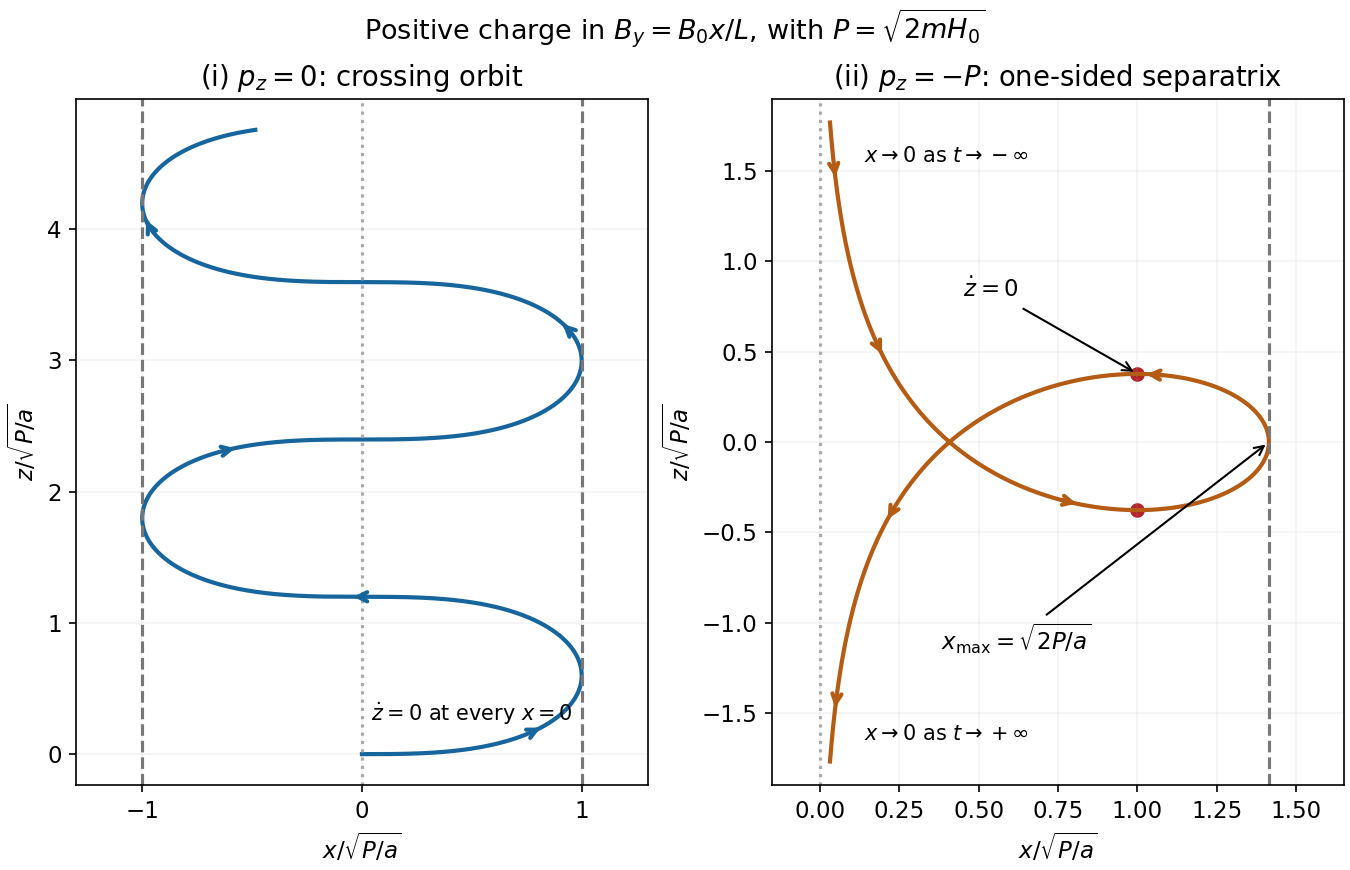
Here z˙=ax2/m≥0: the orbit always advances toward increasing z, except for instantaneous zeros at each midplane crossing x=0. The transverse motion oscillates between −X and X. At these outer turning points x˙=0 and the trajectory is tangent to the z direction; at the midplane x˙=0 while z˙=0, so the tangent is along x. The sign of the initial x˙ only chooses the phase or reflected trace.
The negative-side orbit is its reflection in x=0. For the positive branch, x rises from zero asymptotically, reaches X2 at u=0, then returns asymptotically to zero. Thus the infimum is zero but it is not attained in finite time on this nontrivial branch. Since z˙=(P/m)(2sech2u−1), the two axial-velocity zeros occur at x=P/a. Motion is toward decreasing z near either asymptotic midplane tail and toward increasing z near the outer excursion. These directions are marked in part i.
The exactly midplane initial state x=0, x˙=0 is a separate straight trajectory with z˙=−P/m; it must not be described asa finite-time crossing of the separatrix.