Only Az depends on position. Taking the curl,The field reverses across x=0. Its divergence is zero, as required for a magnetic field; the vanishing field on the midplane is important for the crossing and separatrix trajectories below.
B=∇×A=LB0xy^.
With zero scalar potential, the nonrelativistic charged-particle Lagrangian in SI units is kinetic energy plus qA⋅r˙. ThusThe velocity-dependent magnetic term changes canonical momentum but does not contribute to the mechanical energy.
L=2m(x˙2+y˙2+z˙2)−2LqB0x2z˙.
Define a=qB0/(2L)>0. Differentiating the Lagrangian with respect to each generalized velocity givesThe coordinates y and z are cyclic, so py and pz are conserved. The momentum px is generally not conserved: its equation is p˙x=−2axz˙. In particular, conserved canonical pz is not the same as conserved mechanical mz˙, which changes as the particle moves across the magnetic-field gradient.
px=mx˙,py=my˙,pz=mz˙−ax2.
The Legendre transform cancels the term linear in velocity and givesIt equals the mechanical kinetic energy. The Hamiltonian has no explicit time dependence, so H is conserved. This is also a direct consequence of the magnetic force doing no work: qv⋅(v×B)=0.
H=2mpx2+py2+(pz+ax2)2.
Since py=0 initially and remains constant, the motion stays in a plane of constant y. Setting P=2mH0 and p=pz0 givesThe allowed interval obeys ∣p+ax2∣≤P. The sign of x˙ is set by the initial direction and changes at a turning point. The specified x0 fixes the starting position on the energy orbit, but the data do not specify which sign of the initial transverse velocity is chosen.
z˙=mp+ax2,x˙=±mP2−(p+ax2)2.
Dividing the two velocities givesHere z˙=ax2/m≥0: the orbit always advances toward increasing z, except for instantaneous zeros at each midplane crossing x=0. The transverse motion oscillates between −X and X. At these outer turning points x˙=0 and the trajectory is tangent to the z direction; at the midplane x˙=0 while z˙=0, so the tangent is along x. The sign of the initial x˙ only chooses the phase or reflected trace.
dzdx=±ax2P2−a2x4,−X≤x≤X,X=P/a.
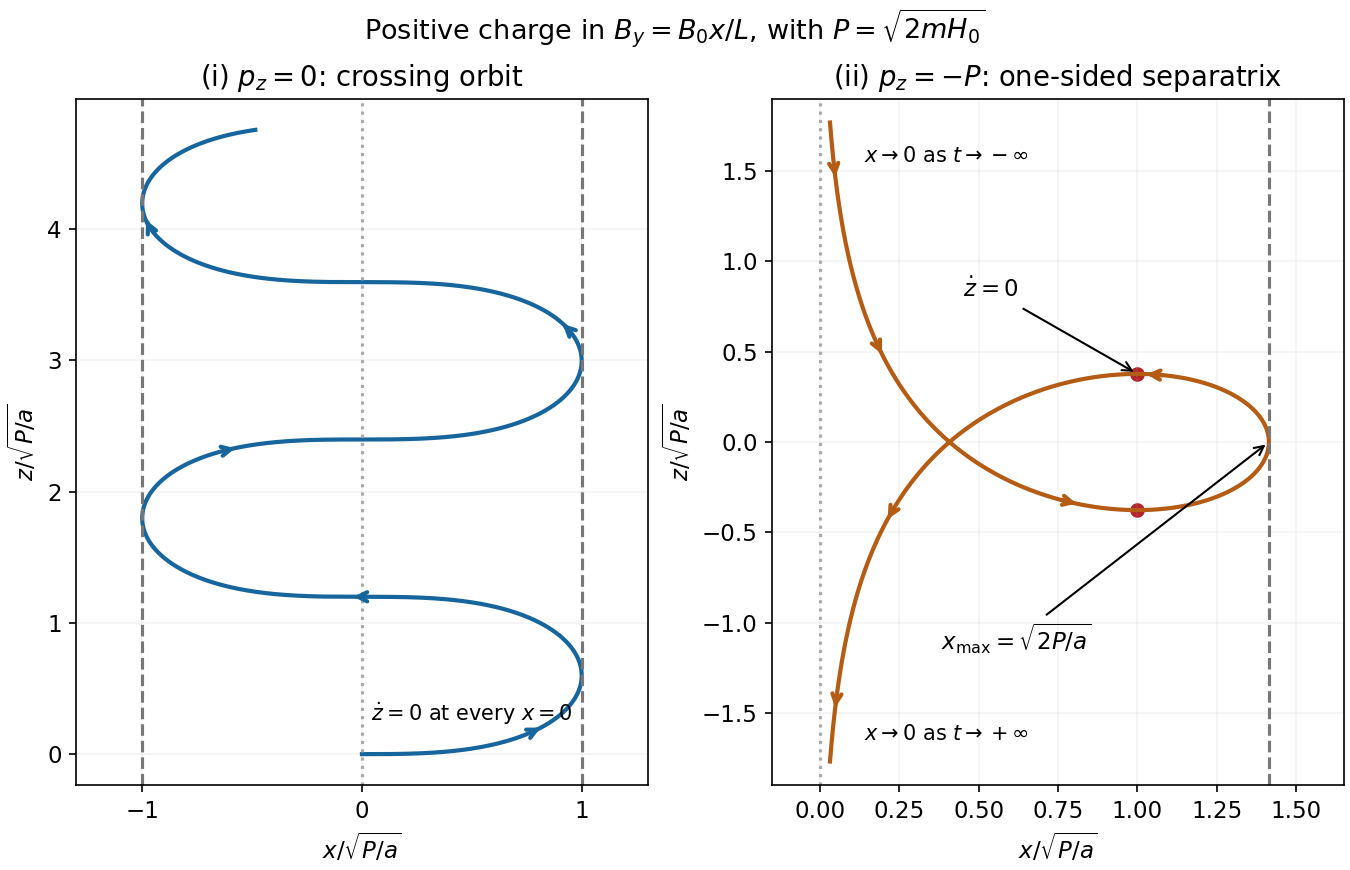

With p=−P, the allowed range is ∣x∣≤X2, where X2=2P/a. But an orbit starting with x=0 never crosses the midplane in finite time, becauseOne positive-side separatrix, with u=ω(t−tc) and ω=2Pa/m, isThe negative-side orbit is its reflection in x=0. For the positive branch, x rises from zero asymptotically, reaches X2 at u=0, then returns asymptotically to zero. Thus the infimum is zero but it is not attained in finite time on this nontrivial branch. Since z˙=(P/m)(2sech2u−1), the two axial-velocity zeros occur at x=P/a. Motion is toward decreasing z near either asymptotic midplane tail and toward increasing z near the outer excursion. These directions are marked in part i.
x˙2=m2a2x2(X22−x2).
x=X2sechu,z=zc+mωP(2tanhu−u).
The exactly midplane initial state x=0, x˙=0 is a separate straight trajectory with z˙=−P/m; it must not be described as a finite-time crossing of the separatrix.
Ancestors (10)
- S7
- 2018
- Past exam of the short options paper shared by Prelims and Parts A and B of the physics course of the University of Oxford
- Short options paper shared by Prelims and Parts A and B of the physics course of the University of Oxford
- Physics course of the University of Oxford
- Undergraduate course of the University of Oxford
- Course of the University of Oxford
- University of Oxford
- List of universities
- Home
Discussion (0)
New discussionThere are no discussions about this article yet.
Articles by others on the same topic (0)
There are currently no matching articles.