Use a temperature-dependent strain energy density with different minimizing deformation gradients in the two crystal phases. Above the transition temperature its wells describe austenite; below it the wells are unions of martensitic variants. Left rotational orbits reflect material frame indifference, while the crystal's discrete material symmetries relate the variants. Minimizing the integral of this elastic energy, together with loading and boundary constraints, models the change of lattice shape. Compatibility restricts which low-energy gradients can meet continuously; fine compatible mixtures can accommodate macroscopic boundary shapes.
For the jump condition, write the two affine pieces as and . Continuity on the interface meansTaking differences along the interface gives for every tangent vector with . Decompose any vector as . ThenWith this provesConversely this rank-one connection permits continuity by choosing . A coherent twin interface is such a compatible planar boundary between different martensitic variants, possibly after a rigid rotation of one variant. The rank-one condition is therefore the geometric compatibility condition for a simple twin.
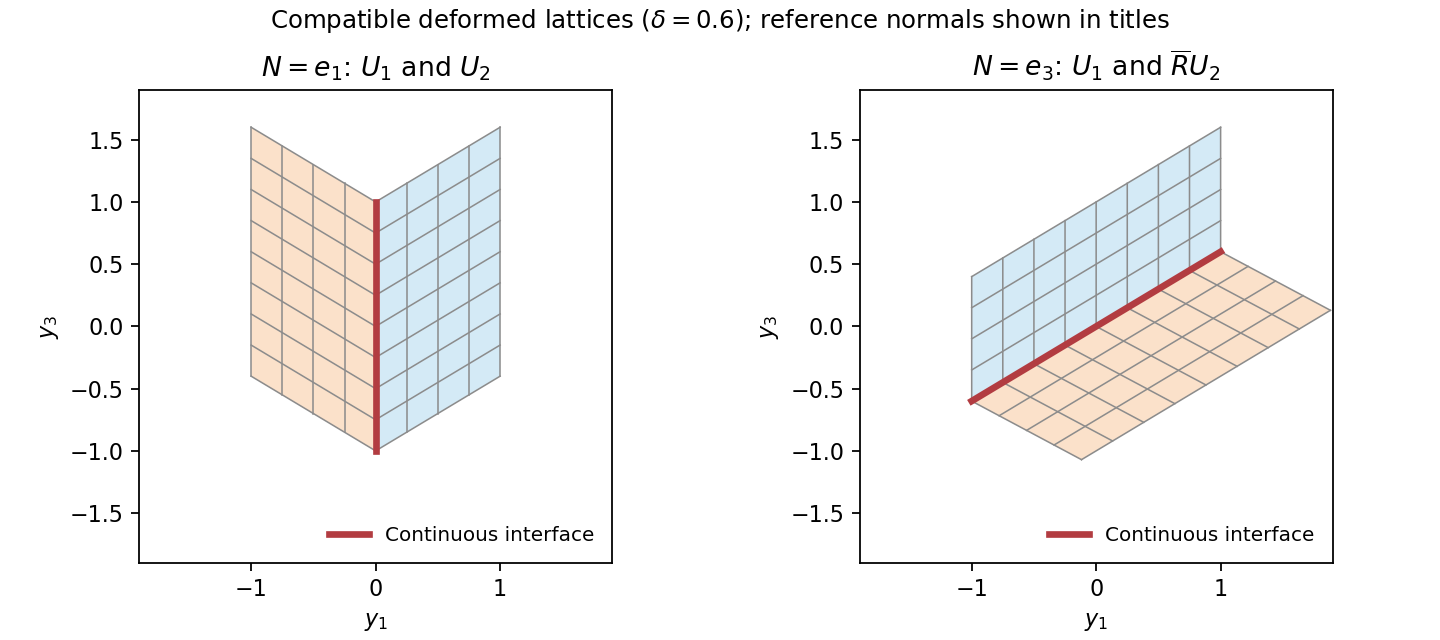
For the unrotated pair, direct subtraction givesso is one solution, with reference interface normal .
Put , and . Since , the stated is a proper rotation. Multiplication givesHere and . ConsequentlyThis is the second rank-one connection, now with normal . Because , the two rotations are distinct. The permitted assertion that there are at most two proves completeness.
Finally suppose is rank-one connected to , with . Left multiplication of their difference by preserves rank and gives . The classification just proved forces to be either or , hence or . The two requested matrices are thereforeTheir connections are explicit: the first was calculated above, and . If desired the second matrix is

Articles by others on the same topic
There are currently no matching articles.