We first derive the stress and energy facts used in both parts. The Cauchy traction is force per unit area in the deformed configuration. The first Piola-Kirchhoff traction is force per unit reference area. Their force vectors are measured in the same spatial coordinates, but the area measures and the normals used to specify the surface are different.
Parametrize a reference surface by . Its oriented area vector is . Under deformation, the two tangents become . The cross-product identitytherefore proves Nanson's formula . Equality of the physical force on corresponding surface patches now givesSince this holds for every reference normal,The first Piola-Kirchhoff stress tensor is generally not symmetric, whereas the Cauchy stress tensor is symmetric in the absence of couple stresses.
For the stated energy on orientation-preserving gradients, differentiation givesA stress-free state satisfies . Taking determinants yields , so and : precisely . These states are also the global energy minimizers. If are the singular values, the arithmetic-geometric mean inequality gives , with equality only when the singular values are equal. The function decreases up to and increases thereafter, with minimum . Thus , with equality precisely at rotations. A constant shift of the energy can set this minimum to zero without changing the stress.
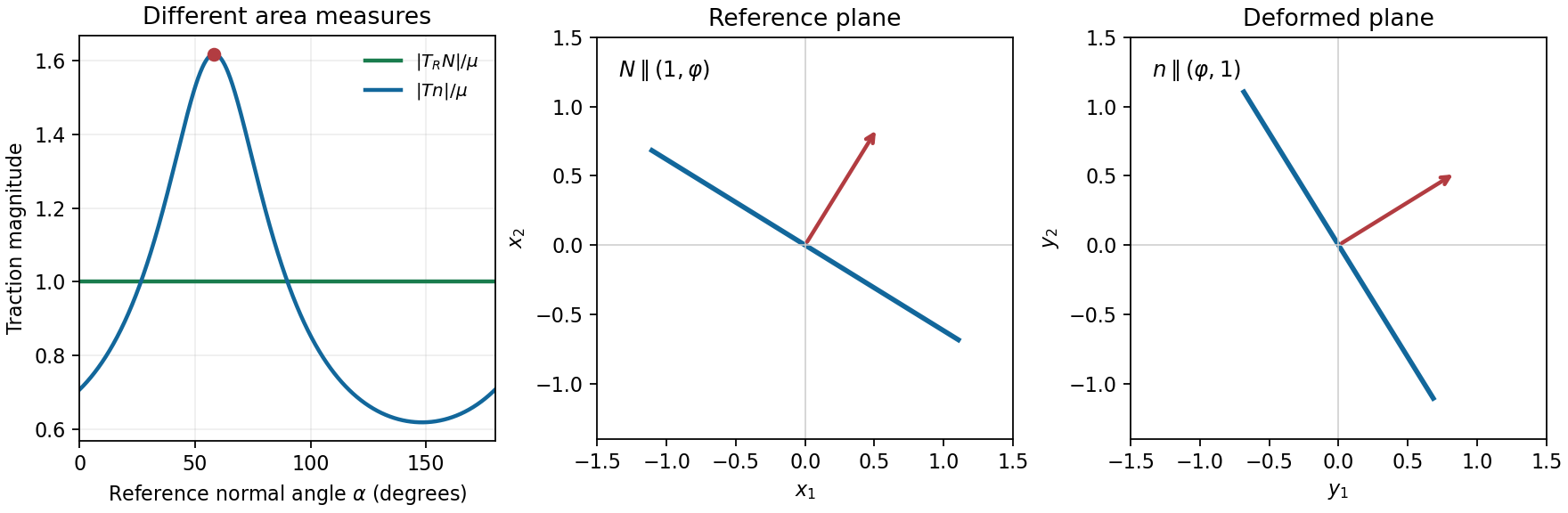
For the given simple shear,For a unit normal , . Hence every reference plane whose normal lies in the plane is maximizing:There is a family of maximizing planes, rather than one distinguished normal.
Using and the preceding first Piola-Kirchhoff stress tensor,Its eigenvalues are , , and zero. Because it is symmetric, its largest traction magnitude on a unit spatial normal is the largest absolute eigenvalue. Put . The positive eigenvalue has the strictly largest modulus, with normalThe question asks for the plane in the reference configuration, so this spatial normal must be pulled back. Nanson's formula gives parallel to , andTherefore the required plane and maximum areEither sign of its unit normal describes the same plane. Maximizing over reference normals is equivalent to maximizing over spatial normals because the map is a bijection of unit normals.
A dead-load traction is prescribed force per unit reference area whose vector is independent of the deformation. It is imposed through on the reference boundary. It does not rotate or rescale with the current surface as a follower load would.
Elastic incompressibility imposes and adds a scalar Lagrange multiplier to the constitutive law. With the pressure sign convention used here,The pressure field is determined by equilibrium and boundary conditions, rather than by the strain energy density alone.
For the diagonal homogeneous deformation, and . Isotropy makes diagonal here, with entries , soThe six face conditions are exactly . Thus for each , orNecessity follows from the boundary conditions. Conversely these equations give a constant pressure and constant stress satisfying those conditions, while because the stress is constant and there is no body force. This proves sufficiency as well.
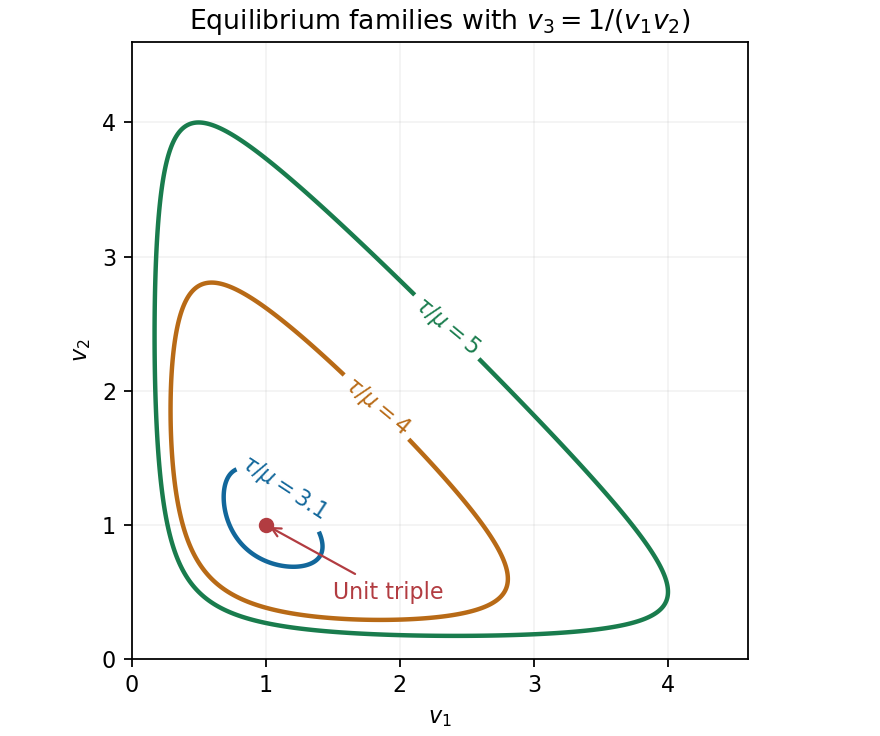
For the particular energy, . Put and . Elastic incompressibility gives , henceEquality for every pair is therefore equivalent to . If all stretches are equal, their positive product one gives , with . Otherwise . Conversely any positive triple with this sum and product one solves the equations, with . Thus the complete solutions within the stated homogeneous diagonal ansatz are the unit triple and the stated sum-product family.
By the arithmetic-geometric mean inequality, , with equality only at the unit triple. Consequently admits only that triple, including equality, when the two descriptions coincide.
To prove infinitely many for , choose near one and setAt the discriminant is ; it stays positive on an interval about one, and both roots remain positive. Every such gives a different admissible triple. HenceThe degeneracy has an energy explanation: under the product constraint the strain energy density is , and the total potential under dead loading is . It depends on the three stretches only through their sum. Its minimum over attainable moves from to the whole level set when the load exceeds .
For a hyperelastic material . Material frame indifference of this first Piola-Kirchhoff law meansThe spatial force components rotate under a superposed rigid rotation, whereas the reference normal does not.
If , differentiate with respect to in direction to obtain , hence the displayed stress transformation. Conversely, assume that stress transformation. For fixed , the derivative of with respect to vanishes. The positive-determinant matrix domain is connected, as follows from polar decomposition and the connectedness of and of the positive-definite cone. Thus , independent of . Iterating givesThe assumed lower bound on forces : either nonzero sign would tend to minus infinity for one direction of integer . This proves the required equivalence and explains the use of the lower-bound hypothesis.
In the frame-indifferent setting, isotropy means invariance under reference rotations as well: for . The distinction matters: left rotations encode changes of observer, and right rotations encode material symmetry.
An orientation-preserving singular value decomposition is , with and . Material frame indifference and isotropy remove , leaving a function of the stretches. Permuting the stretches using signed permutation rotations does not change the value, so is symmetric. Conversely a symmetric stretch function is unchanged by both left and right rotations, in particular is isotropic.
The eigenvalues of are . Its three principal invariants areThey determine the unordered positive eigenvalues as the roots of . Therefore a symmetric stretch function defines a well-defined on the admissible invariant triples. Conversely a function of these invariants is a symmetric stretch function, proving the equivalence of all three descriptions.
The printed domain of must be , since it takes three arguments. Also isotropy alone as right invariance would not imply the spectral representation without material frame indifference: for a fixed nonscalar symmetric positive-definite is right invariant but not generally objective. The equivalence here uses the frame-indifferent constitutive setting.
For the specific energy, Newton identities for the three eigenvalues gives , while . ThusTo differentiate it, useThese follow from , the displayed trace formula for , and . The three partial derivatives of are , and . The chain rule therefore givesFinally , and . This is precisely the requested expression, with the coefficient of separated from the and cofactor terms. The positive sign of the term comes from the contribution in the energy.
Use a temperature-dependent strain energy density with different minimizing deformation gradients in the two crystal phases. Above the transition temperature its wells describe austenite; below it the wells are unions of martensitic variants. Left rotational orbits reflect material frame indifference, while the crystal's discrete material symmetries relate the variants. Minimizing the integral of this elastic energy, together with loading and boundary constraints, models the change of lattice shape. Compatibility restricts which low-energy gradients can meet continuously; fine compatible mixtures can accommodate macroscopic boundary shapes.
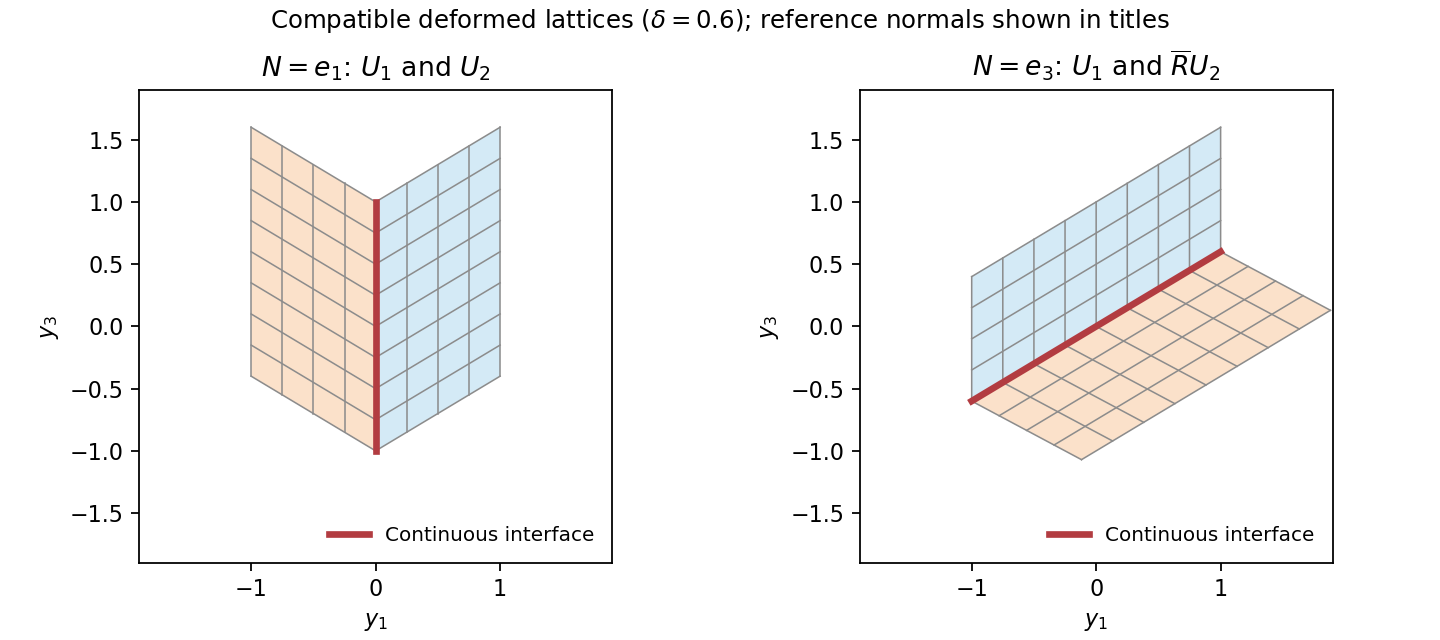
For the jump condition, write the two affine pieces as and . Continuity on the interface meansTaking differences along the interface gives for every tangent vector with . Decompose any vector as . ThenWith this provesConversely this rank-one connection permits continuity by choosing . A coherent twin interface is such a compatible planar boundary between different martensitic variants, possibly after a rigid rotation of one variant. The rank-one condition is therefore the geometric compatibility condition for a simple twin.
For the unrotated pair, direct subtraction givesso is one solution, with reference interface normal .
Put , and . Since , the stated is a proper rotation. Multiplication givesHere and . ConsequentlyThis is the second rank-one connection, now with normal . Because , the two rotations are distinct. The permitted assertion that there are at most two proves completeness.
Finally suppose is rank-one connected to , with . Left multiplication of their difference by preserves rank and gives . The classification just proved forces to be either or , hence or . The two requested matrices are thereforeTheir connections are explicit: the first was calculated above, and . If desired the second matrix is


Articles by others on the same topic
There are currently no matching articles.