Original solutions to past examinations of the solid mechanics course of the University of Oxford.
Solutions to all three questions of the solid mechanics course of the University of Oxford Part C examination, sat on 8 June 2023. Source: original released PDF, inclusive bundle pages 313–316; paper pages 1–4. All eighteen terminal parts are covered, including every question despite the best-two assessment rule. The torque normalization in Question 1 follows the printed integral; the signed pressure in Question 2 is positive for compression.
Write the first strain invariant in components of the deformation gradient:Here lower-case and upper-case indices refer to the current configuration and reference configuration, respectively. Differentiating gives . The chain rule therefore givesSubstitution into the given hyperelastic material law, with its indicated matrix transpose, yieldsThe left Cauchy-Green deformation tensor is . The scalar is the Lagrange multiplier enforcing incompressibility, rather than a function fixed by the strain energy density alone. The identity matrix makes this an isotropic constraint reaction in hyperelastic stress.
Use separate moving orthonormal bases in the reference and current cylindrical coordinate systems. For pure torsion of an incompressible cylinder, the deformation map isThe unit vectors depend on the angle: and . ConsequentlyIn particular, the last derivative includes the rotation of along the cylinder. The material gradient has the reference coordinate scale factor :The outer products specify the images of the three reference unit vectors. Thus, with current basis vectors indexing rows and reference basis vectors indexing columns,Its determinant is one, checking incompressibility. The radius is unchanged, so the current outer radius in part (d) is . The formula at the coordinate axis is understood by continuity in Cartesian coordinates.
Multiplying the deformation gradient by its matrix transpose gives the left Cauchy-Green deformation tensor and its trace:The derivative of the strain energy density isFor brevity put . Part (a) gives the Cauchy stress tensor, in the current cylindrical coordinate system orthonormal basis, asIn particular, the end-face shear stress is . The undetermined pressure affects the normal stresses but does not affect this shear stress. No normal traction conditions have been specified to determine .
Using and the end-face shear stress from part (c), the printed torque normalization givesThe binomial theorem expands the remaining integral into powers of :Integrating each term gives an expression valid also at :For example, gives . The torque is an odd polynomial in the twist per unit reference length, as expected when reversing the twist reverses the end-face shear stress.
For a physical end-face torque , integration over the azimuth normally givesThe original PDF explicitly defines without this , so the boxed answer retains its convention. Since is the Cauchy stress tensor, its shear component here is spatial ; the printed capital in does not require a change to a nominal stress tensor.
Only the term of the polynomial contributes to the limit:Thus the requested torsional stiffness per unit twist isThe small-strain shear modulus is . Therefore , consistently with the usual circular-shaft torque relation after restoring the factor. If the prescribed end rotation is the angle , the physical torsional stiffness is at zero twist. This also explains why does not enter the requested .
The radial unit vector in spherical coordinates is , so . The identity matrix is the sum of the three basis outer products. Substitution in the given deformation gradient givesThe reference and current radial directions coincide for this spherically symmetric deformation. The positive principal stretches are therefore and . Incompressibility imposesIntegrating and using givesIn particular , expressing conservation of shell volume. Writing also gives and .
The Cauchy momentum equation in static elastic equilibrium, with zero body force, is . The Cauchy stress tensor is symmetric. Material isotropy and the equal tangential principal stretches imply , so its radial equation isAll stresses and spatial derivatives in this equation are measured in the current configuration.
Let denote derivatives of the strain energy density with respect to its three principal stretches. The principal stress formula for incompressible hyperelasticity isIt follows by applying in principal axes. Equal tangential principal stretches and material isotropy give at . Differentiating the reduced strain energy density by the chain rule givesThe unknown pressure cancels in this difference. Substituting in part (i), and then using the supplied derivative of , givesConsequently the desired ordinary differential equation isFor completeness, the supplied derivative follows from : , and differentiating gives . At the undeformed value the division must be interpreted by a limit; the spherically symmetric deformation with has and should be handled directly by the radial equilibrium equation.
Take the inner surface to be free of traction, as appropriate to an empty cavity with no surface tension. At the outer surface the imposed pressure is compressive when positive. The outward normal vectors are at and at , givingIntegrating the ordinary differential equation from part (ii) between the two surfaces givesThe outer stretch follows from incompressibility:Hence an expression entirely in terms of the inner stretch and the reference radii isEquivalently . For an expanding shell, ; when on this range, , correctly describing an outward tensile loading. If an inner pressure were present, the same derivation would give on the left. Thus the empty-cavity condition specifies the pressure reference needed for the requested answer.
First let at fixed positive cavity radius and fixed reference outer radius . Thenand the pressure sustaining a finite cavity isThe onset of cavitation is the additional limit . The outer stretch then tends to one, and the signed critical pressure isWhen this improper integral is positive and finite before the minus sign, the tensile loading magnitude is . Thus the cavity opens under tension, even though the load variable is named pressure. The critical value is independent of the original sphere radius .
For and , the deformation map is smooth away from but singular at the original centre: approaches , rather than zero, as . This is the elastic cavitation mechanism; it cannot be represented by a smooth deformation map through the centre.
The neo-Hookean solid corresponds to , with positive shear modulus . Substitution of the principal stretches givesThe identity simplifies the integrand:The two improper integrals are elementary:Thus the critical tensile stress magnitude is . As a check on the finite-sphere limit, part (c) giveswhich tends to as the cavity radius tends to zero.
For general , put . The reduced strain energy density and its derivative areThe same factorization as in part (i) yieldsThis form removes the apparent singularity at : its limit is , finite for every fixed . Thus only the upper endpoint can obstruct convergence of the improper integral.
As , , givingFor , the comparison test with a power integral implies convergence exactly when . Thereforeis precisely the range with finite critical pressure, the cavitation criterion for power-law strain energy. At the divergence is logarithmic; for larger it is a power divergence. These materials require an unbounded tensile loading magnitude in this ideal model. The qualification excludes the degenerate zero-energy material.
The first equation is the local balance of linear momentum. Use for the dimensions of mass, length, and time, to distinguish dimensional time from the Cauchy stress tensor .
- is the current position of the particle labelled by reference position ; both have dimension . The deformation map specifies the particle's trajectory.
- is its material acceleration, with dimension . The dots follow the particle and are not spatially fixed time derivatives.
- is current mass density, with dimension . For a homogeneous material with incompressibility, mass conservation makes it constant in space and time.
- is body force per unit mass, such as gravitational acceleration, with dimension . Hence is force per unit volume.
- is the Cauchy stress tensor, mapping a unit normal vector to surface traction . Each component has dimension , or force per unit area.
- differentiates in the current configuration, with dimension . In Cartesian coordinates, . Thus , , and all have dimension .
- The superscript denotes the dimension-preserving matrix transpose. The relation expresses angular momentum conservation in a continuum without body couples or couple stresses.
Here has dimension . The hypothesis means that the prescribed spatial body force field is the same for every member of the static family and the resulting motion.
Restore the particle label suppressed in the question, writing the static family as . At each fixed , its Cauchy stress tensor satisfiesThis dynamic continuation of a static incompressible elastic deformation sets to form a motion. At every time its deformation gradient is the same as that of the corresponding static member. For an elastic material the elastic part of the Cauchy stress tensor depends on that deformation gradient, while incompressibility leaves an arbitrary scalar constraint reaction in hyperelastic stress. Therefore writeHere is the identity matrix. Subtracting static balance of linear momentum from dynamic balance of linear momentum givesSince the homogeneous incompressible material has constant mass density, define . NecessarilyConversely, suppose this acceleration potential exists. Choose . ThenThe added isotropic stress is symmetric, so angular momentum conservation remains satisfied. This proves both directions for the field equations and the elastic constitutive equation. The surface tractions for the motion are those of the adjusted stress; identical prescribed static tractions would impose an additional boundary restriction on .
The pressure adjustment from part (i) can be writtenIndeed, since , the difference of the two Cauchy momentum equations isThus is constant in space on each connected component. The function is fixed by any prescribed pressure or surface traction datum. In terms of the usual compressive pressure multiplier, . The plus sign in therefore does not identify with the compressive multiplier itself.
For a twice continuously differentiable scalar potential, mixed second partial derivatives commute. Taking the spatial curl of the equation from part (i) givesFor example, its first component is . The curl acts on the spatial representation of the material acceleration, not directly on its expression in reference coordinates.
This is a necessary local condition. It is sufficient locally, and sufficient globally on a simply connected domain under the usual smoothness assumptions. On a domain with holes, a global scalar potential additionally requires every closed-loop line integral of the material acceleration to vanish. The homogeneous motion in part (c) admits an explicit global scalar potential, so this topological qualification causes no obstruction there.
Take two time derivatives at fixed reference position :The constraint ensures that the deformation gradient is invertible, so . Thus the spatial material acceleration is the affine vector fieldIts spatial gradient is , and its curl isPart (b)(iii) therefore requiresEquivalently, multiplying on the left by and on the right by givesThe translation contributes no spatial curl and is unrestricted by this condition. A useful equivalent first integral isthe antisymmetric matrix in parentheses must be constant, and need not vanish. The separate constraint is still required; differentiating it also gives .
The condition is understood in the setting of part (b), where a static family already exists under the prescribed body force. For a homogeneous elastic deformation gradient, the elastic stress is spatially constant. Static balance of linear momentum consequently gives , ensuring that has a scalar potential. If the static-family assumption were dropped and an arbitrary time-independent body force allowed, the general necessary condition would instead be .
For this homogeneous motion, suppose the matrix is symmetric. Put . The acceleration potential of a homogeneous motion iswhere is arbitrary. When taking the spatial gradient, , , , and are fixed. Symmetry givesThis verifies the potential directly and also proves sufficiency of the symmetric matrix condition within the static-family setting. Its dimension is , so the pressure correction has the dimension of stress. Combining with part (b)(ii), the corresponding dynamic Cauchy stress tensor iswhere . Substituting its divergence into the Cauchy momentum equation reproduces , as required.
Source release: Oxford examination archive release thread, Part C bundle pages 426–429. The cover identifies Solid Mechanics, Tuesday 7 June 2011, 9.30am–11.00am.
Answer availability checked on 28 October 2026: bounded searches of official Oxford sources by exact year, title, module and formal code found no advertised exact-paper answers. The 2020–21 Solid Mechanics course page lists an exam compilation covering 2011–2020, but does not advertise it as solutions; its linked resource could not be fetched in the bounded check. No later-year release policy was used to infer 2011 availability.
A homogeneous hyperelastic material has a strain energy density per unit reference volume depending on the deformation gradient, with no explicit dependence on the reference configuration. For orientation-preserving gradients , its first Piola-Kirchhoff stress tensor is the derivative:Equivalently the infinitesimal stored-energy change is . Reference and spatial indices are distinguished here by upper- and lowercase index letters.
The material symmetry group may be written . A volume-preserving relabelling convention restricts the candidate to ; the material isotropy criterion is the same. The material has material isotropy when , meaning for every proper rotation . If only rotational symmetries are included in the definition of the group, material isotropy means that group equals . This right-rotation invariance is distinct from material frame indifference, the left-rotation invariance .
The polar decomposition in continuum mechanics gives the unique factorizationswhere are positive-definite symmetric matrices. Their common positive eigenvalues are the principal stretches, equivalently the singular values of . They describe the local stretch magnitudes after separating out a rigid rotation.
Define the invariants by the characteristic polynomialBecause has positive eigenvalues , its invariants are the elementary symmetric functions in those eigenvalues:The Frobenius norm gives . Write . Since , its singular values are , soFinally . ThereforeThese identities also give and .
Take a singular value decomposition , with positive and . Such a choice is possible because . Left material frame indifference removes , and right material isotropy removes , giving .
Moreover is unchanged when the positive diagonal entries are permuted. Every permutation can be implemented by a signed permutation matrix of determinant one; the signs disappear in conjugating a diagonal matrix. Thus the energy depends only on the unordered principal stretches.
The three invariants determine precisely this unordered triple: the roots of are , and their positive square roots give the stretches. Consequently, on the set of admissible invariant triples, define to be . The preceding argument proves that this is well defined and thatNot every positive triple is realizable by three positive roots. Since the requested statement only asserts existence of a function on , extend arbitrarily on the nonrealizable triples; no choice there affects the formula for a deformation in continuum mechanics. Smooth invariant representations, where needed for differentiating the constitutive equation, are understood locally on the realizable set.
Retain the material frame indifference assumption used in part (c), in addition to material isotropy. Put , and . For this antiplane shear,The invariant identities give and . Hence the restriction of the strain energy density isAntiplane energy does not determine the full stress: the restriction gives one scalar energy along antiplane gradients. It does not determine the full stress derivative with respect to every entry of .
Indeed, using the isotropic hyperelastic stress invariant representation and differentiating the energy, with denoting the corresponding partial derivatives, givesUsing , the general objective isotropic Cauchy stress tensor isAll derivatives are evaluated at the current invariant triple. The extra terms generally remain nonzero on antiplane gradients, so the printed assertion that the full stress must be does not follow.
A stress-free, objective isotropic counterexample is the compressible neo-Hookean solid , with . Its derivative is , so on antiplane gradientsTake . Then but , whereas and . The diagonal entry would force , contradicting the shear entry. Thus this is not a matter of choosing the right scalar coefficient.
For the additional one-invariant constitutive assumption , the stronger formula does hold, withThis is a valid special case, rather than a consequence of material isotropy alone. For the general restricted energy, the shear entries are still fixed: and , since along . The full normal stress needs the constitutive information that the printed claim omits. If material isotropy alone is interpreted without material frame indifference, even the first reduction to needs that additional material frame indifference assumption.
In the classical smooth setting, a deformation in continuum mechanics is a sufficiently regular, injective map with . Injectivity excludes material interpenetration, and a positive determinant preserves orientation and local volume. We use regularity for these kinematics and additional differentiability where stress-divergence identities are applied.
Cauchy's stress theorem states that the contact force on an oriented surface element at a current point depends on the point and its unit normal, rather than on the shape of the chosen subbody. Thus the contact force on the boundary of a current subbody has the form . Static force balance, for a body force per unit current volume, isfor every subbody. A shrinking pillbox gives ; a shrinking tetrahedron then gives linear dependence on the normal, . Applying the divergence theorem and using arbitrary subbodies givesIf body force is specified per unit mass instead, replace by . Symmetry of follows additionally from conservation of angular momentum in the absence of body couples; it is not a consequence of force balance alone.
The surface element relation is Nanson's formula. The force on a corresponding pair of current and reference surface elements must agree:Therefore the first Piola-Kirchhoff stress tensor isIt measures force per reference area, with a current force direction and a reference normal direction.
In components, differentiate . The Piola identity says . One proof writes the cofactor matrix as ; differentiating in produces symmetric second derivatives contracted against antisymmetric epsilon symbols, hence zero. The chain rule consequently givessince . Thus, with the coordinate composition made explicit,The distinction between reference divergence and current divergence is essential to this identity.
For , and . Differentiating the spherically symmetric deformation givesFor an orientation-preserving spherically symmetric deformation with positive radius, and . The radial direction and its perpendicular plane are eigenspaces of this positive symmetric matrix, soAt a positive diagonal matrix , every diagonal rotation with two minus signs commutes with . The supplied equivariance relation therefore forces to be a diagonal matrix: each off-diagonal entry changes sign under one such rotation while stays fixed. Varying a positive diagonal entry shows that the diagonal entries of are . Permutation symmetry of implies when .
Choose a rotation whose first column is . Applying equivariance to now giveswith the derivatives evaluated at . Thus the stress has one radial and one repeated tangential principal value, independently of the choice of tangent basis.
The Green-Lagrange strain tensor has eigenvalues . Its Frobenius norm and trace are invariant under the orthogonal principal-axis change, soFor the homogeneous dilation , put . Then . Differentiating the energy through gives the second Piola-Kirchhoff stress tensor , and multiplication by gives the first Piola-Kirchhoff stress tensor. ThusThe normals of the reference and deformed spheres point in the same radial direction. As , the reference traction magnitude tends to zero, while the current traction magnitude tends to infinity, provided , as for physically stable Lamé parameters. The negative signs of the stress coefficients for indicate compression.
There is no contradiction: the current area is times the reference area, so the same force divided by the vanishing current area has the larger stress. Indeed . The limiting map at is not itself an admissible deformation in continuum mechanics; the statement concerns the approach through positive . A degenerate choice would not have the asserted growth without bound.
The displacement field is , and its gradient is . Linear elasticity expands about an undeformed stress-free reference state, taking with and external loads of the same small order. A rigid translation need not itself be small; it is the deformation gradient that controls the infinitesimal strain tensor.
For with , a Taylor series givesThe constant can be set to zero. The tensor is the elasticity tensor. Commutation of continuous mixed partial derivatives proves its major symmetry:Material frame indifference at a stress-free reference also makes the quadratic energy depend only on the infinitesimal strain tensor , leading to the usual minor symmetries after spatial and reference indices are identified.
In this scaling, an external force of order may be evaluated on the reference geometry: its change due to the order- displacement contributes only at order . Thus the leading forces are fixed dead loads. Likewise , and , so the Piola transformation gives . Hence Cauchy and first Piola stresses agree to linear order. This reasoning uses the usual small-load, stress-free linearization; an order-one prestress or leading follower-load effect requires a different expansion.
Let the boundary split into a displacement part and a traction part . The linearized stored elastic energy functional isIts corresponding total potential subtracts the work of fixed body and surface loads:The problem in the calculus of variations is to minimize among admissible displacements with on . For a stable quadratic elastic energy this is the usual energy minimization formulation. Its stationarity condition suffices to derive equilibrium.
Vary by , with on . Major symmetry combines the two differentiated quadratic terms, givingIntegration by parts, first with test functions compactly supported in the interior, gives . Then arbitrary traces on give the natural traction condition. The complete boundary value problem isFor a homogeneous hyperelastic material the elasticity tensor is constant. In isotropic linear elasticity the constitutive equation is , giving the familiar Navier-Cauchy equation .
Taking traces of the constitutive equation givesThe assumed finite limits of stress and strain make the right side bounded. Therefore , and the limiting strain satisfies . The permitted interchange of derivatives and limits gives . DefineThen the limit stress is . Passing to the limit in force balance and using givesThe pressure acts as the Lagrange multiplier enforcing the volume constraint. The differential equations determine it up to an additive constant, while a specified absolute limit stress can fix that constant.
Nonlinear elastic incompressibility is . Expanding the determinant for gives , so its first-order form is precisely . The volumetric energy term becomes increasingly expensive as grows, while the fixed positive leaves shear strain possible. Thus the infinite-bulk-stiffness limit is the incompressible limit of isotropic linear elasticity, with the same equilibrium operator as the steady Stokes equations.
Original solutions to the paper released at the source request. The complete editable transcription is retained in the private examination archive.
A homogeneous hyperelastic material has a stored energy per reference volume depending on the local deformation gradient but not explicitly on the material point. Its first Piola-Kirchhoff response isA superposed rigid rotation changes the observer's description without changing the energy of the deformation. Material frame indifference is thereforeThis left-rotation invariance is distinct from a material isotropy assumption on right rotations. Differentiate it in an arbitrary matrix direction :The Frobenius inner product then gives , proving .
For the converse, that stress covariance makes the derivative in of zero. The positive-determinant matrices form a connected set, as also follows from polar decomposition, so this difference is a constant independent of . Composition gives . For fixed , continuity of and compactness of make bounded. But for every positive integer, forcing . Thus stress covariance and frame indifference of the energy are equivalent. Compactness removes the possible additive energy constant in the converse.
For small displacement gradients write . Taylor expansion around the stress-free reference state givesThe linear term vanishes because . Drop the irrelevant constant and retain the quadratic term:The major symmetry follows from equality of mixed second derivatives. For a skew matrix , stress covariance along givesDifferentiation at zero yields . Thus for every skew matrix, which forces the input minor symmetry . Combining it with the major symmetry gives the output minor symmetry as well:These identify reference and spatial indices at . Decompose into symmetric and skew parts. Since and the major symmetry also eliminates the other cross term,Thus infinitesimal rotations cost no energy in the quadratic approximation.
As a function of the full deformation gradient, use . Let , a proper rotation. Assumed full frame indifference would give . For , its infinitesimal strain is . Quadratic homogeneity therefore givesChoose . ThenThe homogeneous deformation changes volume but has zero energy. This illustrates why a nondegenerate small-strain quadratic energy cannot also be imposed as a fully frame-indifferent finite-deformation energy.
A deformation maps a material point in the reference body to its current position, , with deformation gradient . A homogeneous deformation has constant gradient and is affine, .
If , the matrix is symmetric positive definite. The matrix-square-root theorem says that any such matrix has a unique symmetric positive definite square root, obtained by taking positive square roots in its orthogonal spectral decomposition. SetThen and , so and . If also , then ; uniqueness of the positive square root gives and then . This proves existence and uniqueness of polar decomposition.
The principal stretches are the positive eigenvalues of , equivalently the singular values of or square roots of the eigenvalues of .
For , differentiation gives and . HenceThe two matrices are the orthogonal projections onto the tangent plane of the reference sphere and its radial line. The gradient multiplies the radial direction by and each tangent direction by . With positive , it is itself symmetric positive definite, so its eigenvalues are its principal stretches:
The determinant condition is , or . Integration gives and the outer boundary value fixes . ThusFor , tends to the positive cavity radius as . Its tangential stretches grow like that radius divided by , so . The deformation is singular at the origin and is interpreted as a finite-energy Sobolev deformation, with a point value irrelevant to its energy.
Since and the determinant penalty is zero almost everywhere,For fixed , the first integrand is near zero and the second is bounded. Thus the energy is finite despite the unbounded gradient. In particular the gradient is square integrable, as required for this competitor.
For large , uniformly on . The first integral is , while . ConsequentlyThe spherical volume factor is what makes the tangential-gradient singularity integrable in three dimensions.
Choose the homogeneous dilation , which has the required endpoint values. For a radial field, put . The radial energy density, after omitting its constant angular factor, is . Its Euler equation simplifies toThe chosen dilation has , constant, and satisfies it. More directly, the full first Piola-Kirchhoff response for the given energy isAt this is , constant throughout the body. Its divergence vanishes, so the deformation satisfies the full force-free equilibrium equations as well.
Its energy isThis grows like , whereas the same-boundary cavitating competitor has energy asymptotic to . Therefore for sufficiently large , the homogeneous equilibrium is not a global energy minimum in the finite-energy class admitting the cavitating deformation.
The admissible class matters: the competitor from the preceding part is not continuous at the center. This comparison is in that Sobolev class, not a claim about minimization restricted to smooth cavity-free deformations.
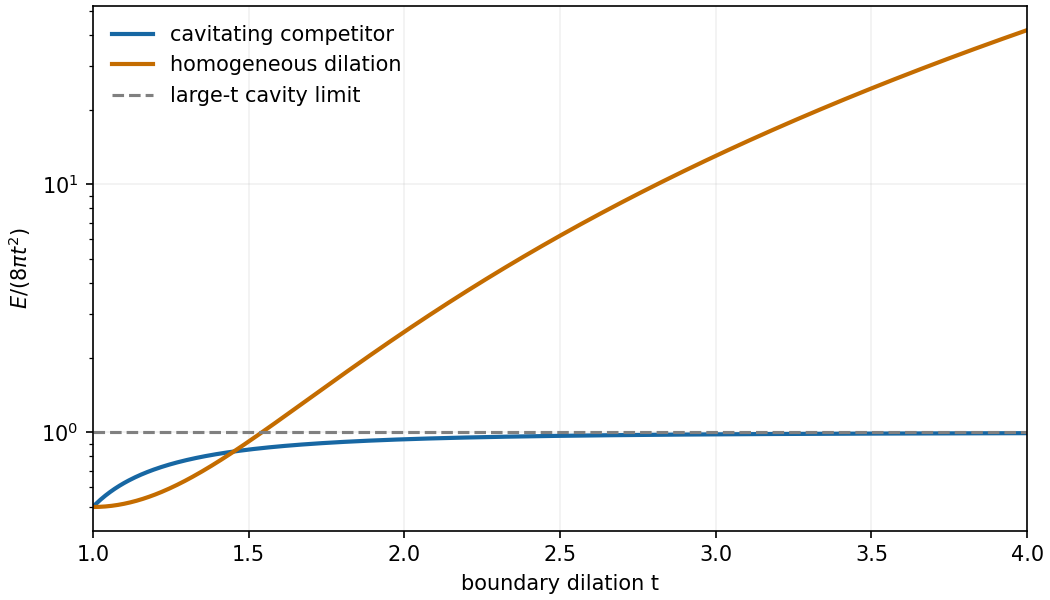
Energy comparison in the finite-energy class: the homogeneous dilation grows like t to the sixth power while the cavitating competitor grows quadratically
. Details. 
An antiplane displacement has the form , independent of the out-of-plane coordinate. Only and are nonzero, so its strain energy per unit out-of-plane thickness is .
The equilibrium minimizes total potential energyHere is the out-of-plane body-force component; the two crack faces have independent traces. For a variation with zero outer-boundary trace, stationarity givesIntegrating by parts first for interior test functions and then for variations free on either crack face yieldsThese are the weak equilibrium equation, prescribed displacement, and zero traction. The tip behavior is selected by finite energy; it is not an additional prescribed tip value.
Use , with the crack along the negative radial axis. In the coefficient convention used here, the leading crack-tip expansion isThe square-root term is harmonic and has zero angular derivative on both crack faces. Regular contributions may include a constant and bounded-gradient terms under smooth loading.
If is the minimized elastic-plus-load potential, the energy release rate is . With this particular square-root coefficient normalization,For example, the small-circle energy flux is . The singular term gives , and . Integration over produces the stated factor. Other stress-intensity normalizations change that factor.
For toughness , local stability against infinitesimal extension means , since the derivative of is nonnegative. Global energetic stability against every extension is the stronger condition for all .
In full isotropic linearized elasticity,For the antiplane field this becomesAhead of the tip, , the singular gradient is . ThusThis is stronger than the printed remainder . If denotes a nonnegative intensity, it has the printed leading coefficient; for a signed singular coefficient its absolute value is essential because the left side is a norm.
For a differentiable crack path, the local quasistatic Griffith laws with constant positive toughness areThey express irreversibility, local stability, and energy balance during growth. A strictly subcritical release rate forces the crack to stop.
Fix a crack parameter and let denote the equilibrium displacement with the prescribed time-dependent loads. The scalar equilibrium problem is linear and has a unique solution for its fixed Dirichlet data. Both body force and boundary displacement scale by , soThe minimized potential energy is quadratic under this scaling: the strain term scales by and so does the load term . Hence andEquivalently the crack-tip coefficient scales by and its squared energy-release formula gives the same result.
Put . Finiteness and continuity of make it bounded by some finite on a neighborhood of . Continuity of supplies a positive interval on which stays in that neighborhood. Shorten it to so that . Then , and complementarity forces throughout. ThereforeNo differentiating an unknown crack path or assuming its length already constant is needed; its continuity first gives the local release-rate bound.
Original solutions to the paper released at the source request. The complete editable transcription is retained in the private examination archive.
The matrix exponential is the absolutely convergent series , with derivative and inverse . If , then . Its determinant is continuous in , is never zero, and starts at one, so it is one throughout: . Conversely, differentiating at zero gives . ThusThe quantifier matters: membership at one isolated time alone would not imply skewness.
Write and . For any skew matrix , differentiate frame indifference along :A matrix orthogonal to every skew matrix is symmetric. Therefore and the Cauchy stress tensor are symmetric.
Let and assume . Differentiating symmetry of at in direction shows is symmetric for every . Hence . As a Hessian, also has pair-interchange symmetry . Combining the two gives . Equivalently annihilates infinitesimal rotations. This proves both requested minor symmetries and shows exactly where the stress-free assumption enters. It is stress-free linearization of an objective energy.
For the particular energy, and , soAt this is . Therefore the reference is stress-free exactly when . To differentiate again, use . The determinant and inverse derivatives at givewhich also proves the supplied hint. It follows thatFor a symmetric this becomesNo additional positivity of the bulk modulus follows from the stated smoothness of alone; this calculation identifies the moduli rather than imposing extra material assumptions.
Articles were limited to the first 100 out of 128 total.
Articles by others on the same topic
There are currently no matching articles.