For a massive particle on a timelike world line, proper time satisfies . Its four-velocity and four-acceleration are and . Differentiating givesThe invariant Minkowski inner products areFor the explicitly requested contraction,Thus four-acceleration is orthogonal to four-velocity. Equivalently this follows by differentiating the constant Lorentz scalar with respect to proper time.
The event separation is timelike precisely whenA simultaneous pair in an inertial frame would instead have . Since a Lorentz transformation preserves this interval, no such simultaneous frame exists. A timelike pair can be brought to the same spatial position: the required velocity is , whose magnitude is less than .
The separate condition says that the two event-position four-vectors, measured from the chosen spacetime origin, are orthogonal in the Minkowski inner product. It is invariant under Lorentz transformations about that origin but not under arbitrary translations. It is not a general criterion for their causal separation.
For a concrete example, put and . Their inner product vanishes, but their separation has squared interval , which can be positive, zero or negative. If is timelike, a rest frame for makes ; this means that and the chosen origin are simultaneous in that frame, not that and are simultaneous.
The proper acceleration is , the magnitude of the instantaneous rest-frame three-acceleration. A pure force is a four-force preserving rest mass, or equivalently satisfying . Indeed gives .
For the right-hand branch of the hyperbola, use , and , taking . Direct differentiation givesThe sign of follows the sign of , whereas the coordinate acceleration on this branch is positive. ConsequentlyThe proper-time parameterization , independently gives constant proper acceleration. Restoring dimensions, a hyperbola has . Constant proper acceleration does not mean that all inertial-frame components of the four-force are constant.
Let and . A constant laboratory three-force means , hence from rest. Using givesThe dimensionless time makes the shapes transparent: starts at one with zero slope and becomes asymptotically linear; starts linearly and approaches one without reaching it at finite time. The acceleration decreases as .
Integrating the velocity gives the distance along the force,Thus a constant three-force produces hyperbolic motion with constant proper acceleration , although its velocity is never Newtonian at large time. The following original curves supply the requested sketches.
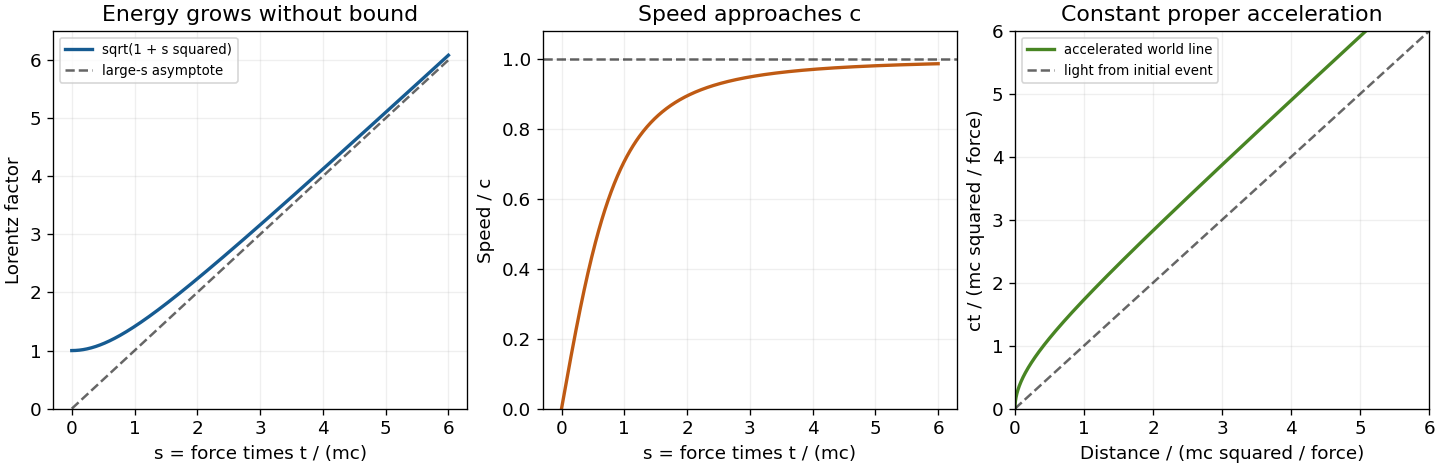
Lorentz factor, speed and world line for acceleration from rest under a constant laboratory three-force
. Details. 
The magnitude of the electric force is , directed so that the electron gains energy. The work across the gap is . With the source precision ,Reducing the field by 20 percent gives kinetic energy andA large fractional energy change therefore produces only a small speed change, since the original electron is already highly relativistic.
Articles by others on the same topic
There are currently no matching articles.