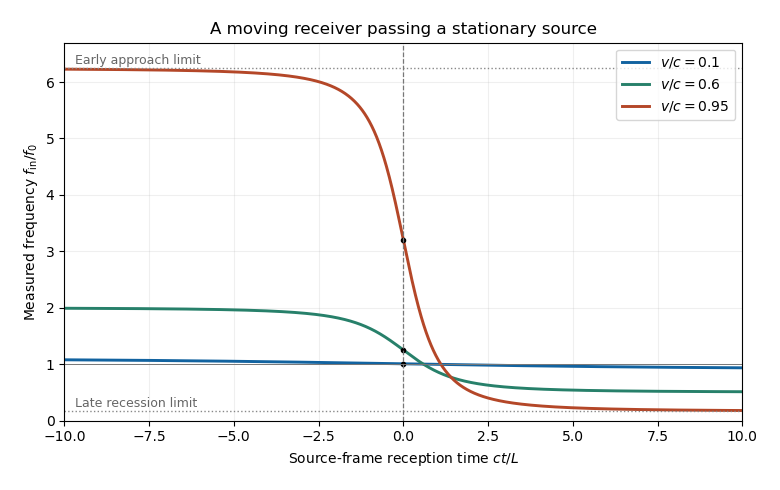
Let label the reception event in the source reference frame. Its distance from the source and the relevant retarded time areThe received phase is . Because the observer's proper time obeys , its measured frequency isEquivalently, write and . The incoming Doppler factor is , obtained also by contracting the photon four-momentum with the observer's four-velocity. The frequency decreases monotonically, withIn particular, the instant of closest approach is not the zero-shift point: a moving receiver looking perpendicular to its motion sees a factor , not . The latter factor applies to a different moving-emitter geometry. The graph uses source-frame reception time, with observer proper time .

Articles by others on the same topic
There are currently no matching articles.