Use the inverse standard Lorentz boost, and . Label two rod endpoints by a separation ; their world lines satisfy . A rod's orientation in must compare endpoint events simultaneous in , not in . ConsequentlyThenThe signed counterclockwise angle therefore satisfiesFor positive , the rod slopes downward to the right, so the acute clockwise angle is . This is a relativity of simultaneity effect in addition to the longitudinal length contraction; the rod is not being mechanically bent by the coordinate change.
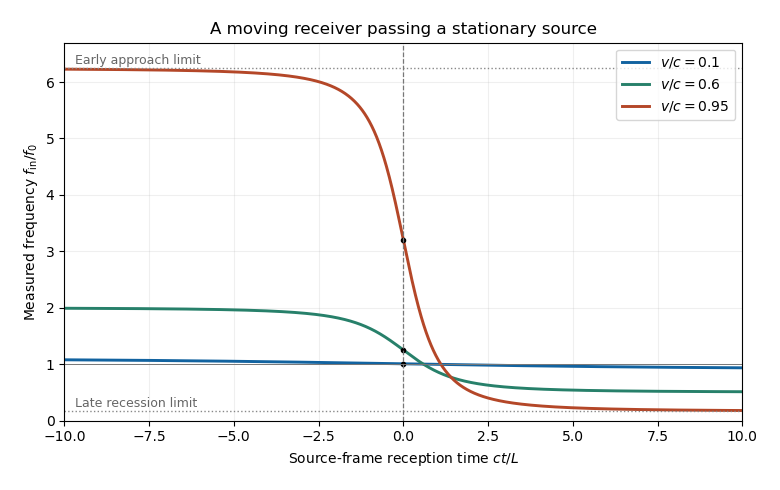
Let label the reception event in the source reference frame. Its distance from the source and the relevant retarded time areThe received phase is . Because the observer's proper time obeys , its measured frequency isEquivalently, write and . The incoming Doppler factor is , obtained also by contracting the photon four-momentum with the observer's four-velocity. The frequency decreases monotonically, withIn particular, the instant of closest approach is not the zero-shift point: a moving receiver looking perpendicular to its motion sees a factor , not . The latter factor applies to a different moving-emitter geometry. The graph uses source-frame reception time, with observer proper time .

A useful plot must keep three different times separate: source emission , atomic absorption or re-emission , and return reception . For the cloud centroid,Let . Resonant excitation requires . Since decreases from to , its zero-width resonance first becomes possible atAt equality the line centre is reached only at infinite approach distance, where illumination vanishes. A finite source start time further limits how closely that ideal threshold is approached. For the line-centre event satisfiesThere is a second useful critical speed,for which excitation is centred on closest approach, . For it occurs on approach; for it occurs after closest approach. Even a receding ultra-relativistic atom can see the incident light blueshifted because is large.
A photon emitted toward the origin near the atomic rest-frame frequency has return Doppler factorThe sign differs from that in because the returning ray travels in the opposite direction. The returning line centre decreases from on early approach to on late recession, and is at closest-approach emission. The origin receives that closest-approach radiation at , not at zero. Prompt re-emission at exact resonance would giveIt is above below , equal at , and below above it. A finite fluorescence lifetime shifts emission later along the orbit and therefore usually toward a lower return frequency.
The following plots adopt a compact, optically thin cloud, weak excitation, isotropic incoherent spontaneous emission in the atomic rest frame, and negligible velocity dispersion. They show an intensity envelope as the observable amplitude; its rms electric-field amplitude is proportional to the square root of this intensity. An incoherent fluorescence signal has no fixed optical phase. The four rows include a nonrelativistic speed, both critical speeds, and an ultra-relativistic speed. All rows share one intensity normalization, so off-resonant signals remain visibly weak.
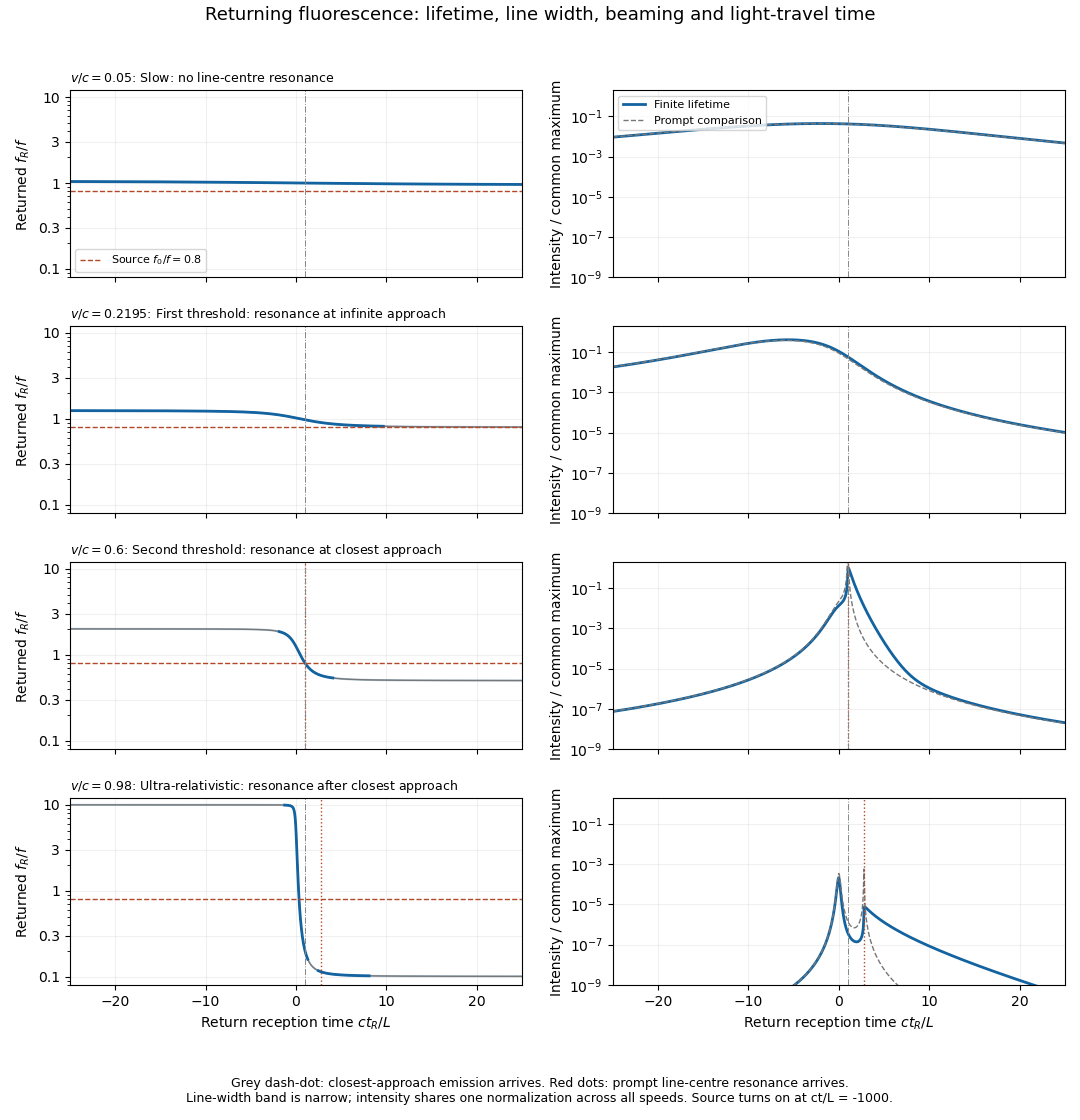
Illustrative returning fluorescence for slow motion, both resonance thresholds, and ultra-relativistic motion
. Left panels show the returned atomic line centre and its finite-width band; a dashed line marks the source frequency. Right panels show received intensity on a common logarithmic scale, with a thin curve for the zero-lifetime comparison. The model uses f0/f equal to 0.8, proper lifetime c tau/L equal to 0.4, fractional natural full width 0.02, and a finite source turn-on. Solid curves include the population decay, retarded reception and beaming. Details.
A model for fluorescence from a uniformly moving cloud generating the plotted envelopes iswhere is a Lorentz line shape of full width . The factor is the incident photon-flux correction per source-frame time. The population is an exponential memory of earlier absorption events, not an instantaneous resonance indicator. For a detector of fixed small area at the origin, its received bolometric intensity scales asTwo powers of come from aberration of light, one from photon energy, and one from arrival-rate compression. Finite lifetime is dilated to in the source frame; over an interval with slowly changing geometry its observed decay time is . Thus approach can compress and amplify a pulse, while recession stretches and redshifts it. Illumination and collection each supply an inverse-square geometric factor in the prompt weak-excitation limit. Strong forward beaming can even make a detuned approaching precursor brighter than the later line-centre feature, as in the ultra-relativistic row; the intensity maximum need not occur at exact resonance.
Absolute amplitude and a unique detailed spectral line profile cannot be inferred from alone: cloud size, atom number, source power, optical depth, angular emission pattern and saturation were not specified. Finite cloud size convolves these point-centroid curves with additional delays. The plots describe incoherent, frequency-redistributed emission near ; a coherent Rayleigh scattering component would instead retain the driving frequency in the atom frame and add a different spectral component. These qualifications do not change the kinematic resonance thresholds or return-time relations.
Decreasing increases the blueshift required for excitation. Both characteristic speeds move toward :If is near one, modest approach speeds can excite the line. If , only strongly relativistic motion reaches the line centre. At a fixed qualifying speed, decreasing moves the resonance toward earlier approach, since a larger is required. It can also move the event outside the illumination window set by .
At fixed , increasing moves the resonance from the far approaching tail, through closest approach at , and eventually to the receding side. The received pulse frequency cannot be estimated simply by applying the same blueshift twice: the inward and outward Doppler factors are different, and decay may occur well after excitation. The critical-speed rows of part i make these changes explicit.
An excited-state population lifetime gives a natural linewidth whose Lorentzian full width in ordinary frequency iswhen no extra dephasing broadens it. Additional thermal motion, collisions or inhomogeneity may increase the effective width. Therefore excitation is appreciable over , rather than only at one event. A Lorentz line shape has nonzero wings, so is a line-centre threshold, not a mathematically sharp cutoff of all signal. Below it, only a weak detuned wing may be excited; at it, finite-width illumination produces a broad weak precursor rather than a delta-function burst at infinity.
For a narrow line with a finite resonance time, a useful local excitation duration isNear the far-approach threshold this linear estimate becomes large and the full line shape and inverse-square illumination must be retained. After re-emission, the received full width is approximately at a fixed emission event. Lifetime memory and the changing return Doppler factor additionally produce a chirp and a redder tail.
The plots in part i use and , consistently corresponding to if the width is entirely natural. They are illustrative dimensionless parameters, not an asserted measurement for a specified atomic species.
Articles by others on the same topic
There are currently no matching articles.