Set . Continuity gives , hence . Substituting into radial and angular momentum givesFor example , and the radial acceleration is . Equality of the mixed pressure derivatives now requiresThus the equation for radial viscous flow in a wedge isIt can also be integrated once as .
No slip on the two fixed radial walls gives . The outward flux through a circular arc is , so source strength requires that integral to equal . Set and . ThenAt leading order , whose general solution is a constant plus sine and cosine of . The symmetric source-driven branch has no sine term; for generic this also follows directly by subtracting its two wall conditions. ThusIndeed its integral is . At isolated angles where an odd zero-flux homogeneous mode satisfies both wall conditions, symmetry selects the stated branch.
The normalization denominator vanishes when , namely . The relevant first root above is radians. The zero root is not the critical angle of interest.
For the denominator is positive. The profile is even, with outward flow near the bisector and reverse flow adjacent to each wall:It vanishes at the walls and at ; its minima are at . The following sketch shows the leading approximation to for small .
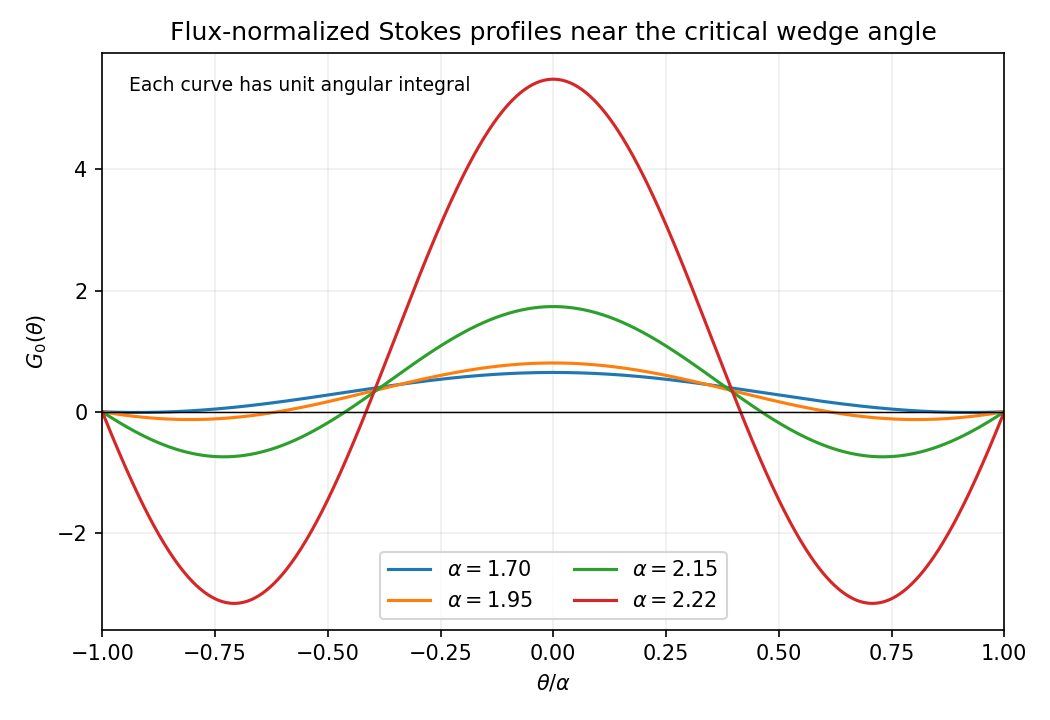
Leading radial wedge-flow profiles: outward central flux and reverse wall layers grow near the critical angle
. Details. 
As approaches from below, the large positive central and negative wall contributions nearly cancel while the prescribed net flux remains one. The leading Stokes solution diverges, so the supposedly small nonlinear inertial term can no longer be treated as a perturbation. This is the critical angle of a flux-normalized Stokes wedge flow. It demonstrates breakdown of this regular expansion; it does not establish that the exact viscous flow must have infinite speed or that a global steady branch continues through the critical angle.
Articles by others on the same topic
There are currently no matching articles.