Original solutions to the paper released at the source request. The complete editable transcription is retained in the private examination archive.
Label fluid particles by , with flow map satisfying . If , differentiation of the determinant gives . Pull the material-volume integral back to a fixed initial volume:The chain rule and the Jacobian identity give the integrand . Transforming back yields the Reynolds transport theoremEquivalently the additional surface flux is . The material boundary moves with the same normal velocity as the fluid, which is the key distinction from a fixed control volume.
Use conservation of mass and Newton's momentum balance, in addition to the supplied constitutive law. For a material volume,The Reynolds transport theorem and reduce the left side to . The divergence theorem then gives . For constant ,Incompressibility removes the last term. ThusThe stress formula and zero divergence alone are not a dynamical law: the force balance supplies the required physical input.
Take and no imposed streamwise pressure gradient. The normal momentum balance gives . The streamwise equation is , since the convective acceleration vanishes. With no slip at the lower wall and signed upper-wall traction in the positive direction, the conditions areIntegration givesThe required upper-wall velocity is its endpoint value . The unfactored formula remains meaningful when .
The fluid exerts shear per unit length on the lower plane in the positive direction. The force of that plane on the fluid has the opposite sign. The total wall force on the fluid balances its downslope weight, providing an independent sign check.
Let , stretch and write the original transverse velocity as . Continuity then gives . In the streamwise momentum equation is order one, while is negligible. The transverse equation gives to leading order, so pressure is supplied by the outer Euler flow. Its streamwise balance is . ConsequentlyFor a stationary impermeable plate, , with matching as . The transverse velocity must match the outer displacement flow; it is generally wrong to impose independently at infinity.
At the leading edge the wall no-slip data meet the external stream abruptly, and the boundary-layer approximation is nonuniform. For a constant external speed, the thickness is , whose ratio to ceases to be small when the local Reynolds number is order one. A leading-edge region retaining neglected derivatives is needed there. An adverse pressure gradient can also cause separation farther downstream; a large global Reynolds number alone does not prevent it.
Use , , and put , . ThenMatching requires . Equating the powers in streamwise inertia and transverse diffusion givesThe two convective terms combine to , while . Hence the Falkner-Skan equation in this scaling isThe additive stream-function constant is fixed by ; when this also encodes no penetration. For it is a harmless choice of additive constant choice. Existence of an attached physical branch for a given is a separate issue from deriving the similarity reduction.
On an attached branch with away from the wall, use itself as the independent variable. The chain rule gives and . ThereforeIf the wall shear , then , so . Thus is singular at zero while is finite. Imposing a finite arbitrary would remove the usual attached branch. This is the velocity as dependent variable in the Falkner-Skan equation reduction.
Set . Continuity gives , hence . Substituting into radial and angular momentum givesFor example , and the radial acceleration is . Equality of the mixed pressure derivatives now requiresThus the equation for radial viscous flow in a wedge isIt can also be integrated once as .
No slip on the two fixed radial walls gives . The outward flux through a circular arc is , so source strength requires that integral to equal . Set and . ThenAt leading order , whose general solution is a constant plus sine and cosine of . The symmetric source-driven branch has no sine term; for generic this also follows directly by subtracting its two wall conditions. ThusIndeed its integral is . At isolated angles where an odd zero-flux homogeneous mode satisfies both wall conditions, symmetry selects the stated branch.
The normalization denominator vanishes when , namely . The relevant first root above is radians. The zero root is not the critical angle of interest.
For the denominator is positive. The profile is even, with outward flow near the bisector and reverse flow adjacent to each wall:It vanishes at the walls and at ; its minima are at . The following sketch shows the leading approximation to for small .
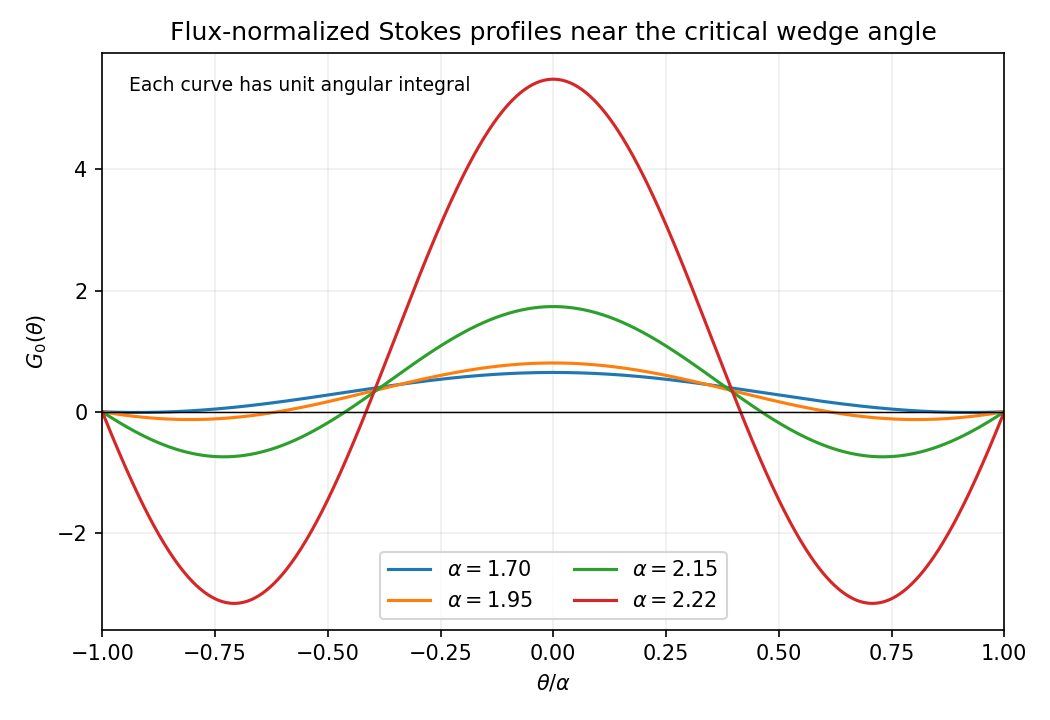
Leading radial wedge-flow profiles: outward central flux and reverse wall layers grow near the critical angle
. Details. As approaches from below, the large positive central and negative wall contributions nearly cancel while the prescribed net flux remains one. The leading Stokes solution diverges, so the supposedly small nonlinear inertial term can no longer be treated as a perturbation. This is the critical angle of a flux-normalized Stokes wedge flow. It demonstrates breakdown of this regular expansion; it does not establish that the exact viscous flow must have infinite speed or that a global steady branch continues through the critical angle.
Let , , scale horizontal and vertical velocities by and , and define . The small aspect ratio makes independent of at leading order. The second small parameter, , makes inertia negligible compared with transverse viscous stress. Thus the lubrication equations are and .
No slip gives , , soNo penetration at the two solid walls and continuity make constant. Therefore, writing the dimensionless variables again as ,The pressure scale is set by balancing the longitudinal pressure gradient with shear across the thin gap, not by the inertial dynamic-pressure scale.
Integrate once and use to obtain . The two zero endpoint pressures determineConsequentlyThe constant is a weighted average of with positive weight , so . Since decreases strictly, changes sign exactly once, from positive to negative. Thus the unique maximum is atFor small , , so . The exponential-gap slider bearing provides a particularly simple example where a converging gap produces positive load-bearing pressure.
The first energy term is the rate of change of internal plus kinetic energy per unit volume; the second transports that energy with the moving gas; the pressure term is the mechanical work flux across the boundary. There is no heat flux or viscous work in the stated inviscid adiabatic model.
Use mass conservation to replace a conservative derivative of by . Dotting the momentum equation with gives . Subtraction from total energy leavesNow and implyThus : smooth adiabatic inviscid trajectories are isentropic. Shocks need an entropy inequality rather than this smooth equality.
Adding models Fourier heat conduction, with heat flux . The same subtraction gives , henceFor a fixed container use impermeability , insulation , and mass conservation. ThenThe boundary term vanishes and supplies the positive sign. For , , total entropy cannot decrease: this is entropy production by Fourier heat conduction.
Rigid walls require zero normal velocity, so at and at . Separation of variables gives spatial modes , for nonnegative integers . The wave equation therefore givesThe spatially constant mode has zero frequency and is not an ordinary positive-frequency acoustic oscillation.
A spatially uniform boundary forcing excites the transverse mode. Put . Then and , hence . The condition fixes and givesArbitrary free oscillations can be superposed. The denominator vanishes at longitudinal resonances. Near them the lossless steady harmonic response ceases to be a uniformly small-amplitude approximation; damping from viscosity, heat transfer or wall losses regularizes the response, and large amplitudes can require nonlinear equations of motion or a more accurate moving-boundary model. At exact resonance a switched-on ideal forcing produces secular growth rather than a bounded harmonic particular solution.
For the semi-infinite duct expand . Each axial mode hasFor a propagating mode a particular solution is ; differentiating at zero gives the prescribed . A nonzero higher transverse coefficient propagates when .
The outgoing radiation condition selects , its positive axial group velocity. Thus . This sign is selected by the absence of waves incident from infinity, not by the differential equation alone. If has a nonzero mean, its component can propagate even below every higher-mode cutoff.
For and , put . The decaying solution isIt is evanescent and carries no mean energy to infinity. These mode and sign conditions are summarized by the radiation condition for a waveguide mode.
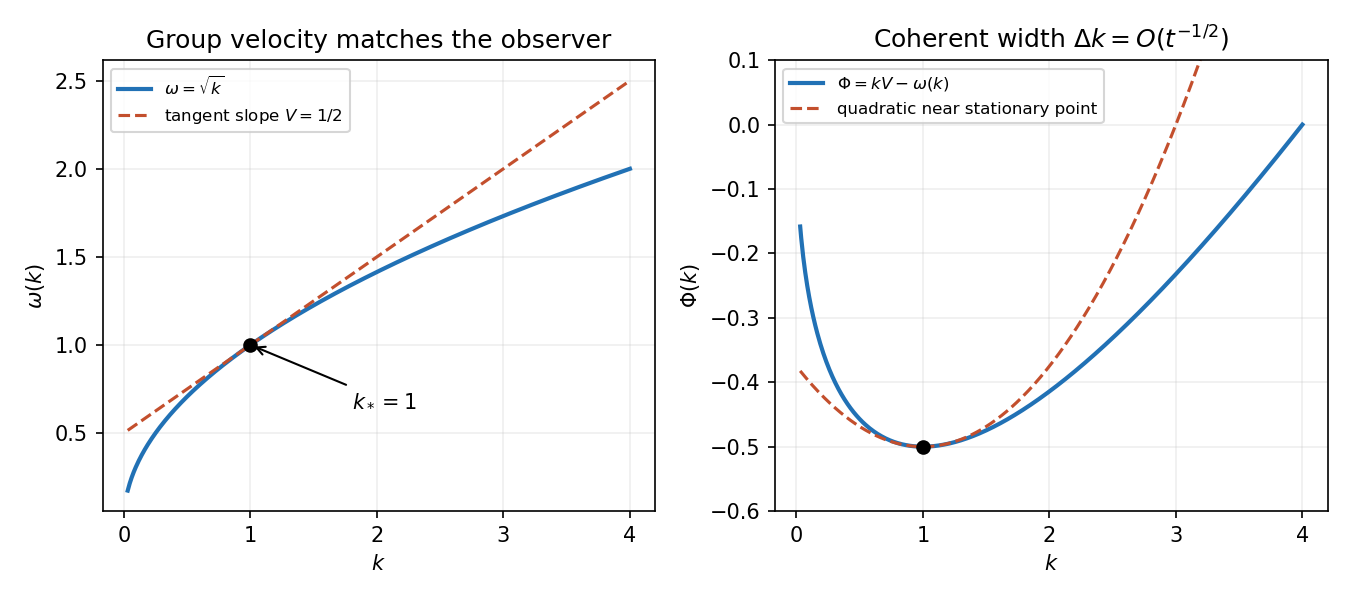
Along , the phase is , with . Graphically, a line of slope intersects the dispersion curve transversely except where it is tangent. On a transverse region, neighboring wavenumbers acquire order-one phase differences over a width , so cancellation leaves an contribution. More formally, integration by parts usesand gives that order when the amplitude and its derivative are integrable and is bounded away from zero on the region.
At a nondegenerate tangent point , , equivalently , and . Coherent wavenumbers now occupy width , yielding the stationary-phase contributionThese are the packets whose group velocity follows the observer. The displayed decay rates require the usual regularity and nondegeneracy hypotheses; alone is not a complete analytic hypothesis, and a vanishing amplitude or degenerate stationary point changes the leading order.


For deep water take a velocity potential satisfying Laplace's equation below the undisturbed surface and decaying with depth. A Fourier mode has vertical factor . The linearized kinematic and dynamic surface conditions are and at . ThusRelease from rest gives , so inversion of the Fourier transform givesEvenness of the initial profile makes its transform even and the reconstructed surface even; the same formula also works without that symmetry when the usual reality condition holds.
Split the cosine into its two time phases. Along the moving observer, their stationary conditions are , where . Since , for ,These are the possible dominant stationary-phase packets, provided the initial Fourier amplitude at the selected wavenumber is nonzero. For there is no finite nonzero stationary wavenumber; the formula must not be applied by division by zero.
Let the bed be and the free surface . In a long, shallow layer, vertical acceleration is smaller than gravity, so the vertical Euler equation gives hydrostatic pressure . Incompressibility makes the vertical speed smaller than the horizontal speed by the aspect ratio; irrotationality then makes the leading horizontal velocity depth-independent. The horizontal Euler equation becomesIntegrating across the depth, using bed impermeability and the surface condition , yieldsCombining these gives the conservative momentum equation . Integral mass and momentum balance across a stationary thin jump therefore requireThese conservation laws still apply across a jump where the smooth hydrostatic/irrotational derivation does not resolve the internal turbulent structure.
Put , and , orienting the flow from minus to plus. For a nontrivial jump the momentum condition gives . Its change in mechanical-energy flux isA passive jump cannot create mechanical energy, so the change is nonpositive. Since , for a genuine jump; equality describes no jump. The upstream flow is supercritical and the downstream flow subcritical, since and .
The gas-dynamic analogue is a compressive normal shock: density and pressure increase and flow changes from supersonic to subsonic. Entropy increases; directed mechanical energy is irreversibly converted into internal energy. Total gas energy, including internal energy, is conserved across an adiabatic shock. This distinguishes that total-energy balance from the reduced shallow-water mechanical-energy loss.
Articles by others on the same topic
There are currently no matching articles.