Label fluid particles by , with flow map satisfying . If , differentiation of the determinant gives . Pull the material-volume integral back to a fixed initial volume:The chain rule and the Jacobian identity give the integrand . Transforming back yields the Reynolds transport theoremEquivalently the additional surface flux is . The material boundary moves with the same normal velocity as the fluid, which is the key distinction from a fixed control volume.
Use conservation of mass and Newton's momentum balance, in addition to the supplied constitutive law. For a material volume,The Reynolds transport theorem and reduce the left side to . The divergence theorem then gives . For constant ,Incompressibility removes the last term. ThusThe stress formula and zero divergence alone are not a dynamical law: the force balance supplies the required physical input.
Take and no imposed streamwise pressure gradient. The normal momentum balance gives . The streamwise equation is , since the convective acceleration vanishes. With no slip at the lower wall and signed upper-wall traction in the positive direction, the conditions areIntegration givesThe required upper-wall velocity is its endpoint value . The unfactored formula remains meaningful when .
The fluid exerts shear per unit length on the lower plane in the positive direction. The force of that plane on the fluid has the opposite sign. The total wall force on the fluid balances its downslope weight, providing an independent sign check.
Let , stretch and write the original transverse velocity as . Continuity then gives . In the streamwise momentum equation is order one, while is negligible. The transverse equation gives to leading order, so pressure is supplied by the outer Euler flow. Its streamwise balance is . ConsequentlyFor a stationary impermeable plate, , with matching as . The transverse velocity must match the outer displacement flow; it is generally wrong to impose independently at infinity.
At the leading edge the wall no-slip data meet the external stream abruptly, and the boundary-layer approximation is nonuniform. For a constant external speed, the thickness is , whose ratio to ceases to be small when the local Reynolds number is order one. A leading-edge region retaining neglected derivatives is needed there. An adverse pressure gradient can also cause separation farther downstream; a large global Reynolds number alone does not prevent it.
Use , , and put , . ThenMatching requires . Equating the powers in streamwise inertia and transverse diffusion givesThe two convective terms combine to , while . Hence the Falkner-Skan equation in this scaling isThe additive stream-function constant is fixed by ; when this also encodes no penetration. For it is a harmless choice of additive constant choice. Existence of an attached physical branch for a given is a separate issue from deriving the similarity reduction.
On an attached branch with away from the wall, use itself as the independent variable. The chain rule gives and . ThereforeIf the wall shear , then , so . Thus is singular at zero while is finite. Imposing a finite arbitrary would remove the usual attached branch. This is the velocity as dependent variable in the Falkner-Skan equation reduction.
Set . Continuity gives , hence . Substituting into radial and angular momentum givesFor example , and the radial acceleration is . Equality of the mixed pressure derivatives now requiresThus the equation for radial viscous flow in a wedge isIt can also be integrated once as .
No slip on the two fixed radial walls gives . The outward flux through a circular arc is , so source strength requires that integral to equal . Set and . ThenAt leading order , whose general solution is a constant plus sine and cosine of . The symmetric source-driven branch has no sine term; for generic this also follows directly by subtracting its two wall conditions. ThusIndeed its integral is . At isolated angles where an odd zero-flux homogeneous mode satisfies both wall conditions, symmetry selects the stated branch.
The normalization denominator vanishes when , namely . The relevant first root above is radians. The zero root is not the critical angle of interest.
For the denominator is positive. The profile is even, with outward flow near the bisector and reverse flow adjacent to each wall:It vanishes at the walls and at ; its minima are at . The following sketch shows the leading approximation to for small .
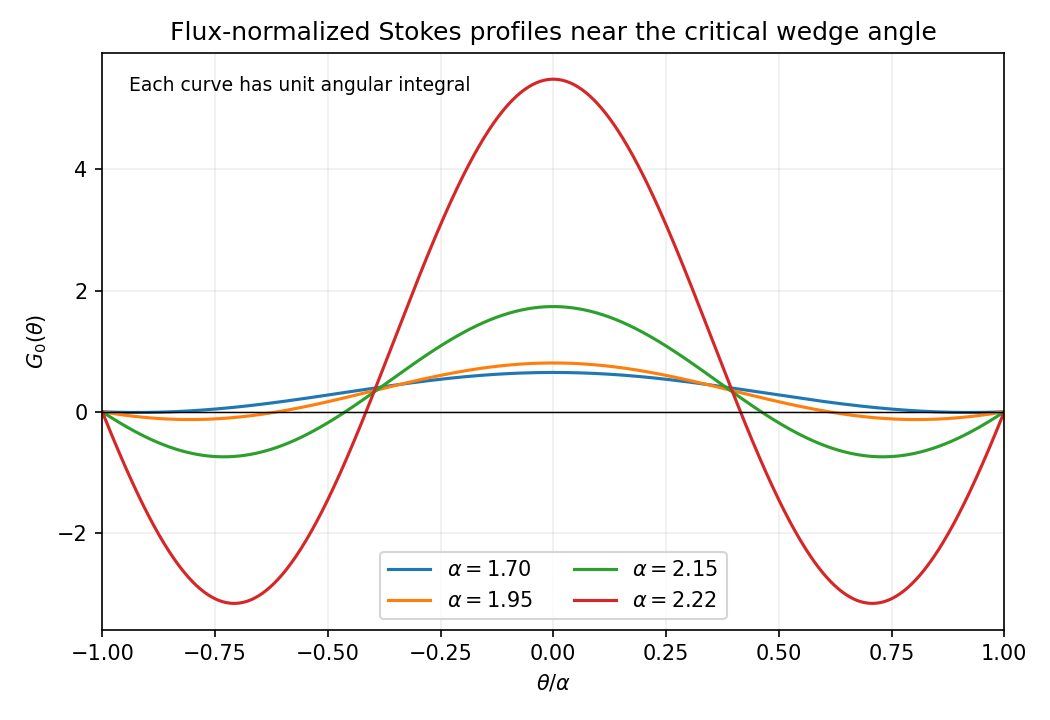
Leading radial wedge-flow profiles: outward central flux and reverse wall layers grow near the critical angle
. Details. 
As approaches from below, the large positive central and negative wall contributions nearly cancel while the prescribed net flux remains one. The leading Stokes solution diverges, so the supposedly small nonlinear inertial term can no longer be treated as a perturbation. This is the critical angle of a flux-normalized Stokes wedge flow. It demonstrates breakdown of this regular expansion; it does not establish that the exact viscous flow must have infinite speed or that a global steady branch continues through the critical angle.
Let , , scale horizontal and vertical velocities by and , and define . The small aspect ratio makes independent of at leading order. The second small parameter, , makes inertia negligible compared with transverse viscous stress. Thus the lubrication equations are and .
No slip gives , , soNo penetration at the two solid walls and continuity make constant. Therefore, writing the dimensionless variables again as ,The pressure scale is set by balancing the longitudinal pressure gradient with shear across the thin gap, not by the inertial dynamic-pressure scale.
Integrate once and use to obtain . The two zero endpoint pressures determineConsequentlyThe constant is a weighted average of with positive weight , so . Since decreases strictly, changes sign exactly once, from positive to negative. Thus the unique maximum is atFor small , , so . The exponential-gap slider bearing provides a particularly simple example where a converging gap produces positive load-bearing pressure.
Articles by others on the same topic
There are currently no matching articles.