Source release: Oxford examination archive release thread, Part B bundle pages 284–290. The cover identifies Theoretical Mechanics, paper B6, Friday 17 June 2011. Section A concerns viscous flow and section B waves and compressible flow.
Answer availability checked on 28 October 2026: bounded official Oxford searches by exact year, title, module and formal code found no full-paper or selected-part solution advertisement. No release policy for later years was assumed to cover 2011.
For a material volume moving with the fluid, the Reynolds transport theorem gives, componentwise,For a scalar this is also . Apply the component formula to momentum density . Constant density and incompressibility make the integrand .
The traction is the force per unit area exerted by the material outside a surface on the material inside, with outward unit normal . Reversing the normal exchanges the two sides of the same internal surface. Thus expresses equal and opposite internal contact forces, the local form of Newton's third law.
With no body force, Newton's second law equates the rate of change of the material volume's total momentum to its surface force. Combining this balance with the transport theorem givesThis is a vector identity, since the component argument applies to each direction.
Define : the second index labels the normal direction of a coordinate face, and the first labels the force component. These nine entries form the Cauchy stress tensor.
Take a small tetrahedron with oblique face of area and outward normal . First suppose ; its other three faces have normals and areas , by orthogonal projection of the oblique face. The total surface force isIf its linear size is , its inertia is while its surface forces are . Divide the momentum balance by and shrink the tetrahedron to the point. Smoothness of the stress and the odd-normal relation then give . Choosing coordinate faces with the appropriate reversed normals gives the same identity in the other octants. In components,The face-area relations used are exactly , with each coordinate face oriented opposite the corresponding component of the oblique normal.
Insert the traction formula into the material-volume balance and apply the divergence theorem to each row of the stress tensor:The volume is arbitrary, so continuity of the fields gives the local Cauchy momentum equationFor an incompressible Newtonian fluid, the constitutive law isHere the pressure enforces incompressibility, and the viscous stress is twice the viscosity times the symmetric rate-of-strain tensor. With constant ,Using proves the stated Navier-Stokes equations.
The only velocity component is axial, so incompressibility gives . Thus , and the steady convective acceleration is . The transverse momentum equations give , so . The axial momentum equation is thereforeIts left side depends only on , while its right side depends only on . Equality throughout the pipe forces both to be one constant, say . Consequently the axial pressure gradient is constant, and . This is absence of dependence on a coordinate, rather than probabilistic independence.
For equilateral triangular pipe flow, the polynomial vanishes on all three walls, so it satisfies no-slip boundary conditions. Direct differentiation givesThusFor , and the velocity is positive in the triangular interior.
At the wall , the outward normal of the fluid is . The axial traction exerted by the wall on the fluid is , so the fluid exerts the opposite axial traction on the wall. Since , the force per unit axial length isIt points with the flow for a negative axial pressure gradient. As a check, the triangular area is , so the total pressure driving force per unit length is ; each of the three equivalent walls receives one third.
Take the tangential length and velocity scales as order one. In the boundary layer, continuity reads , so a nontrivial balance requires . Tangential inertia is order one, and the normal viscous term has size . Balancing them givesup to constants absorbable in the scaled variables. Streamwise diffusion is then smaller by . The normal momentum equation has a pressure term of size and inertial/viscous terms of size , hence at leading order. The remaining Prandtl boundary-layer equations areThe boundary conditions are no slip and no penetration at the plate, and matching to the outer tangential velocity:The outer inviscid tangential momentum equation supplies ; pressure is shared between the boundary layer and outer flow because it has no leading normal variation.
Continuity allows a stream function with and . Substituting these into the tangential equation givesThe outer inviscid equation gives , while . ThusThe wall no-penetration condition makes constant along the wall; its additive freedom may be used to set that constant to zero.
For a boundary layer with exponentially varying outer velocity, the ansatz has . Matching it to requires and . The nonlinear terms in the stream-function equation scale as , whereas scales as . Matching exponents gives , henceMore explicitly,Canceling the common factor givesTogether with , the other two conditions areThey represent wall no slip and outer-flow matching, respectively.
Use autonomous third-order reduction using the dependent variable. On a monotone branch where can serve as the independent variable, the chain rule givesTherefore the reduced second-order equation isThe wall and matching conditions becomeFor the usual positive outer flow this is the limit . The reduced equation is singular at : if , then and , so has square-root behavior as a function of near the wall. A finite value for should not be imposed as an extra boundary condition.
An attached similarity profile must approach as . Linearizing about gives, for the small velocity correction ,When , one independent far-field correction decays with a Gaussian factor; when , the two nontrivial asymptotic modes grow, one algebraically and one exponentially, so a nonconstant wall profile cannot decay into the prescribed outer flow. Thus the attached exponential similarity construction requiresEquivalently the outer speed increases along the direction of motion, giving a favorable pressure gradient. In the intended flow away from the leading edge along positive , this means and . The sign-reversed choice describes locally favorable flow in the opposite direction; it is not a layer developing downstream from the stated leading edge.
The asymptotic approximation also requires a geometrically thin layer, away from the leading-edge region. Comparing its thickness with the streamwise variation length gives the local condition . An exponentially decaying outer speed eventually violates this condition on an infinite downstream interval. These scale and orientation requirements distinguish formal similarity reduction from a uniformly valid attached boundary layer.
Let and use the given anisotropic scales. Continuity makes the transverse velocity scale consistent with the gap height . The streamwise viscous stress divergence has scale , while the streamwise pressure gradient has scale . Their balance selectsThe streamwise equation then has the dimensionless formThe normal equation becomesWhen and , neglecting the indicated smaller terms givesThe bottom conditions express no slip on a plate moving at speed and no penetration. The top conditions express no slip and no penetration on the stationary wall. The leading pressure is a function of the streamwise coordinate alone.
Suppress hats temporarily. Mass conservation between any two cross-sections, together with impermeability of both walls, makes their fluxes equal. Where the wall is differentiable, the same result follows locally by differentiating the flux with a variable upper limit and using continuity givesBoth the upper-limit term and the boundary velocities vanish by the wall conditions. Thus the flux is constant. Since , integrate twice and impose , :Integrating across the gap gives . Restoring hats,The endpoint conditions are the specified equal reservoir pressures after subtracting and dividing by the pressure scale.
The flux average for a translating lubrication gap follows by integrating the pressure gradient between the endpoints:If were smaller than the minimum height, the integrand would be strictly positive everywhere, contradicting zero total pressure change. If it were larger than the maximum, the integrand would be strictly negative. ThereforeEquivalently,is a weighted average of the height with strictly positive weight . This also identifies the constant flux uniquely.
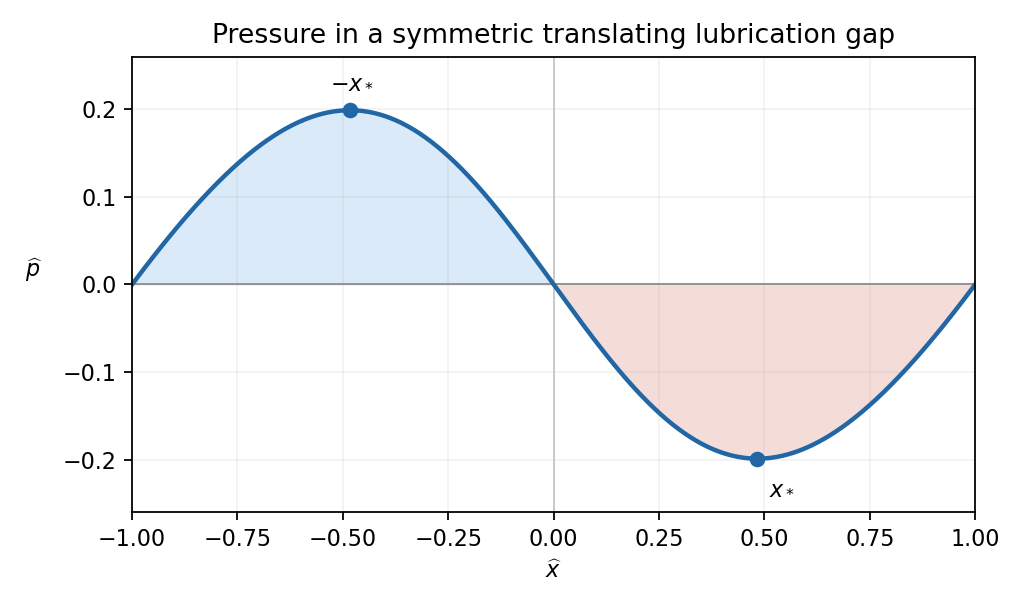
For pressure lobes in a symmetric translating lubrication gap, the height integrals areHenceThe denominator of the pressure gradient is positive. Its numerator changes sign when , that is at with . The gradient is positive for , zero at those two points, and negative for . Integration, with either endpoint condition, givesThis function is odd and vanishes at . It has a positive maximum at and a negative minimum at . Thus the sketch has a positive pressure lobe in the converging left half of the gap and a negative gauge-pressure lobe in the diverging right half.

Let rotate vectors from the rotating frame to the inertial frame. For any rotating-frame vector , differentiating adds to . Thus an inertial particle velocity is , and, for constant angular velocity, its acceleration isInsert this into the inertial Euler equations and express forces in the rotating coordinates. This givesThe additional terms are the Coriolis acceleration and the centripetal term associated with frame rotation. There is no angular-acceleration term because is constant.
Write the conservative body force as . The supplied vector identity gives . For constant density, defineMoving the centrifugal and conservative terms to the right then gives . Only the gradient of this reduced pressure matters, so an additive spatial constant is immaterial.
Linearize about rest, with the equilibrium forces already absorbed in the reduced pressure. The quadratic convective acceleration drops out. Since , the component equations areThe scan prints in the continuity equation; the derivative required by incompressibility is .
To eliminate pressure, put and . Taking the vertical component of the curl of momentum givesTaking horizontal divergence of momentum and substituting continuity givesDifferentiate this in and use :One more time derivative, followed by the vorticity relation, yields the Poincaré equation for inertial wavesThis derivation retains all three velocity components, including the transverse component coupled by rotation.
Write for the nonzero forcing frequency, to distinguish it from the vertical velocity . Put and . Then and , so it meets the rigid-wall conditions. Substituting into the scalar wave equation givesorThe radiation sign for an inertial wave must exclude any disturbance arriving from . This means an radiation condition for propagating waves, or bounded decay for an evanescent wave.
For , put . The solutions are oscillatory. The inertial-wave dispersion relation is ; its horizontal group velocity is . Positive energy transport into the channel therefore requires . The solution isFor a positive frequency, the phase travels towards negative while the group velocity travels towards positive . Choosing the outgoing sign from the phase velocity alone would give the wrong result.
For , set . Excluding the exponentially growing solution givesThis disturbance decays away from the wavemaker and does not propagate horizontally. At the cutoff the ODE degenerates to ; zero frequency is not a nonzero forced harmonic mode with this vertical shape.
There is a second printed inconsistency: the stated velocity , if taken literally with no dependence and no transverse velocity, cannot support a nontrivial rotating inertial wave. Its transverse momentum equation would give , then continuity and the rigid walls would force . The scalar solutions above are the intended inertial-wave solutions when two-dimensional means dependence on while retaining the transverse component . For a mode, explicitly supplies the generally nonzero transverse velocity. Thus the scalar equation can be solved as requested, but the full vector field needs this correction to the printed two-component description.
Take the nondegenerate stationary point in the interior of the integration interval. Choose a smooth cutoff equal to one near . Away from its support, is bounded away from zero. Integration by parts using makes that nonstationary contribution , under the usual smooth-phase assumptions.
Near the stationary point use the signed coordinateSince , this is locally invertible, with at the point. The local integral becomesScale . The supplied Fresnel integral gives . Approximating the smooth amplitude by its value at zero, with a cutoff and a nonstationary estimate for the tails, therefore givesIf , this is the requested asymptotic equivalence. The phase shift comes from the positive quadratic curvature. A stationary point at an integration endpoint instead needs a one-sided formula.
The printed auxiliary estimate asserting an Fourier integral for every continuous amplitude is too strong without extra regularity. The argument here uses integration by parts only for the actual smooth, cutoff nonstationary amplitudes, where that estimate is justified; continuity alone generally guarantees convergence to zero, not this rate.
For a negative second derivative, the corresponding local normal form is . The oscillatory Gaussian integral is the complex conjugate of the positive-curvature one, so the phase shift changes sign. ThusWhen the leading amplitude is nonzero, the equality may again be written as an asymptotic equivalence. Both signs are summarized by the factor .
Irrotationality permits a velocity potential with . Incompressibility gives Laplace's equation in the moving domain . Neglecting surface tension and taking the free-surface pressure as constant atmospheric pressure, the full surface conditions areThe kinematic condition makes the free surface material; the dynamic condition is Bernoulli's equation on that surface. A time-dependent additive gauge in has absorbed the spatially uniform Bernoulli constant. Deep below the surface, impose as , together with suitable horizontal decay. Initially and the fluid is at rest, so ; its initial constant may be chosen as zero.
Linearize about a flat quiescent surface. The product and the kinetic-energy term are quadratic, and the boundary conditions can be evaluated at to first order. Thus and there. Fourier transformation in changes into multiplication by , givingThe transform uses in its forward definition; the inverse transform therefore uses . The zero-wavenumber potential has an irrelevant spatially constant gauge freedom.
For , the solution decaying at depth is . The surface conditions give and , henceInitial rest implies . Define the transform of the initial elevation by . Solving this oscillator equation and inverting the transform givesThe formula also includes the continuous zero-frequency limit. For real even initial data, the transform is real and even, ensuring a real even surface profile at every time.
For wavenumber selection by a moving observer of deep-water waves, an observer with nonzero velocity follows up to a constant initial displacement. Splitting the cosine into exponentials gives phase functions . Their stationary points satisfyso the selected wavenumbers areThe two signs arise in the conjugate branches needed for a real wave. Equivalently the observer selects wave packets whose group velocity equals . Stationary-phase contributions decay as , whereas smooth nonstationary contributions decay more rapidly, so these are the dominant wavenumbers when the initial spectrum is nonzero there.
For real even data, one may make this explicit. Set . The stationary curvature has magnitude , yieldingwhen its leading coefficient is nonzero. If that spectral value vanishes, the leading stationary term vanishes too. At there is no finite nonzero stationary wavenumber selected by this condition.
A weak solution is a field for which the composed densities and fluxes are locally integrable andfor every smooth compactly supported vector test function in the spacetime domain. This is the distributional form of the conservation law, obtained by moving derivatives onto the test function. If tests are allowed to meet an initial boundary , the specified initial density contributes the additional term in the usual initial-value formulation.
If the fields are continuously differentiable and obey the pointwise conservation law, integration by parts against a compactly supported test function gives the weak identity, with no boundary terms. Conversely, integrate the weak identity by parts for a continuously differentiable field:for every test function. The fundamental lemma of the calculus of variations, applied to each component, makes the continuous integrand vanish at every point. Hence the classical and weak formulations are equivalent for continuously differentiable fields.
Write the shock as and let the plus trace be on . Locally its discontinuous part can be represented with the Heaviside factor . Distributional differentiation gives and . The singular part of the conservation law is thereforeIt must vanish, so the Rankine-Hugoniot conditions areThe smooth parts of the fields still satisfy the classical conservation law on each side. The jump condition ensures that the moving discontinuity creates no extra source of the conserved quantities.
Put , the velocity in the shock frame. The mass jump condition gives a common mass flux . Subtracting times the mass balance from the momentum balance givesFor energy, transform the conserved energy to the shock frame by subtracting times momentum and adding times mass. The resulting energy flux isFor a genuine shock, ; dividing its continuous energy flux by the same nonzero on both sides givesThe second term is the ideal-gas specific enthalpy. A contact discontinuity has zero relative mass flux and does not in general require equal specific enthalpies; the division here is appropriate for the shock specified in the question.
Let the undisturbed state ahead have , and the uniform compressed state behind have velocity . The piston boundary fixes that downstream velocity. Mass and momentum jumps giveThus . Equality of specific stagnation enthalpy in the shock frame isSubstitute and , then multiply by . The resulting difference factors as . Since the piston moves into the gas with , division givesThis determines the constant speed of the compression shock ahead of the piston.
For a piston-driven normal shock with , and , the quadratic has one positive and one negative root. The forward-moving shock usesSince the square root is greater than ,Therefore there is always a forward root with shock speed greater than the gas and piston speed under the stated compression assumptions. This also makes the density ratio positive and greater than one. Evaluating the quadratic at gives a negative value, so the positive root additionally has : it is supersonic relative to the undisturbed gas. The negative root does not describe the shock driven into the region .
Original solutions to the paper released at the source request. The complete editable transcription is retained in the private examination archive.
Let be the particle flow map from the fixed reference volume to the material volume, and let . Change variables and differentiate on the fixed domain:Use the two permitted identities, and . Changing back givesThis is the Reynolds transport theorem: both the value carried by each particle and the changing volume element contribute.
The traction is force per unit area across an oriented surface with unit normal . The stress component is its th component on a surface normal to the th coordinate axis. Cauchy's stress theorem states that this dependence is linear:For the boundary of a material volume, take the outward normal and the traction exerted by the surrounding fluid. Newton's law and the divergence theorem giveConstant density and incompressibility make the transport-theorem integrand on the left . The volume is arbitrary, soSubstitute the Newtonian constitutive law. With constant viscosity,Hence
For a steady unidirectional field , incompressibility gives . Thus and the convective acceleration vanishes. The transverse momentum equations give , so . The axial equation isIts left side is independent of and its right side independent of , so both equal a constant . No slip against the translating wall gives on the boundary. Thus the asserted Poisson problem follows.
For the circular pipe, the axisymmetric solution isIt satisfies the boundary value and . Integrating over the cross-section givesTherefore the laboratory-frame volume flux vanishes precisely whenFor a pressure decrease in the positive axial direction, this requires upstream wall translation.
Balance streamwise convection of order one with transverse viscous diffusion . This requires a thickness . Continuity then makes the normal velocity of that same small order. SetThe normal momentum equation makes the leading pressure independent of . It equals the outer pressure, whose inviscid tangential momentum balance gives . The leading tangential equation and continuity are consequentlyThe divergence-free field has a streamfunction with , . Substituting yieldsThe stationary impermeable wall has , so and is constant, chosen to be zero. Matching to the outer slip velocity gives .
For the proposed form,Matching the outer velocity requires . The convective and outer-pressure terms have order , while has order . Equality of exponents givesThe two terms containing cancel in , leaving . Since , the reduced equation isThe wall and matching conditions become . This establishes a consistent similarity reduction; existence of an actual profile is a separate boundary-value question for a particular choice of parameters.
At these parameters the equation becomes , where . Multiply by and integrate:Outer matching gives and , so . No slip gives . At that point the first integral fixes , so there are exactly two smooth initial-value solutions of the second-order equation satisfying the matching condition. Put . Translation invariance of the supplied profile gives them explicitly:The first decreases monotonically from zero to . The second first rises to at , crosses zero again at , and then tends to . Integrating either profile from zero recovers with .
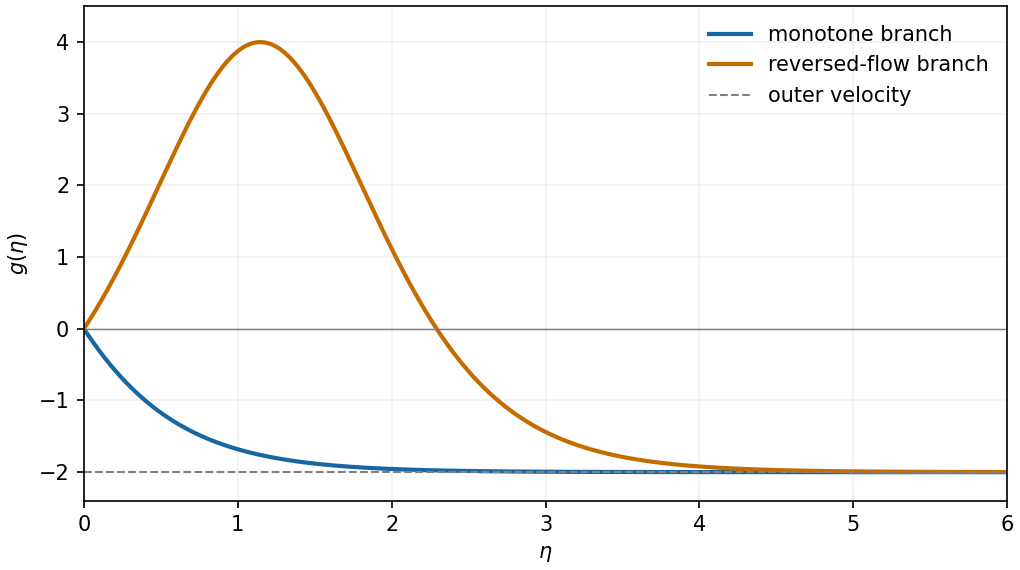
Two translated similarity profiles: monotone outer-flow matching and a branch with an internal reversed-flow region
. Details. 
One would not expect both branches to be equally stable. The rising branch contains flow opposite to its negative outer stream and interior inflection points, typical ingredients for shear instability. The monotone branch has at finite positive and no interior inflection point, so the classical inviscid inflection-point mechanism is absent there. This motivates expecting the reversed-flow branch to be unstable and the monotone branch to be the stable candidate. A definitive viscous temporal-stability result requires perturbing the time-dependent equations; the steady first integral alone is not a stability proof.
Introduce . Balancing the streamwise pressure gradient with cross-layer viscosity givesAfter division by that viscous scale, the streamwise momentum equation isThe transverse equation, divided by its pressure-gradient scale, isContinuity scales exactly to . With , and , the leading equations are
No slip and impermeability give dimensional , on the upward-moving wall, so there. For the interface normal, , and hencein its components. The relevant stresses scale asMultiplying by the inward normal gives the leading tractionIts leading normal component vanishes only if at the interface; the tangential component then requires .
The free surface is material. Applying the material derivative to gives , which in the scaled variables becomes
Articles were limited to the first 100 out of 234 total.
Articles by others on the same topic
There are currently no matching articles.