Let be the particle flow map from the fixed reference volume to the material volume, and let . Change variables and differentiate on the fixed domain:Use the two permitted identities, and . Changing back givesThis is the Reynolds transport theorem: both the value carried by each particle and the changing volume element contribute.
The traction is force per unit area across an oriented surface with unit normal . The stress component is its th component on a surface normal to the th coordinate axis. Cauchy's stress theorem states that this dependence is linear:For the boundary of a material volume, take the outward normal and the traction exerted by the surrounding fluid. Newton's law and the divergence theorem giveConstant density and incompressibility make the transport-theorem integrand on the left . The volume is arbitrary, soSubstitute the Newtonian constitutive law. With constant viscosity,Hence
For a steady unidirectional field , incompressibility gives . Thus and the convective acceleration vanishes. The transverse momentum equations give , so . The axial equation isIts left side is independent of and its right side independent of , so both equal a constant . No slip against the translating wall gives on the boundary. Thus the asserted Poisson problem follows.
For the circular pipe, the axisymmetric solution isIt satisfies the boundary value and . Integrating over the cross-section givesTherefore the laboratory-frame volume flux vanishes precisely whenFor a pressure decrease in the positive axial direction, this requires upstream wall translation.
Balance streamwise convection of order one with transverse viscous diffusion . This requires a thickness . Continuity then makes the normal velocity of that same small order. SetThe normal momentum equation makes the leading pressure independent of . It equals the outer pressure, whose inviscid tangential momentum balance gives . The leading tangential equation and continuity are consequentlyThe divergence-free field has a streamfunction with , . Substituting yieldsThe stationary impermeable wall has , so and is constant, chosen to be zero. Matching to the outer slip velocity gives .
For the proposed form,Matching the outer velocity requires . The convective and outer-pressure terms have order , while has order . Equality of exponents givesThe two terms containing cancel in , leaving . Since , the reduced equation isThe wall and matching conditions become . This establishes a consistent similarity reduction; existence of an actual profile is a separate boundary-value question for a particular choice of parameters.
At these parameters the equation becomes , where . Multiply by and integrate:Outer matching gives and , so . No slip gives . At that point the first integral fixes , so there are exactly two smooth initial-value solutions of the second-order equation satisfying the matching condition. Put . Translation invariance of the supplied profile gives them explicitly:The first decreases monotonically from zero to . The second first rises to at , crosses zero again at , and then tends to . Integrating either profile from zero recovers with .
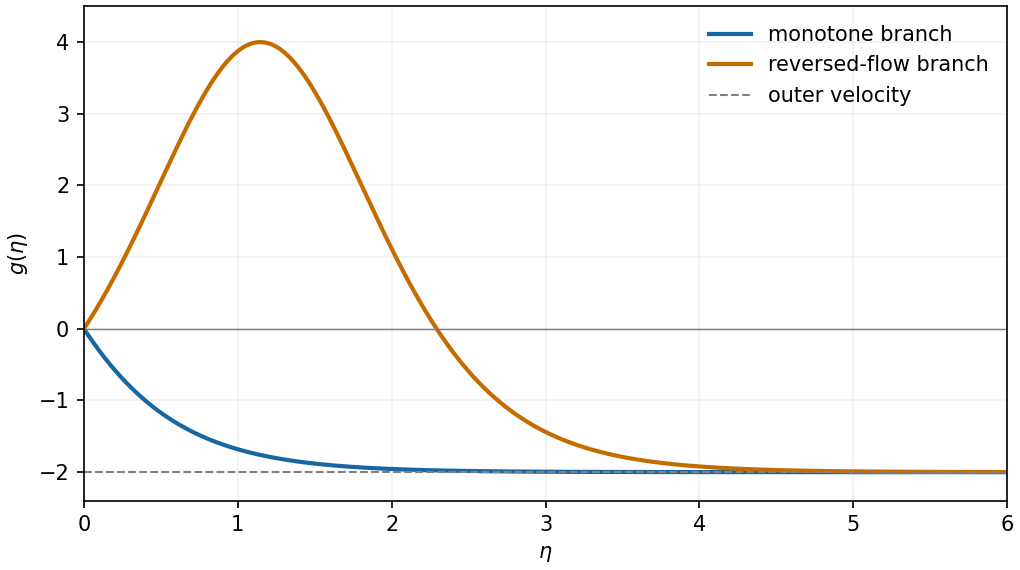
Two translated similarity profiles: monotone outer-flow matching and a branch with an internal reversed-flow region
. Details. 
One would not expect both branches to be equally stable. The rising branch contains flow opposite to its negative outer stream and interior inflection points, typical ingredients for shear instability. The monotone branch has at finite positive and no interior inflection point, so the classical inviscid inflection-point mechanism is absent there. This motivates expecting the reversed-flow branch to be unstable and the monotone branch to be the stable candidate. A definitive viscous temporal-stability result requires perturbing the time-dependent equations; the steady first integral alone is not a stability proof.
Introduce . Balancing the streamwise pressure gradient with cross-layer viscosity givesAfter division by that viscous scale, the streamwise momentum equation isThe transverse equation, divided by its pressure-gradient scale, isContinuity scales exactly to . With , and , the leading equations are
No slip and impermeability give dimensional , on the upward-moving wall, so there. For the interface normal, , and hencein its components. The relevant stresses scale asMultiplying by the inward normal gives the leading tractionIts leading normal component vanishes only if at the interface; the tangential component then requires .
The free surface is material. Applying the material derivative to gives , which in the scaled variables becomes
Suppress hats for this calculation. Transverse pressure uniformity and zero surface pressure give throughout the film. Thus . Integrating twice, using and , givesThe flux is . Integrate continuity across the layer and apply the wall and kinematic conditions to obtain . Restoring hats yieldsThe cubic flux contains downward gravity-driven transport and upward wall entrainment.
Articles by others on the same topic
There are currently no matching articles.